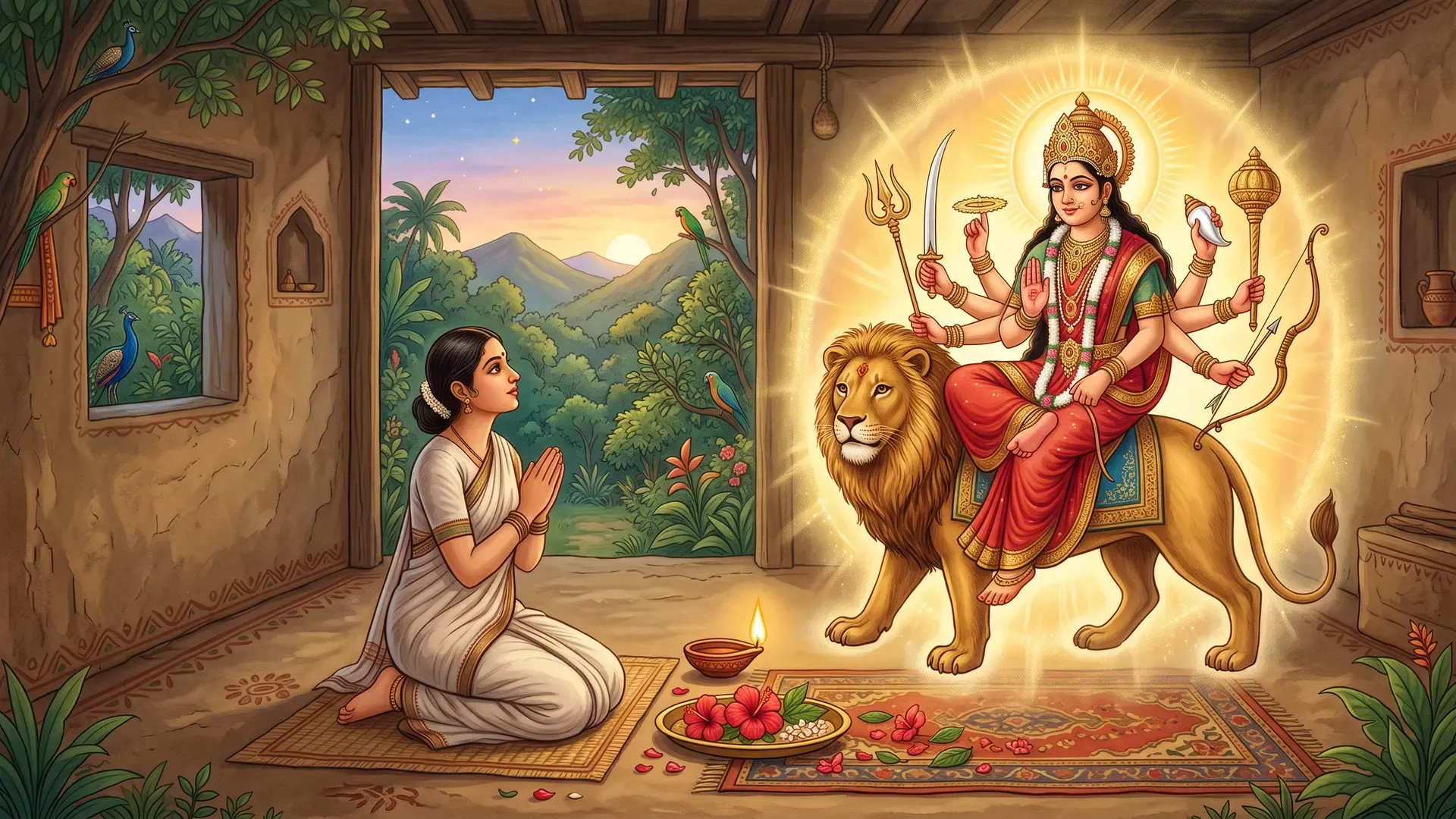
The Navratri vrat katha is the story of Sumati, a brahmin’s daughter: when she misses the Devi’s puja one day, her angry father marries her to a man with leprosy, and in the forest the goddess Bhagavati appears and tells her she is pleased by the merit of a nine-day Navratri fast Sumati kept unknowingly in a past life. By that merit her husband is healed, she is promised a son, and the Devi teaches her how to keep the Navratri vrat. It is a vrat katha handed down in tradition; it is not in the Devi Bhagavata Purana or the Durga Saptashati.
Each morning the tithi, Rahu Kaal and coming festivals, in one short WhatsApp message.Follow the channel
In Navratri, above all in Sharad Navratri (Ashwin Shukla Pratipada to Navami), this story of Sumati is read and heard in homes that keep the fast. The katha opens by speaking of both the Chaitra and the Ashwin Navratri, and says it should be heard for ten days together with one’s family.
It is a vrat katha handed down in tradition and printed in vrat-katha booklets and newspapers. No source names a scripture for it. The Devi Bhagavata Purana (3.26–28) gives the rules of the Navaratra vrat and a different story, of Sushila, a poor trader of Kosala who kept the vrat on a brahmin’s advice; Sumati is not in it. Nor is this katha in the Gita Press “Vrat-Parichay”, which gives the Navratri rules with citations from the shastras.
The scripture recited in Navratri is the Durga Saptashati (Devi Mahatmya): chapters 81 to 93 of the Markandeya Purana, with the dialogue of King Suratha, the trader Samadhi and the sage Medha, and the three episodes of the Devi. It is a separate text, and Sumati’s story is not in it. Below, Sumati’s katha is told as it is most often printed; where other sources differ, it is noted at the end.
How the vrat and katha are kept
- By the katha, the vrat is kept for nine days from Ashwin Shukla Pratipada; whoever cannot fast the whole day may eat one meal.
- The opening of the katha says it should be heard for ten days with one’s relatives. The vidhi printed with this text on Sanskrit Subhashita says to read it after bathing, at a temple or at home.
- By the Gita Press “Vrat-Parichay”, the chief rites of the Devi’s Navratri are the worship of Mahakali, Mahalakshmi and Mahasaraswati and the recitation of the Durga Saptashati, and Kumari puja is held essential: girls aged two to ten are worshipped and fed, on all nine days if possible, otherwise on the last day.
The story of Sumati
A vrat katha handed down in tradition. This telling follows the text printed in the same words by Amar Ujala (2019, 2020) and the Sanskrit Subhashita blog; Times Now Navbharat, Webdunia, Sri Mandir and HinduPad tell it in their own words.
Once Brihaspati, the guru of the gods, asked Brahma: “Why are the Navratri fast and festival kept in the bright fortnight of Chaitra and of Ashwin? What does the vrat give, how should it be kept, and who kept it first?”
Brahma was glad that Brihaspati had asked something for the good of all. By the katha, he said that those who meditate on Durga, who fulfils wishes, and on Mahadev, Surya and Narayana are blessed, and that this vrat fulfils the heart’s wishes: a son for one who wants a son, wealth for one who wants wealth, learning for one who wants learning, and happiness for one who wants happiness. He added that whoever cannot fast the whole day may eat one meal, and should hear this katha for ten days with their kin. Then he said, “Listen closely to the story of the one who first kept this great vrat.”
Long ago, in the town of Manohar, lived an orphaned brahmin named Pithat, a devotee of Bhagavati Durga. A daughter named Sumati was born to him, very beautiful and full of every virtue. Playing with her friends, she grew day by day like the moon of the bright fortnight. Every day her father worshipped Durga and offered homa, and every day Sumati was there without fail.
One day Sumati was so caught up in play with her friends that she did not come at the time of puja. Her father was deeply displeased at her carelessness. In anger he said, “Today you did not worship Bhagavati. For this I will marry you to a leper or a pauper.”
Sumati was hurt by her father’s words, but she answered calmly: “Father, I am your daughter and in every way under your authority. Marry me to a king, to a leper or to a poor man, and what happens will be what is written in my fate. Action is in human hands; its fruit is in God’s.”
Hearing his daughter speak so fearlessly, the father’s anger flared up like dry grass thrown on a fire. He married Sumati to a man with leprosy and said, “Go, live with the fruit of your deeds. Let us see what you can do, trusting to fate.”
Her father’s bitter words filled Sumati with grief, and she wondered why such sorrow had been written in her fate. Then she went away into the forest with her husband. It was a lonely, frightening forest, overgrown with kusha grass, and there the two of them passed that night in great hardship.
Seeing the plight of the sorrowing girl, and moved by the merit of her past life, the goddess Bhagavati appeared there and said, “Brahmin woman, I am pleased with you. Ask for any boon you wish.” Sumati folded her hands and asked, “Who are you?” The Devi said, “I am Adi Shakti, Bhagavati. I am Brahmavidya, and I am Saraswati. When I am pleased, I take away the sorrow of living beings and give them happiness.”
Then the Devi told her, “I am pleased with you because of the merit of your past life. In that life you were the faithful wife of a Nishad (a Bhil). One day your husband stole, and soldiers seized you both, threw you into prison and gave you nothing to eat. Those were the days of Navratri. For nine days you ate nothing and drank no water, and so, without knowing it, you kept the Navratri vrat. By the power of that vrat I grant you whatever boon you wish.”
Sumati bowed and said, “Mother, if you are pleased with me, take away my husband’s leprosy.” The Devi said, “Offer your husband the merit of one day of the fast you kept in those days. By that merit he will be free of the disease.” Sumati joyfully said “Tathastu, so be it”, and that very moment, by the Devi’s grace, her husband’s body was freed of the disease and shone with radiance.
Seeing her husband’s fair form, Sumati began to praise the Devi: “O Durga, you are the mother of the world, who removes misfortune, takes away the suffering of the three worlds, heals the sick and destroys the wicked. My father married me to a sick man and sent me from home, and I was wandering in the forest. You alone have lifted me out of this trouble. I bow to you; protect me.”
The Devi was delighted with this praise and said, “Soon a son named Udalaya will be born to you, very wise, wealthy, renowned and master of his senses.” Then she told Sumati to ask for anything else she wished. Sumati asked, “Mother, if you are pleased, tell me in full how the Navratri vrat is kept and what it gives.” Then the Devi told her the vidhi of the vrat, given next.
The vrat as the Devi taught it to Sumati
The last part of the katha, from the same text (Amar Ujala 2020, Sanskrit Subhashita). This is the vidhi as the katha gives it; keep the vrat by your family custom and your own purohit’s advice.
The Devi said: keep the vrat by its rules for nine days from Ashwin Shukla Pratipada; if you cannot fast the whole day, eat one meal. Set up the ghat (kalash) after asking learned brahmins, and make a small sown bed, a vatika, and water it every day.
Install images of Mahakali, Mahalakshmi and Mahasaraswati, worship them by rule every day, and offer arghya with flowers. The katha also names the fruit of offering arghya with fruits: with the citron, beauty; with nutmeg, renown; with grapes, success in one’s work; with amla, happiness; and with bananas, ornaments.
When the vrat is complete, perform a havan by rule on the ninth day, with khand sugar, ghee, wheat, honey, barley, sesame, bel, coconut, grapes and kadamba. By the katha, offerings of wheat bring Lakshmi; kheer and champa flowers, wealth; bel leaves, radiance and happiness; amla, renown; bananas, a son; lotuses, honour from the king; and grapes, riches; while khand, ghee, coconut, honey, barley, sesame and fruits bring whatever one wishes.
After the havan, bow humbly to the acharya and give him dakshina so that the rite is complete. The Devi said that whoever keeps the vrat this way has their wishes fulfilled, that gifts given in these nine days bear fruit crores of times over, and that the vrat gives the fruit of an Ashvamedha sacrifice. It may be kept at a tirtha, at a temple or at home.
With these words the Devi vanished. Brahma told Brihaspati that any woman or man who keeps this vrat with devotion finds happiness in this world and, at the end, the rare gift of moksha. Brihaspati, overjoyed, thanked him. Brahma said, “This Bhagavati Shakti sustains all the worlds; who can know the greatness of the Mahadevi?” The katha ends with “Bolo Devi Bhagavati ki jai.”
Other tellings
- Names: in the Amar Ujala text and in Times Now Navbharat the brahmin is Pithat, and only the Amar Ujala text names the town Manohar. In Sri Mandir and HinduPad, Pithat is the town and the brahmin is Sunatha. Webdunia names neither brahmin nor town, only Sumati.
- The father’s anger: in Sri Mandir and HinduPad the father feels Sumati cares more for her looks and adornment than for puja. In Webdunia Sumati accepts his word gladly; in Sri Mandir she trusts in Bhagavati; in HinduPad she says Mother Durga will protect her, and her father takes this as defiance.
- The night in the forest: in Webdunia her husband had no house, so Sumati spent the night on a mat of grass in the forest. In Sri Mandir and HinduPad the night is spent in meditation on and worship of the Devi, and she appears because she is pleased by that devotion.
- The past life: in the Amar Ujala text Sumati was the wife of a “Nishad (Bhil)”, in Webdunia of a Bhil and in Times Now Navbharat of a Nishad. In Sri Mandir both husband and wife were Nishads, that Navratri was in Ashwin, and the husband’s illness in this life is said to come from that theft.
- The healing: the offering of one day’s merit is in the Amar Ujala text, Times Now Navbharat and HinduPad; in Webdunia and Sri Mandir the Devi simply heals the husband. Webdunia’s telling ends there.
- The son: in the Amar Ujala text and Times Now Navbharat he is Udalaya; in Sri Mandir and HinduPad, Uddalaka. In HinduPad the merit of the other eight days brings prosperity and the son; in Sri Mandir the son is born and the family keeps the Navratri vrat every year.
- The frame and the vidhi: the opening dialogue of Brihaspati and Brahma is not in Webdunia or Times Now Navbharat. The opening speaks of both the Chaitra and Ashwin Navratri, but the Devi’s instructions name only Ashwin.
- Other stories: some vrat-katha booklets print the Durga Saptashati story of Suratha, Samadhi and Medha under the heading “Navratri vrat katha”, and Webdunia gives the slaying of Mahishasura and Rama’s nine-day worship of the Devi as separate kathas. These are different from Sumati’s story.
After the katha
The katha closes with “Bolo Devi Bhagavati ki jai.” The Ghatasthapana muhurat for your city, the nine forms of Durga and the Navratri dates are on the Navratri page.
Durga Aarti: Jai Ambe GauriFrequently asked questions
When should the Navratri vrat katha be read?
The katha itself opens by saying it should be heard for ten days in Navratri together with one’s relatives. The vidhi printed on Sanskrit Subhashita says to read it after bathing, at a temple or at home. The time follows one’s family custom.
Is the story of Sumati in a Purana?
Not in the texts we checked. In the Devi Bhagavata Purana (3.26–28) the Navaratra story is of Sushila, a trader of Kosala, and in the Durga Saptashati (Markandeya Purana, chapters 81–93) it is of King Suratha and the trader Samadhi. The Gita Press “Vrat-Parichay” has no Sumati story either. It is read as a vrat katha handed down in tradition.
How is the Durga Saptashati different from the Navratri vrat katha?
The Durga Saptashati (Devi Mahatmya) is chapters 81–93 of the Markandeya Purana: the dialogue of King Suratha, the trader Samadhi and the sage Medha, and the three episodes of the Devi. The Gita Press “Vrat-Parichay” names its recitation as a chief rite of Navratri. Sumati’s story is a separate vrat katha handed down in tradition. Some booklets print the story of Suratha and Samadhi under the name “Navratri vrat katha”.
What if one cannot fast all nine days?
The katha says that whoever cannot fast the whole day may eat one meal. By the Gita Press “Vrat-Parichay”, if the whole Navratri fast is not possible, it may be kept as a saptaratra (Pratipada to Saptami), pancharatra, triratra (Saptami, Ashtami and Navami), yugmaratra (the first and last days) or ekaratra (the first or the last day). Decide by your health and family custom, and ask your own purohit if you need to.
Sources
- Amar Ujala: Navratri 2020, the complete Devi katha (Yogesh Joshi, 25 March 2020); Navratri 2019, the complete Devi katha (Vinod Shukla, 21 September 2019)
- Sanskrit Subhashita (sanskritsubhashita.com): Shri Durga Navratri Vrat Katha (2019)
- Times Now Navbharat: Navratri 2024 vrat katha (Lavina Sharma, 11 October 2024)
- Webdunia (hindi.webdunia.com): Navratri vrat ki pramanik kathayen
- Sri Mandir (srimandir.com): Navratri vrat evam parampara (25 September 2025)
- HinduPad (hindupad.com): Navratri Vrat Katha and Pujan Vidhi
- Devi Bhagavata Purana 3.26–28 (Swami Vijnanananda’s translation, checked on wisdomlib.org)
- Gita Press, Vrat-Parichay (Pt. Hanuman Sharma, book no. 610), pp. 62–65 and 134–137: Navaratra
- Markandeya Purana, chapters 81–93 (Devi Mahatmya / Durga Saptashati)
Something wrong? Report a mistake