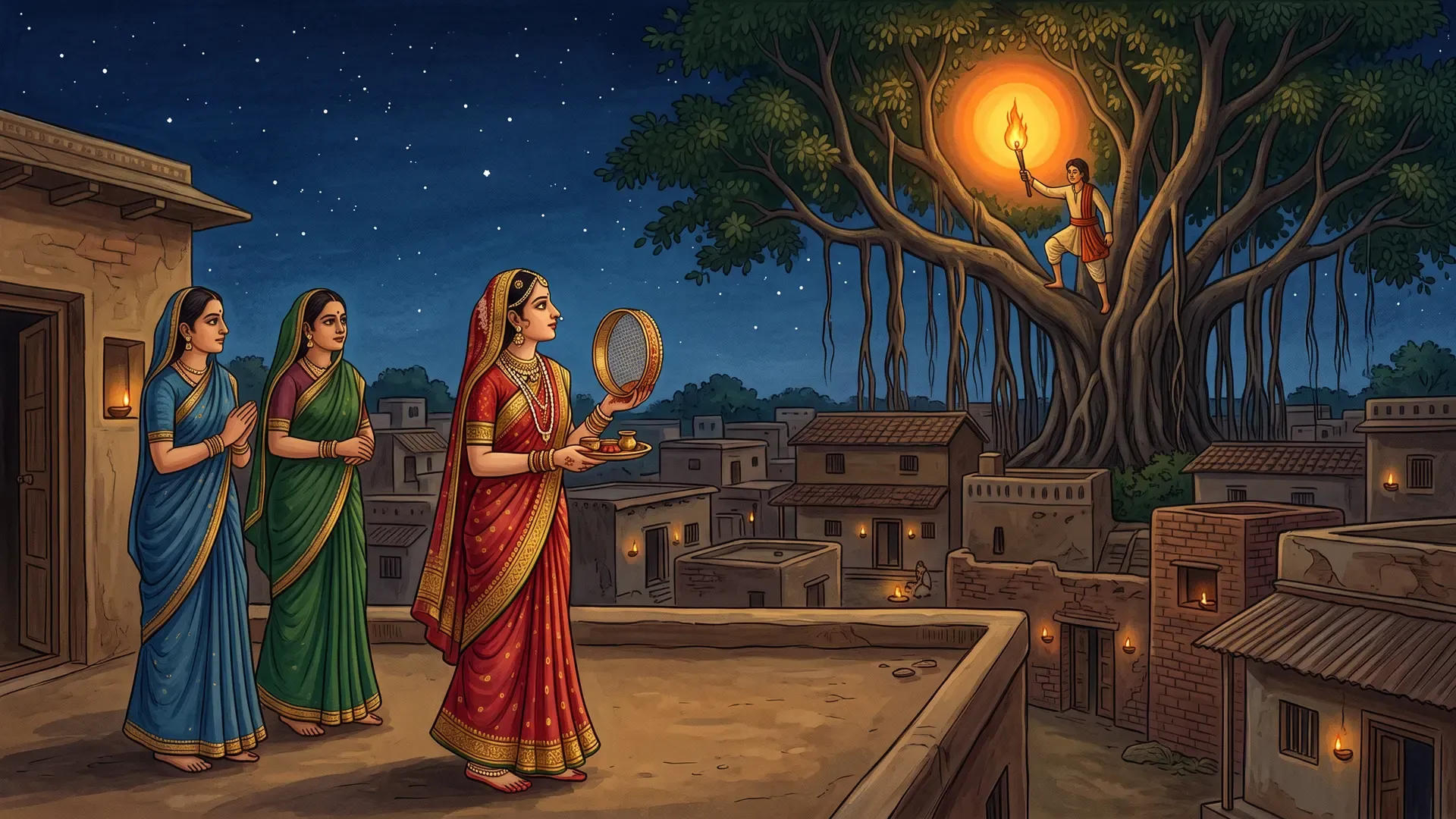
The katha mainly heard on Karva Chauth is Veeravati’s. When Veeravati, the beloved sister of seven brothers, was faint with hunger and thirst, a brother lit a lamp behind a sieve up a tree to show her a false moon; she broke her fast and her husband died. On Indrani’s advice she kept every Chauth of the year with care, and by that merit her husband came back to life. Many homes also tell the story of Karva and the crocodile.
Each morning the tithi, Rahu Kaal and coming festivals, in one short WhatsApp message.Follow the channel
Karva Chauth (Karaka Chaturthi) falls on Kartik Krishna Chaturthi (Purnimanta; Ashwin in the Amanta calendar). Married women fast from sunrise to moonrise, hear the Karva Chauth katha at the evening puja, and break the fast after offering water to the moon. Many families hold that the fast is not complete without the katha.
The rite itself is in the Narada Purana (Purva Bhaga, chapter 113): on Kartik Krishna Chaturthi women worship Ganesha, offer ten karvas filled with cooked food, and eat after offering water to the moon at moonrise; it tells no story. The Veeravati story is found in Sanskrit in the Vrataraja (printed 1897) in 41 verses, which assigns it to the Vamana Purana; but the editors of the Vamana Purana’s critical edition (Kashiraj Trust, 1967) note that the passage is not found in any available manuscript of that Purana. So we call it a katha of tradition.
Below, the Veeravati story is told as it is most often heard; how the Sanskrit text and other tellings differ is given at the end. After it comes the folk tale of Karva and the crocodile.
How the vrat and katha are kept
- The katha is usually heard in the evening at the puja, before moonrise; in many places in Punjab, in the afternoon. An elder woman of the family tells it, or a pandit; in Punjab women go to the pandit in the evening to hear it.
- Thirteen dots are put on the karva, and thirteen grains of wheat or rice are held in the hand while the katha is heard (Bharatkosh).
- In parts of Uttar Pradesh and in Punjab the women sit in a circle, and during pauses in the story pass their thalis round (the feri); in Punjab there are seven rounds, with a Karva Chauth song.
- After the katha, the hand is passed over the karva, the mother-in-law’s feet are touched and she is given the karva (the baya).
Veeravati
The opening with Draupadi is in the Sanskrit Vrataraja, Bharatkosh and Webdunia; the Veeravati story follows Drik Panchang’s telling, which is how it is heard in most homes.
The katha begins like this. Arjuna had gone to the mountains to do tapas, and in his absence trouble after trouble fell on the Pandavas. Worried, Draupadi asked Krishna which vrat would remove every obstacle. Krishna said, “Parvati once asked Lord Shiva this same question, and Shiva told her of the Karaka Chaturthi vrat, which removes all obstacles.” Then Krishna told its story.
In Indraprasthapura lived a learned brahmin named Vedasharma with his wife Leelavati. They had seven sons and one daughter, Veeravati. The only sister of seven brothers, she was everyone’s darling. In time she was married to a worthy young brahmin learned in the Vedas.
Her first Karva Chauth after the wedding came while she was at her parents’ home. She kept the fast from sunrise together with her brothers’ wives. By evening hunger and thirst had worn her out, and before the moon rose she fainted and fell. The family wept, and brought her round with sprinkled water and fanning.
The brothers could not bear to see their dear sister like this. They knew she would take no food or water without offering water to the moon. So one brother climbed a big banyan tree far off and lit a lamp behind a sieve, so that its glow looked like the rising moon. The others brought Veeravati up to the roof and said, “Look, the moon has risen.”
Taking the glow for the moon, Veeravati offered water to it and sat down to eat. In the first mouthful she found a hair. At the second she sneezed. She had just raised the third when a summons came from her in-laws’ house.
Alarmed, she hurried to her in-laws’ home and found her husband dead. She wept bitterly, wondering what wrong she had done.
Hearing her grief, Indrani, the wife of Indra, came to her. She said, “You broke your fast by offering water before the moon had risen; that is why this trouble came. Now keep the fast of every month’s Chauth for a year, faithfully, and keep the next Karva Chauth with the full rite.”
With full devotion Veeravati kept the Chauth fasts of twelve months and then kept Karva Chauth with every rite. By the merit of these fasts her husband came back to life. They lived happily, and their home had plenty and children.
Krishna told Draupadi to keep this same vrat. As the katha says, Draupadi kept the Karva Chauth fast, and by its power the Pandavas’ troubles came to an end.
Karva and the crocodile
A folk tale, given by Webdunia, Bharatkosh and English Wikipedia; no text is named for it.
In a village by a river lived a devoted wife named Karva with her old, frail husband. One day, as he bathed in the river, a crocodile seized his leg and began to drag him into the water. He cried out, “Karva! Karva!”
Karva came running and bound the crocodile with a thread of raw cotton. Then she went to Yama. One telling says Yama was going through Chitragupta’s ledgers just then; Karva swept with seven grass stalks and the ledgers flew up into the sky, and Yama asked her what she wanted.
Karva said, “This crocodile has seized my husband’s leg. Send it to hell and give my husband a long life.” Yama said, “The crocodile’s life is not yet over; I cannot take it before its time.” Karva said, “Then I will curse you.”
Yama feared the curse of a devoted wife. He sent the crocodile to his realm and granted Karva’s husband a long life. In one telling Yama promises to protect the married life of every woman who fasts on that day. The day was Kartik Krishna Chaturthi, and from then on the fast bore Karva’s name: Karva Chauth.
The katha ends with a prayer: O Karva Mata, as you protected your husband’s life, protect the married life of all.
Other tellings
- In the Sanskrit Vrataraja (1897) one brother shows a burning torch from a banyan; there is no sieve and no omen at the meal. After her husband’s death Veeravati fasts for a year, and at the next Karva Chauth Indrani (Shachi) herself comes down to keep the vrat and, when it is done, sprinkles water on the husband and he lives again.
- The sieve is in no Sanskrit or early printed text (the Vrataraja, Gita Press’s Vrat-Parichay, the 1923 Vratotsav Chandrika); it entered later tellings. In some the brothers light a fire behind a pipal tree, a sand dune or the house, and English sources also speak of a mirror.
- The city is Indraprasthapura in Drik Panchang, Shakraprasthapura in the Vrataraja and Shakaprasthapura in Gita Press; the father is Vedasharma or Vedadharma. In the Draupadi opening the Sanskrit texts place Arjuna on Mount Indrakila, newer tellings on the Nilgiri; in one Sanskrit text it is Vyasa, not Krishna, who tells Draupadi the story.
- In folk tellings the one who revives the husband is Indrani in some, the youngest sister-in-law, Chauth Mata, Parvati or Ganesha in others. In Rajasthani tellings the family is a moneylender’s, and the sisters-in-law even warn Veeravati about the false moon.
- The order of the omens at the meal differs too: in Drik Panchang first a hair, then a sneeze, then the summons; in some tellings the sneeze comes first.
- In one telling of Karva’s story she is a washerwoman, the river is the Tungabhadra, and the crocodile seizes her husband as he washes clothes (Webdunia).
- Some families also recall the story of Satyavan and Savitri on this day; Savitri’s own fast is Vat Savitri.
- In many families a short story of Ganesha (Vinayak ji) is heard after the Karva Chauth katha. Several are current, such as the blind old woman’s clever boon and the kheer made from a pinch of rice and a spoon of milk.
After the katha
After the katha the mother-in-law is given the karva (baya) and her blessing is sought. At moonrise the grains held during the katha go into the water offered to the moon, and the fast is broken. Moonrise for your city is on the Karva Chauth page.
Karva Chauth Aarti: Om Jai Karva MaiyaFrequently asked questions
When is the Karva Chauth katha heard?
Usually in the evening at the puja, before moonrise; in many places in Punjab in the afternoon, while the thalis are passed round. The 1923 Vratotsav Chandrika says to hear it after the moon has been offered water. Follow your family’s custom.
What is held in the hand while hearing the katha?
Thirteen grains of wheat or rice, with thirteen dots on the karva (Bharatkosh). At moonrise the grains go into the water offered to the moon.
Which Purana has the Karva Chauth katha?
The Sanskrit Vrataraja and several books assign the katha to the Vamana Purana, but the editors of the Vamana Purana’s critical edition (1967) say the passage is in none of its available manuscripts. The rite is in the Narada Purana (Purva Bhaga, chapter 113), without the story.
How did Veeravati’s husband come back to life?
In Drik Panchang’s telling, on Indrani’s advice Veeravati keeps every monthly Chauth for a year and then Karva Chauth with every rite, and by that merit her husband lives. In the Sanskrit Vrataraja, Indrani revives him by sprinkling water after the vrat; in folk tellings the youngest sister-in-law or Chauth Mata does it.
Sources
- Vrataraja (Vishvanatha), Khemraj Shrikrishnadas, Bombay, 1897, leaves 81–82: the Karaka Chaturthi katha (Sanskrit; checked on the printed pages at archive.org)
- Vamana Purana, critical edition, ed. A. S. Gupta, All-India Kashiraj Trust, Varanasi, 1967, appendix pp. 743–751
- Narada Purana, Purva Bhaga, chapter 113, verses 43–50 (Sanskrit Wikisource)
- Gita Press, Vrat-Parichay (Pt. Hanuman Sharma), pp. 152–153
- Vratotsav Chandrika (Pt. Shravanlal Sharma), 1923, pp. 235–237
- Drik Panchang: Karwa Chauth legends (Hindi and English)
- Webdunia: four folk tales of Karva Chauth (2020)
- Bharatkosh (bharatdiscovery.org): Karva Chauth
- English Wikipedia: Karva Chauth; Punjabi Wikipedia: ਕਰਵਾ ਚੌਥ; the Government of India’s Incredible India page (the katha and the passing of thalis)
Something wrong? Report a mistake