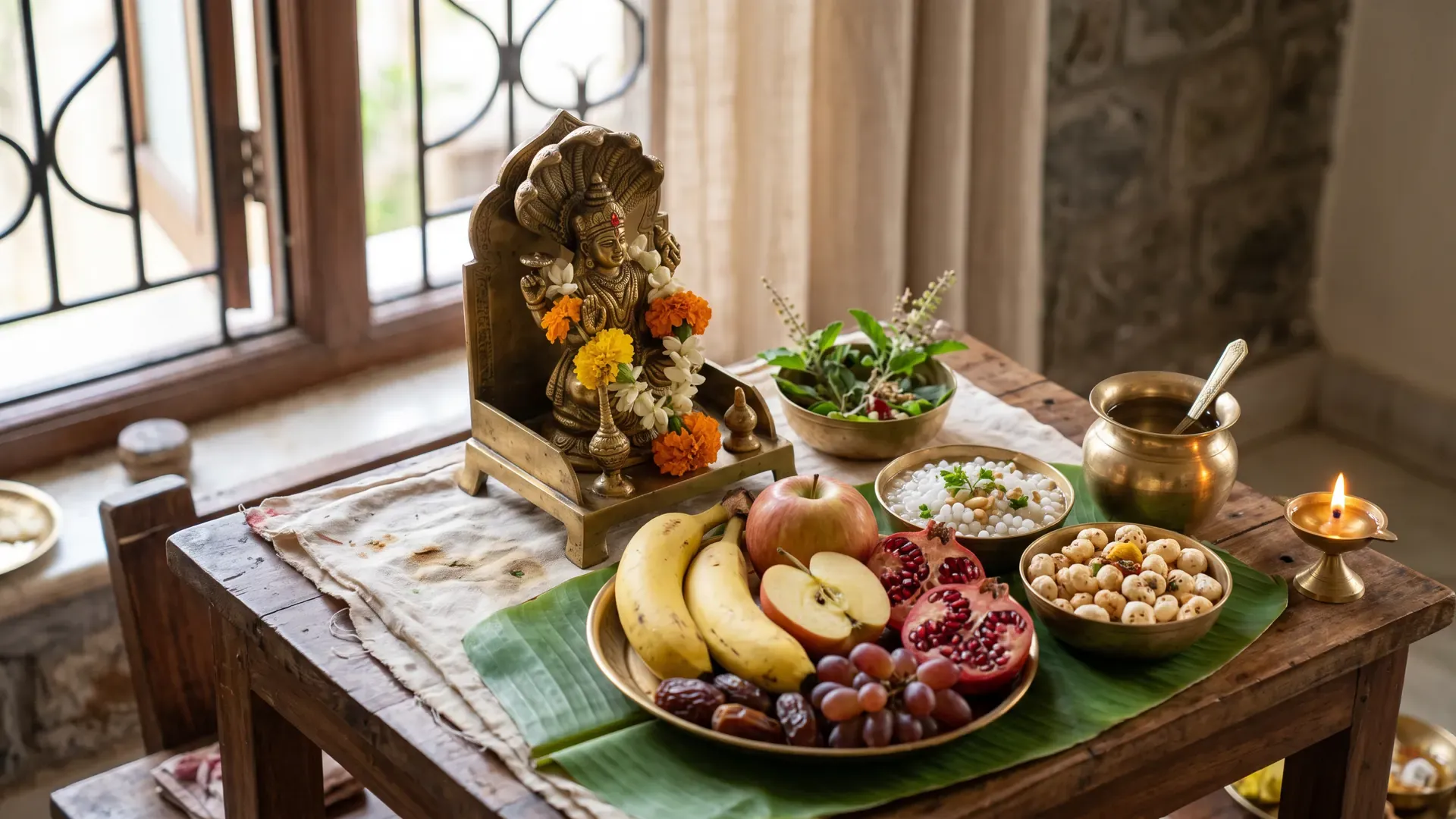
The Ekadashi fast begins with a single midday meal on Dashami and runs to the parana on Dwadashi. The Narada Purana says no meal is to be eaten on the Ekadashi of either fortnight, and the Dharmasindhu gives one who cannot keep the full fast the choice of water only, milk only, fruit only or one meal. A common phalahar has fruit, milk, dry fruits, sabudana, singhara and potato with rock salt; no grain, above all no rice. The parana is on Dwadashi after Hari Vasara has passed, while Dwadashi lasts.
The next Ekadashi
Papankusha Ekadashi, Thursday, 22 October 2026. Parana 23 October, 6:27–8:42 AM (New Delhi).
Papankusha Ekadashi: katha and parana in 16 citiesAll Ekadashis
Text a rule read in a text, with the text and place. Custom a folk custom, as the sources describe it; follow your family’s practice.
The rules of the fast
No meal on the Ekadashi of either fortnight Text
The Narada Purana (Uttarabhaga 3.17) says: “ekādaśyāṃ na bhoktavyaṃ pakṣayor ubhayor api”, that is, no meal is to be eaten on the Ekadashi of either the bright or the dark fortnight. In the same chapter King Rukmangada has this proclaimed by drumbeat: do not eat on Hari’s day (3.29).
Sources: Narada Purana, Uttarabhaga 3.17 and 3.29 (Ekadashi), Sanskrit Wikisource; Naradiya Mahapurana (Sanskrit), Nag Publishers edition
A three-day vrata: Dashami to Dwadashi Text
According to the Dharmasindhu the vrata begins on Dashami: take the sankalpa in the morning, eat only once at midday (ekabhakta), and sleep on the floor at night. ‘Vrat-Parichay’ gives one meal of havishyanna on both Dashami and Dwadashi: barley, wheat, moong, rock salt, black pepper, sugar and cow’s ghee.
Sources: Dharmasindhu (Kashinatha Upadhyaya), Khemraj Shrikrishnadas, Bombay 1907: chapter 1 (Ekadashi, pp. 15–17), chapter 2 (Navaratra, pp. 78–81); Dharmasindhu, with the Hindi commentary of Vasishthadatta Mishra, Chowkhamba Sanskrit Series, Varanasi; Gita Press, Vrat-Parichay, pp. 49–52 (the Ekadashi vrata) and 96–97 (Nirjala)
The Ekadashi day: sankalpa, puja and jagaran Text
On Ekadashi morning, after bathing, take the sankalpa to stay without food and eat on the next day, worship Vishnu, and keep a night vigil (jagaran) with katha, stotras or bhajans. The Dharmasindhu sets celibacy, truthful speech and no sleeping by day for this day.
Sources: Dharmasindhu (Kashinatha Upadhyaya), Khemraj Shrikrishnadas, Bombay 1907: chapter 1 (Ekadashi, pp. 15–17), chapter 2 (Navaratra, pp. 78–81); Dharmasindhu, with the Hindi commentary of Vasishthadatta Mishra, Chowkhamba Sanskrit Series, Varanasi; Gita Press, Vrat-Parichay, pp. 49–52 (the Ekadashi vrata) and 96–97 (Nirjala)
Waterless or with fruit: as your strength allows Text
For one who cannot keep the full fast, the Dharmasindhu gives four forms of the sankalpa: water only, milk only, fruit only, or one meal in the day (nakta). Drik Panchang lists the same four kinds: jalahara, kshirabhoji, phalahari and naktabhoji.
Sources: Dharmasindhu (Kashinatha Upadhyaya), Khemraj Shrikrishnadas, Bombay 1907: chapter 1 (Ekadashi, pp. 15–17), chapter 2 (Navaratra, pp. 78–81); Dharmasindhu, with the Hindi commentary of Vasishthadatta Mishra, Chowkhamba Sanskrit Series, Varanasi; Drik Panchang: Ekadashi fasting food
Nirjala Ekadashi Text
Jyeshtha Shukla Ekadashi is called Nirjala. On the basis of Vyasa’s words from the Mahabharata as quoted by Hemadri, ‘Vrat-Parichay’ says that on this day not even water is taken except for achamana, and the meal follows on the next day after bathing and giving.
Sources: Gita Press, Vrat-Parichay, pp. 49–52 (the Ekadashi vrata) and 96–97 (Nirjala)
Health first
If you are pregnant, unwell, elderly or on regular medication, keep a hard or waterless fast only after asking your doctor and your elders. A fast is kept in spirit; taking a lighter rule within your strength is still a fast.
What to eat (phalahar)
The texts say not to eat a meal on Ekadashi and give water, milk or fruit as the alternative for one who cannot fast. The things eaten in a phalahar today are common practice.
Fruit, milk and dry fruits Custom
A phalahar takes seasonal fruit (mango, grapes, banana and so on), dry fruits like almonds and pistachios, and in a milk fast things made from milk. Drik Panchang says not to take leafy greens in a phalahar; the Dharmasindhu too forbids shaka on the days of the vrata.
Sources: Drik Panchang: Ekadashi fasting food; Dharmasindhu (Kashinatha Upadhyaya), Khemraj Shrikrishnadas, Bombay 1907: chapter 1 (Ekadashi, pp. 15–17), chapter 2 (Navaratra, pp. 78–81)
In the one fasting meal Custom
According to Drik Panchang the one meal (nakta) usually has sabudana, singhara (water chestnut), sweet potato, potato and peanuts. Many people also eat kuttu (buckwheat) flour and samak rice, but Drik counts these as semi-grains and notes that views differ on them; choose by your own tradition.
Sources: Drik Panchang: Ekadashi fasting food
Rock salt Text
Where salt is taken, it is rock salt (sendha namak). ‘Vrat-Parichay’ lists rock salt in the havishyanna of Dashami and Dwadashi.
Sources: Gita Press, Vrat-Parichay, pp. 49–52 (the Ekadashi vrata) and 96–97 (Nirjala)
What not to eat
Grain: rice, wheat, pulses Custom
No grain is eaten on Ekadashi. In common practice rice is the most strictly avoided, and Drik Panchang also lists wheat, rice, pulses and beans as forbidden. The stories told about rice (such as that of the sage Medha) we did not find in any text, so they are left out.
Sources: Drik Panchang: Ekadashi fasting food; Webdunia, why rice is not eaten on Ekadashi, 10 July 2019; Narada Purana, Uttarabhaga 3.17 and 3.29 (Ekadashi), Sanskrit Wikisource
Avoided from Dashami to Dwadashi Text
Both the Dharmasindhu and ‘Vrat-Parichay’ forbid, on the days of the vrata, bell-metal (kansa) vessels, masoor, chana, shaka (greens), honey, oil, drinking too much water, lying, gambling and sex. The Dharmasindhu adds meat, a second meal, overeating, sleeping by day, kodo millet, another’s food and paan.
Sources: Dharmasindhu (Kashinatha Upadhyaya), Khemraj Shrikrishnadas, Bombay 1907: chapter 1 (Ekadashi, pp. 15–17), chapter 2 (Navaratra, pp. 78–81); Dharmasindhu, with the Hindi commentary of Vasishthadatta Mishra, Chowkhamba Sanskrit Series, Varanasi; Gita Press, Vrat-Parichay, pp. 49–52 (the Ekadashi vrata) and 96–97 (Nirjala)
Parana: how to break the fast
On Dwadashi, after Hari Vasara Text
The parana is on the next day, Dwadashi. According to the Dharmasindhu the first quarter of Dwadashi is called ‘Hari Vasara’; let it pass, and break the fast while Dwadashi still lasts. The parana times on this page and on each Ekadashi page are worked out by this rule.
Sources: Dharmasindhu (Kashinatha Upadhyaya), Khemraj Shrikrishnadas, Bombay 1907: chapter 1 (Ekadashi, pp. 15–17), chapter 2 (Navaratra, pp. 78–81); Dharmasindhu, with the Hindi commentary of Vasishthadatta Mishra, Chowkhamba Sanskrit Series, Varanasi
After the puja, with the Lord’s prasad Text
On Dwadashi worship again and then break the fast. The Dharmasindhu says to break it with the naivedya offered to the Lord, mixed with tulsi, and according to ‘Vrat-Parichay’, in difficulty the parana can be made with water alone.
Sources: Dharmasindhu (Kashinatha Upadhyaya), Khemraj Shrikrishnadas, Bombay 1907: chapter 1 (Ekadashi, pp. 15–17), chapter 2 (Navaratra, pp. 78–81); Gita Press, Vrat-Parichay, pp. 49–52 (the Ekadashi vrata) and 96–97 (Nirjala)
Read next
Frequently asked questions
What can be eaten on an Ekadashi fast?
For those who cannot keep the full fast, the texts give water, milk, fruit or one meal as the alternative. A common phalahar has fruit, milk and dry fruits, and the one meal has sabudana, singhara, sweet potato, potato and peanuts, with rock salt.
Why is rice not eaten on Ekadashi?
The Narada Purana (Uttarabhaga 3.17) says not to eat a meal at all on Ekadashi; not eating rice has become the best-known form of that rule. The stories told about rice we did not find in any text.
When is the Ekadashi parana?
On the next day, Dwadashi, after Hari Vasara (the first quarter of Dwadashi) and before Dwadashi ends. Each Ekadashi’s parana time is in the Ekadashi list.
What is the rule on Dashami?
According to the Dharmasindhu, eat only once on Dashami, at midday, eat nothing after that, and sleep on the floor at night. Avoid bell-metal vessels, masoor, chana, honey, oil and greens.
How can someone unwell or elderly keep Ekadashi?
The Dharmasindhu gives one who cannot fast fully a sankalpa of water only, milk only, fruit only or one meal. Take whichever rule suits your health, on your doctor’s advice.
Sources
- Narada Purana, Uttarabhaga 3.17 and 3.29 (Ekadashi), Sanskrit Wikisource
- Naradiya Mahapurana (Sanskrit), Nag Publishers edition
- Dharmasindhu (Kashinatha Upadhyaya), Khemraj Shrikrishnadas, Bombay 1907: chapter 1 (Ekadashi, pp. 15–17), chapter 2 (Navaratra, pp. 78–81)
- Dharmasindhu, with the Hindi commentary of Vasishthadatta Mishra, Chowkhamba Sanskrit Series, Varanasi
- Gita Press, Vrat-Parichay, pp. 49–52 (the Ekadashi vrata) and 96–97 (Nirjala)
- Drik Panchang: Ekadashi fasting food
- Webdunia, why rice is not eaten on Ekadashi, 10 July 2019
- Dates and times: SanatanBodh panchang calculation, checked against Drik Panchang (New Delhi)
Something wrong? Report a mistake