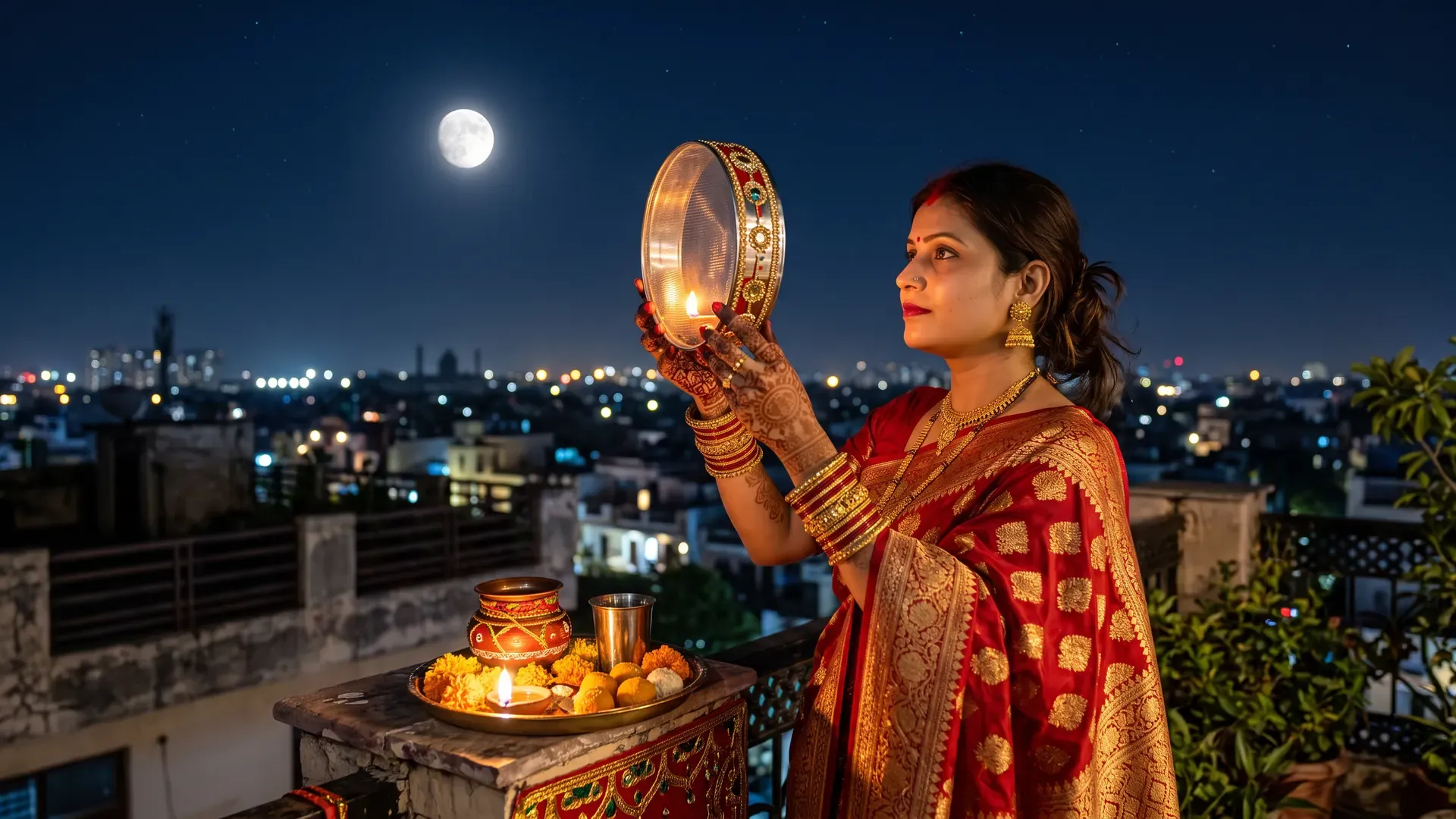
Karva Chauth is on Thursday, 29 October 2026. The fast runs from sunrise (6:31 AM in New Delhi) to moonrise (8:17 PM), and the common practice is to keep it without water. The sargi is eaten before sunrise, given by custom by the mother-in-law: pheni, fruit, dry fruits and coconut. The evening puja muhurat is 5:39–6:56 PM; when the moon rises, arghya is offered from the karva and the fast is broken, as the Karaka vrata of the Narada Purana describes.
New Delhi: Karva Chauth, 29 October
- SunriseSargi before this
- 6:31 AM
- MoonriseThen arghya to the moon and breaking the fast
- 8:17 PM
- Puja muhuratAfter sunset
- 5:39–6:56 PM
- Fasting timeSunrise to moonrise
- 6:31 AM–8:17 PM
- Chaturthi tithi
- until 10:11 PM
Clouds, buildings or hills can delay the sight of the moon by a few minutes.
Moonrise in your cityText a rule read in a text, with the text and place. Custom a folk custom, as the sources describe it; follow your family’s practice.
The rules of the fast
Karva Chauth in the texts: the Karaka vrata of the Narada Purana Text
The Narada Purana (Purvabhaga, chapter 113, verses 43–50) gives the rite of the ‘Karaka’ vrata on Kartik Krishna Chaturthi. After bathing and dressing, the woman worships Ganesha, places before him ten karvas (pots) filled with cooked food and offers them, then gives them to married women and brahmins. At night, when the moon rises, she offers arghya with due rite and eats sweet food. The text gives the right to this vrata to women, and says it is kept for twelve or sixteen years and then completed with an udyapana, or kept for life.
Sources: Narada Purana, Purvabhaga 113.43–50 (the Karaka vrata), Sanskrit Wikisource; Naradiya Mahapurana (Sanskrit), Nag Publishers edition; The Narada Purana, part 4 (English translation), Motilal Banarsidass
Which Chaturthi, whom to worship, who keeps it Text
According to Gita Press’s ‘Vrat-Parichay’, the vrata is kept on the Kartik Krishna Chaturthi that holds at moonrise. Shiva and Parvati, Swami Kartikeya and the Moon are worshipped; Drik Panchang adds Ganesha and puts Parvati’s puja first. The vrata is kept above all by married women, and ‘Vrat-Parichay’ also names girls married that year.
Sources: Gita Press, Vrat-Parichay (Pt. Hanuman Sharma), pp. 152–153 (Karaka Chaturthi); Drik Panchang: Karwa Chauth puja vidhi
From sunrise to moonrise, without food or water Custom
In common practice the fast is kept from sunrise until the moon is seen, without food or water; the sankalpa Drik Panchang gives says the same. The Narada Purana does not use the word ‘nirjala’; it says to eat after the arghya at moonrise. So going without water is given here as the common practice.
Sources: Drik Panchang: Karwa Chauth 2026, New Delhi; Drik Panchang: Karwa Chauth puja vidhi; Webdunia, Karva Chauth sargi and karva, 6 October 2025; Wikipedia: Karva Chauth
The evening puja and the katha Text
The puja is done after sunset, in the evening muhurat; women often worship together and tell and hear the Karva Chauth katha. According to ‘Vrat-Parichay’, karvas or laddoos of flour roasted in ghee with khand are offered as naivedya.
Sources: Gita Press, Vrat-Parichay (Pt. Hanuman Sharma), pp. 152–153 (Karaka Chaturthi); Drik Panchang: Karwa Chauth puja vidhi
Health first
If you are pregnant, unwell, elderly or on regular medication, keep a hard or waterless fast only after asking your doctor and your elders. A fast is kept in spirit; taking a lighter rule within your strength is still a fast.
What to eat in the sargi
Sargi is a folk custom, not a rule of the texts.
What sargi is Custom
Sargi is the meal eaten before the fast begins, before sunrise. By custom the mother-in-law makes it or sends it for her daughter-in-law; the custom is strongest in Punjab, and the practice differs somewhat in Uttar Pradesh and Bihar.
Sources: Wikipedia: Karva Chauth; Webdunia, Karva Chauth sargi and karva, 6 October 2025; Webdunia, what a karva is and what sargi is, 4 November 2020
What the sargi thali holds Custom
In common practice the sargi has pheni (fine vermicelli soaked in milk), fruit, dry fruits and coconut, along with suhag items and clothes. In Uttar Pradesh many homes eat soot pheni with milk and sugar the evening before.
Sources: Webdunia, Karva Chauth sargi and karva, 6 October 2025; Wikipedia: Karva Chauth
Finish the sargi before sunrise
The fast is counted from sunrise, so eat and drink the sargi before it. New Delhi’s sunrise is in the timings box above.
What not to eat
No meal before moonrise Text
The Narada Purana says to eat after offering arghya at moonrise, and the rule in the Karva Chauth katha given in ‘Vrat-Parichay’ is the same: the meal comes after moonrise. In the katha, Veeravati eats early after seeing a false moon her brother shows her; so offer arghya only after seeing the moon yourself.
Sources: Narada Purana, Purvabhaga 113.43–50 (the Karaka vrata), Sanskrit Wikisource; Naradiya Mahapurana (Sanskrit), Nag Publishers edition; Gita Press, Vrat-Parichay (Pt. Hanuman Sharma), pp. 152–153 (Karaka Chaturthi)
Neither food nor water by day Custom
In the common waterless practice nothing is eaten or drunk after the sargi until the moon is seen. Homes that follow another practice for health reasons can go by what their elders or their purohit say.
Sources: Drik Panchang: Karwa Chauth puja vidhi; Webdunia, what a karva is and what sargi is, 4 November 2020; Wikipedia: Karva Chauth
How to break the fast
Arghya to the moon, then the meal Text
When the moon rises, worship it and offer arghya from the karva, then break the fast. According to ‘Vrat-Parichay’, the cooked naivedya (in the karvas) and dakshina are given to a brahmin, arghya is offered to the moon, and then the meal is eaten; the Narada Purana says sweet food.
Sources: Gita Press, Vrat-Parichay (Pt. Hanuman Sharma), pp. 152–153 (Karaka Chaturthi); Narada Purana, Purvabhaga 113.43–50 (the Karaka vrata), Sanskrit Wikisource; Drik Panchang: Karwa Chauth puja vidhi
Seeing through a sieve, and water from the husband’s hand Custom
In common practice the woman looks at the moon, and then at her husband, through a sieve (or a dupatta), and breaks the fast with a first sip of water from her husband’s hand. This is a folk custom; the texts do not prescribe it.
Sources: Wikipedia: Karva Chauth
Baya: the karva and gifts for the mother-in-law Custom
After the puja the baya is given. According to ‘Vrat-Parichay’, 13 karvas or laddoos from the naivedya, a lota, a cloth and one special karva are given to the husband’s parents; Wikipedia names halwa, puri and mathri, given to the mother-in-law or sister-in-law.
Sources: Gita Press, Vrat-Parichay (Pt. Hanuman Sharma), pp. 152–153 (Karaka Chaturthi); Wikipedia: Karva Chauth
Read next
Frequently asked questions
What time is moonrise on Karva Chauth 2026, and when is the puja?
On Thursday, 29 October 2026 the moon rises at 8:17 PM in New Delhi and the puja muhurat is 5:39–6:56 PM. The fast runs from sunrise at 6:31 AM to moonrise. Other cities’ times are on the Karva Chauth page.
What is eaten in the sargi?
By custom the sargi has pheni, fruit, dry fruits and coconut, and is eaten before sunrise. The mother-in-law gives it; it is a folk custom, not a rule of the texts.
Can the Karva Chauth fast be kept with water?
The common practice is a waterless fast, and the sankalpa Drik Panchang gives also says no food or water. The Narada Purana does not use the word ‘nirjala’. If you are unwell, pregnant or on medication, decide after asking your doctor and your elders.
When and how is the Karva Chauth fast broken?
When the moon rises, worship it and offer arghya from the karva, then eat. By custom the woman looks at the moon and her husband through a sieve and breaks the fast with water from her husband’s hand.
What if clouds hide the moon?
The texts speak of arghya at moonrise and say nothing about clouds. Families differ in what they do then; ask your elders or your purohit. The moon rises at a different time in each city, so check your own city’s moonrise.
Who keeps the Karva Chauth fast?
The Narada Purana gives the right to this vrata to women. It is kept above all by married women for their husbands’ long life and the family’s wellbeing; Gita Press’s ‘Vrat-Parichay’ also names girls married that year.
Sources
- Narada Purana, Purvabhaga 113.43–50 (the Karaka vrata), Sanskrit Wikisource
- Naradiya Mahapurana (Sanskrit), Nag Publishers edition
- The Narada Purana, part 4 (English translation), Motilal Banarsidass
- Gita Press, Vrat-Parichay (Pt. Hanuman Sharma), pp. 152–153 (Karaka Chaturthi)
- Drik Panchang: Karwa Chauth 2026, New Delhi
- Drik Panchang: Karwa Chauth puja vidhi
- Wikipedia: Karva Chauth
- Webdunia, Karva Chauth sargi and karva, 6 October 2025
- Webdunia, what a karva is and what sargi is, 4 November 2020
- Dates and times: SanatanBodh panchang calculation, checked against Drik Panchang (New Delhi)
Something wrong? Report a mistake