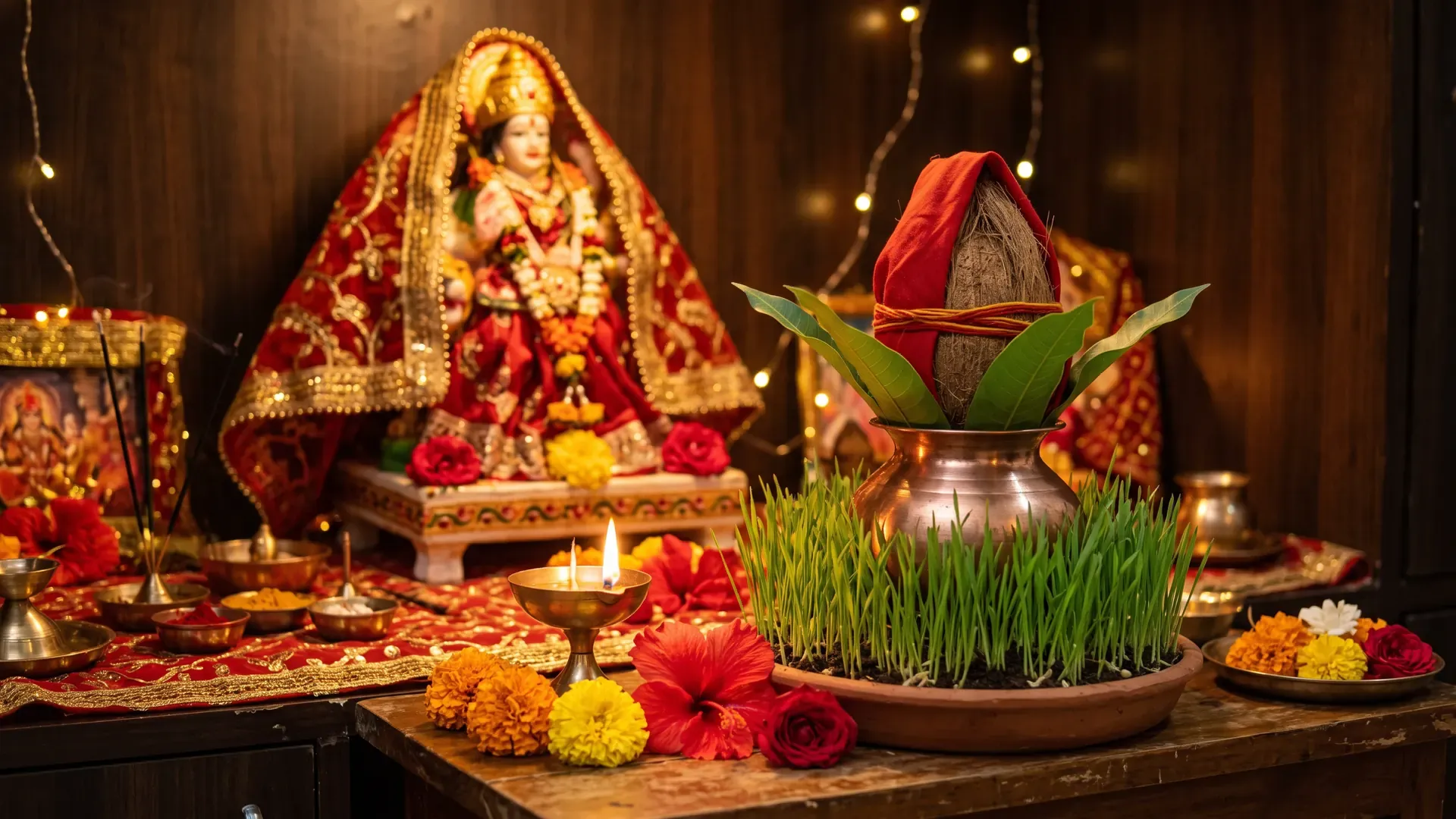
Sharad Navratri 2027 runs from Thursday, 30 September 2027 to Friday, 8 October 2027. The fast leaves out grain, onion, garlic and ordinary salt; a common phalahar has fruit, milk and curd, dry fruits, kuttu or singhara flour, sabudana, sama rice and potato, with rock salt. If the full nine days are not possible, the Dharmasindhu allows seven, five, three or one day, and a single meal a day. The parana is on Navami or Dashami, by family custom.
Text a rule read in a text, with the text and place. Custom a folk custom, as the sources describe it; follow your family’s practice.
The rules of the fast
For everyone, as one is able Text
According to ‘Vrat-Parichay’, man or woman, everyone may keep the Navaratra; one who cannot may have the puja done by a spouse, the eldest son, a brother or a brahmin. The Dharmasindhu too says the puja may be done through another when one cannot do it oneself.
Sources: Gita Press, Vrat-Parichay, pp. 62–64 (Navaratra); Dharmasindhu (Kashinatha Upadhyaya), Khemraj Shrikrishnadas, Bombay 1907: chapter 1 (Ekadashi, pp. 15–17), chapter 2 (Navaratra, pp. 78–81)
If not nine days, then seven, five, three or one Text
According to the Dharmasindhu, if the full nine days are not possible, one may keep seven days from Tritiya, five from Panchami, three from Saptami, two from Ashtami, or a single day, Ashtami or Navami, by one’s family custom. ‘Vrat-Parichay’ too gives seven, five, three or one day.
Sources: Dharmasindhu (Kashinatha Upadhyaya), Khemraj Shrikrishnadas, Bombay 1907: chapter 1 (Ekadashi, pp. 15–17), chapter 2 (Navaratra, pp. 78–81); Dharmasindhu, with the Hindi commentary of Vasishthadatta Mishra, Chowkhamba Sanskrit Series, Varanasi; Gita Press, Vrat-Parichay, pp. 62–64 (Navaratra)
Forms of the fast: upavasa, ekabhakta, nakta, ayachita Text
Keep the fast as you can: a full fast, one meal by day (ekabhakta), one meal only at night (nakta), or only what comes unasked (ayachita). The Dharmasindhu and ‘Vrat-Parichay’ both give these options, and Drik Panchang too speaks of a nakta or ekabhukta fast in special circumstances.
Sources: Dharmasindhu (Kashinatha Upadhyaya), Khemraj Shrikrishnadas, Bombay 1907: chapter 1 (Ekadashi, pp. 15–17), chapter 2 (Navaratra, pp. 78–81); Dharmasindhu, with the Hindi commentary of Vasishthadatta Mishra, Chowkhamba Sanskrit Series, Varanasi; Gita Press, Vrat-Parichay, pp. 62–64 (Navaratra); Drik Panchang: Navratri FAQ (food)
What is done in the Navaratra Text
The Dharmasindhu lists for the Navaratra the ghatasthapana, worship of the family deity, recitation of the Durga Saptashati and other texts, the akhand deep, feeding married women and girls and the kumari puja, and a homa at the end; adding that not every family does all of these, but as many as its custom has.
Sources: Dharmasindhu (Kashinatha Upadhyaya), Khemraj Shrikrishnadas, Bombay 1907: chapter 1 (Ekadashi, pp. 15–17), chapter 2 (Navaratra, pp. 78–81); Dharmasindhu, with the Hindi commentary of Vasishthadatta Mishra, Chowkhamba Sanskrit Series, Varanasi
Health first
If you are pregnant, unwell, elderly or on regular medication, keep a hard or waterless fast only after asking your doctor and your elders. A fast is kept in spirit; taking a lighter rule within your strength is still a fast.
What to eat (phalahar)
The texts give the forms of the fast, not a list of foods. The things below are common practice; follow your family’s custom.
Fruit, milk and curd, dry fruits Custom
Seasonal fruit and juice, milk, curd, buttermilk, paneer and dry fruits (almonds, walnuts, cashews) are taken in a phalahar.
Sources: Drik Panchang: Navratri FAQ (food); Webdunia, what to eat and not to eat in Navratri, 23 September 2024; Webdunia, when to break the Sharad Navratri fast, 23 September 2025
Kuttu, singhara, sabudana, sama Custom
In place of grain: roti or puri of kuttu (buckwheat) or singhara (water chestnut) flour, sabudana khichdi, and sama (mordhan, barnyard millet) rice or flour. Drik Panchang names sabudana, water chestnut flour, mordhan flour and dry fruits; kuttu is in Webdunia’s lists.
Sources: Drik Panchang: Navratri FAQ (food); Webdunia, what to eat and not to eat in Navratri, 23 September 2024; Webdunia, when to break the Sharad Navratri fast, 23 September 2025
Among vegetables Custom
Potato, sweet potato, arbi (taro), bottle gourd, pumpkin, tomato and cucumber are commonly taken in a phalahar.
Sources: Webdunia, what to eat and not to eat in Navratri, 23 September 2024; Webdunia, when to break the Sharad Navratri fast, 23 September 2025
Rock salt Custom
Rock salt (sendha namak) is used in fasting food in place of ordinary salt.
Sources: Webdunia, what to eat and not to eat in Navratri, 23 September 2024; Webdunia, when to break the Sharad Navratri fast, 23 September 2025
What not to eat
Grain Custom
Those fasting avoid grain: wheat, rice, pulses, maize, semolina and their flours.
Sources: Drik Panchang: Navratri FAQ (food); Webdunia, what to eat and not to eat in Navratri, 23 September 2024; Wikipedia: Navaratri, “Cuisine”
Onion, garlic, meat and intoxicants Custom
Onion, garlic, meat, eggs and alcohol are not taken. Drik Panchang advises even those not fasting to eat pure vegetarian food these days, without onion, garlic or drumstick.
Sources: Drik Panchang: Navratri FAQ (food); Webdunia, what to eat and not to eat in Navratri, 23 September 2024; Wikipedia: Navaratri, “Cuisine”
Ordinary salt Custom
No ordinary salt in fasting food; rock salt instead.
Sources: Webdunia, what to eat and not to eat in Navratri, 23 September 2024; Webdunia, when to break the Sharad Navratri fast, 23 September 2025
Parana: how to break the fast
On Navami or Dashami, by family custom Text
According to the Dharmasindhu the visarjan is on Dashami and the parana follows the visarjan that day; by another view the parana is on Navami itself. Where the custom is parana on Navami (the Dharmasindhu names the people of the south) it is done on Navami, and where the custom is Dashami, on Dashami. Drik Panchang gives the same two views: before Navami ends, or on Dashami.
Sources: Dharmasindhu (Kashinatha Upadhyaya), Khemraj Shrikrishnadas, Bombay 1907: chapter 1 (Ekadashi, pp. 15–17), chapter 2 (Navaratra, pp. 78–81); Dharmasindhu, with the Hindi commentary of Vasishthadatta Mishra, Chowkhamba Sanskrit Series, Varanasi; Drik Panchang: Sharad Navratri parana 2026, New Delhi
After the Kanya Puja Custom
In many North Indian families, women especially break the fast after the Kanya Puja on Ashtami or Navami; in a year when the Ashtami and Navami pujas fall on one day, after the Kanya Puja that day. Some homes break it on Saptami.
Sources: Drik Panchang: Sharad Navratri parana 2026, New Delhi; Webdunia, when to break the Sharad Navratri fast, 23 September 2025
Read next
Frequently asked questions
What is eaten in the Navratri fast?
A common phalahar has fruit, milk and curd, dry fruits, roti of kuttu or singhara flour, sabudana, sama rice, potato and sweet potato, with rock salt. No grain, onion, garlic or meat.
Can salt be eaten in the Navratri fast?
In common practice not ordinary salt, but rock salt (sendha namak).
What if one cannot fast all nine days?
According to the Dharmasindhu and Gita Press’s ‘Vrat-Parichay’, the fast can also be kept for seven, five, three days or one day (Ashtami or Navami), and as one meal a day or one meal at night.
Can the fast be broken after the Kanya Puja?
Yes, in many North Indian families the fast is broken after the Kanya Puja on Ashtami or Navami. The texts put the parana on Navami or Dashami; follow your family’s custom.
Sources
- Dharmasindhu (Kashinatha Upadhyaya), Khemraj Shrikrishnadas, Bombay 1907: chapter 1 (Ekadashi, pp. 15–17), chapter 2 (Navaratra, pp. 78–81)
- Dharmasindhu, with the Hindi commentary of Vasishthadatta Mishra, Chowkhamba Sanskrit Series, Varanasi
- Gita Press, Vrat-Parichay, pp. 62–64 (Navaratra)
- Drik Panchang: Navratri FAQ (food)
- Drik Panchang: Sharad Navratri parana 2026, New Delhi
- Webdunia, what to eat and not to eat in Navratri, 23 September 2024
- Webdunia, when to break the Sharad Navratri fast, 23 September 2025
- Wikipedia: Navaratri, “Cuisine”
- Dates and times: SanatanBodh panchang calculation, checked against Drik Panchang (New Delhi)
Something wrong? Report a mistake