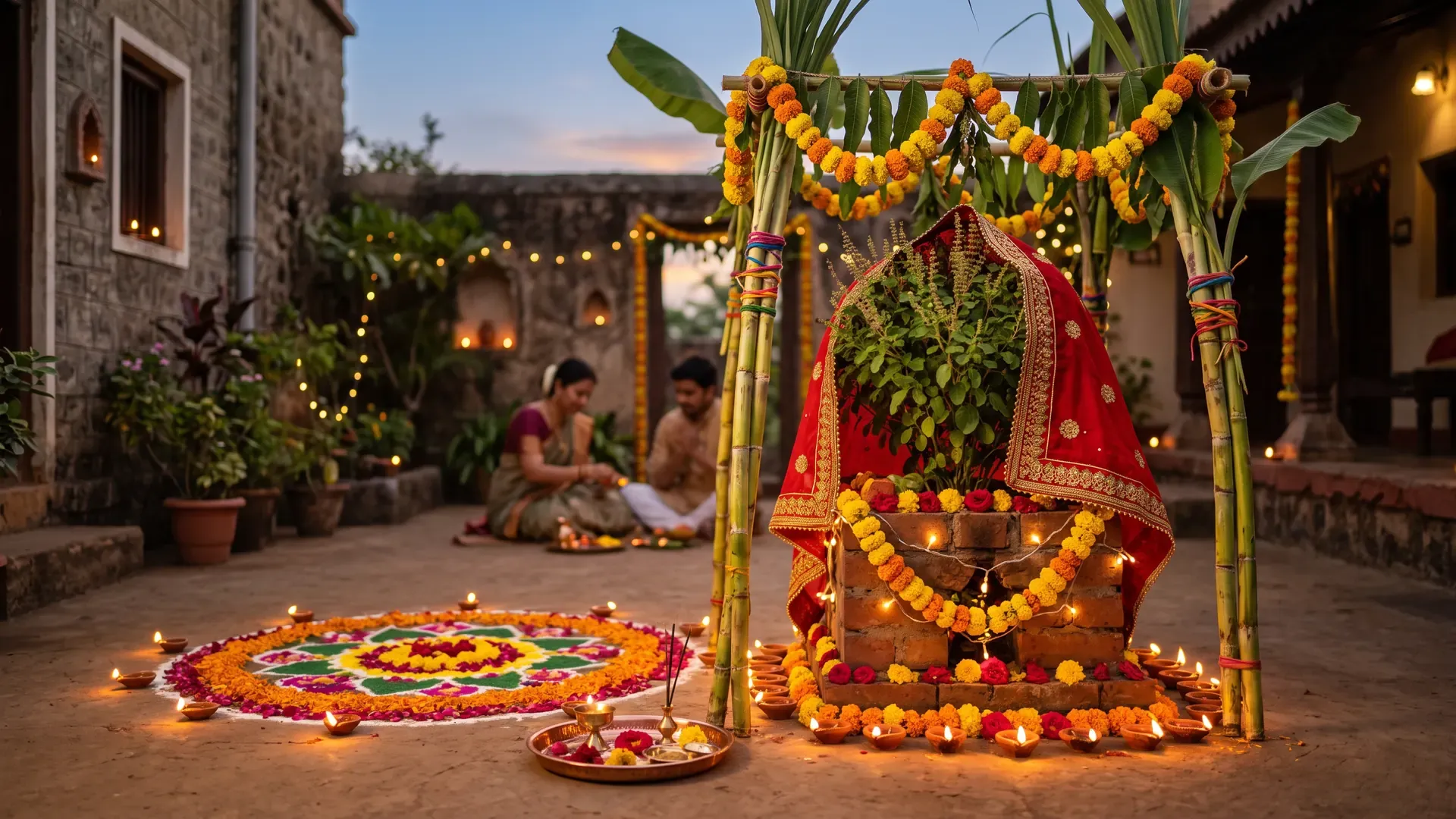
The Tulsi Vivah 2026 evening is on Saturday, 21 November 2026; in New Delhi the Godhuli muhurat is 5:25–5:52 PM (sunset 5:25 PM). Many families hold the wedding a day earlier, on the Ekadashi evening (20 November); the Godhuli that day is 5:26–5:52 PM. Keep ready: the Tulsi plant and the Shaligram (or an image of Vishnu), two chowkis, sugarcane for the mandap, a red chunri and suhag items for Tulsi, haldi, roli, akshat, Gangajal, raw thread, diyas, dhoop, camphor, a kalash, seasonal fruit and roots and an aarti thali. Below is the full list by group, each item with its use.
New Delhi: Wedding timings, 21 November
- Godhuli muhuratFrom sunset; the wedding is held in the evening
- 5:25–5:52 PM
- Sunset
- 5:25 PM
- Dwadashi tithi
- 6:33 AM to 4:58 AM (22 Nov)
- Ekadashi tithi (Dev Uthani)
- 7:17 AM (20 Nov) to 6:33 AM
In Indian Standard Time, SanatanBodh panchang calculation, checked against Drik Panchang. Godhuli muhurat for 12 cities (on the vidhi page)
Before the wedding: a quick check
- Time: the Godhuli muhurat, 5:25–5:52 PM (New Delhi, Saturday, 21 November 2026). The wedding is in the evening; in Drik Panchang’s method the worship of Vishnu and Tulsi’s kanyadaan are at Godhuli. The muhurat for your city is in the table on the vidhi page.
- Place: the middle of the courtyard, terrace or puja room; the pot of Tulsi on one chowki or low board, the Shaligram on another (Webdunia, Navbharat Live).
- Mandap: a canopy of sugarcane over Tulsi, decorated with flowers and the red chunri (Navbharat Live, Webdunia).
- Samagri: match it against the list below. Each item can be ticked, and the ticks stay in this browser.
- Order: the kanyadaan, Mangalashtak, pheras, aarti. Every step is on the vidhi page.
Who the groom and the bride are
- The bride: the Tulsi plant, dressed like a married woman (Drik Panchang, Wikipedia, Bhakti Bharat).
- The groom: the Shaligram stone, taken as a form of Vishnu; without one, in many homes and temples an image of Vishnu or Krishna, and in Andhra-Telangana a branch of amla (Drik Panchang, Wikipedia).
- On the Shaligram: sesame in place of rice (Navbharat Live, Webdunia); Webdunia also has white sandalwood.
Custom / belief: All this is custom; we did not find this procedure of the wedding in the chapters we checked. The day also differs: Drik Panchang and Vrat-Parichay say the Padma Purana mentions Kartik Shukla Navami, while other texts give the five days from Prabodhini Ekadashi to the full moon.
Tulsi Vivah puja samagri: the full list
By tradition; follow your family’s custom. Separate parts for Tulsi (the bride) and the Shaligram (the groom), then the mandap, the haldi and tilak, the puja and the bhog; where the sources say it, the use of each item is written. 40 items in all; tick them off as you shop.
sanatanbodh.in/en/festivals/tulsi-vivah/samagri/
Tulsi and the Shaligram
The mandap and decoration
Dressing Tulsi (the bride)
Lists of the sixteen adornments differ; below are the items that at least two sources name
The Shaligram (the groom)
Haldi, tilak and the rites of the wedding
Lamps, incense and the kalash
Bhog and naivedya
Seasonal produce, as the lists of the sources have it
If a havan is done
Aarti
How homes and regions differ
- In Drik Panchang’s method the Tulsi may be one nurtured for three months or one of gold or silver. The groom is the Shaligram in some places, an image of Vishnu or Krishna in others, and in Andhra-Telangana a branch of amla.
- In Maharashtra a white cloth (antarpat) is held between the groom and the bride and removed amid showers of akshat after the Mangalashtak, so keep a white cloth (Drik Panchang, Wikipedia). In the temples of Braj all the rites of a wedding are done: haldi, mehndi, jaimala, pheras and the baraat.
- Things that only one source names are not in the list: kajal and mahavar (Webdunia), supari, paan and dakshina (Webdunia), a mangalsutra (Wikipedia), panchamrit (Webdunia), and ‘a pretty handkerchief’ and ‘the things given to groom and bride’ (the same list in Times Now Hindi and Navbharat Live, with no explanation).
- Navbharat Live and Webdunia say sesame in place of rice on the Shaligram, and Webdunia also white sandalwood; this is a custom, and we did not find it as a rule in a text.
Checked against these sources and written in our own words; only items named by at least two of them are listed: Navbharat Live: Tulsi Vivah at home (2025); Navbharat Live: Tulsi Vivah puja (2024); Navbharat Live: Tulsi Vivah, worship material (2023); Times Now Hindi: Tulsi Vivah samagri list (2025); Amar Ujala: Tulsi-Shaligram wedding samagri (2025); Webdunia: Tulsi Vivah puja vidhi and samagri (2025); Drik Panchang: Tulasi Vivah 2026; English Wikipedia: Tulasi Vivaha; Bhakti Bharat: Tulsi Vivah
Aartis and chalisas
Frequently asked questions
What is the samagri for Tulsi Vivah (Tulsi Vivah samagri list)?
By tradition: the Tulsi plant, the Shaligram (or an image of Vishnu), two chowkis, sugarcane for the mandap, a red chunri and suhag items for Tulsi (sindoor, bindi, bangles, mehndi, toe rings), haldi, roli, akshat, Gangajal, raw thread, diyas, dhoop, camphor, a kalash with mango leaves, seasonal fruit and roots (radish, singhada, ber, amla, sweet potato) and an aarti thali. What each is for is in the list on this page.
What is the Tulsi Vivah 2026 muhurat?
On the evening of Saturday, 21 November 2026 at Godhuli, 5:25–5:52 PM in New Delhi (sunset 5:25 PM). For those who hold the wedding on the Ekadashi evening (20 November): 5:26–5:52 PM. Drik Panchang (New Delhi, read on 8 November 2026): Godhuli 5:25 PM to 5:52 PM on 21 November and 5:26 PM to 5:52 PM on 20 November; the same as ours. The times for 12 cities are in the table on the vidhi page.
How is the sugarcane mandap for Tulsi Vivah made?
A canopy of sugarcane is made over the pot of Tulsi and decorated with flowers and the red chunri (Navbharat Live, Webdunia); some sources give banana leaves in place of or with the sugarcane (Amar Ujala, Webdunia). No source fixes the number of canes, so follow your family’s way.
What is offered in dressing Tulsi?
A red chunri (or sari) and suhag items: sindoor, bindi, bangles, mehndi, toe rings. Lists of the sixteen adornments differ, so we kept what at least two sources name. Some lists add kajal and mahavar (Webdunia). The Maharashtra custom of giving the bridal offerings to a Brahmin priest or a female ascetic after the ceremony is in Drik Panchang.
What to use if you have no Shaligram?
In many homes and temples an image or picture of Vishnu or Krishna is used, and at the Tulasi Kalyanam of Andhra Pradesh and Telangana Vishnu is a branch of amla (Drik Panchang, Wikipedia). The lists of Webdunia, Amar Ujala and Navbharat Live also have ‘the Shaligram or an image of Vishnu’.
Sources
- The samagri list: Navbharat Live (2023, 2024, 2025), Times Now Hindi (2025), Amar Ujala (31 October 2025), Webdunia (31 October 2025)
- Drik Panchang: Tulasi Vivah 2026 (New Delhi): the date, the Dwadashi tithi, the method after Vrat Parichay and Vishnuyamala, the regional forms; the day panchang for 20 and 21 November 2026 (Godhuli muhurat)
- English Wikipedia: Tulasi Vivaha; Bhakti Bharat: Tulsi Vivah
- Gita Press, Vrat-Parichay, pp. 172–173: Tulsi Vivah (from the Vishnuyamala) and the Navami of the Padma Purana
- Godhuli and tithi: SanatanBodh panchang calculation (Lahiri ayanamsha); Godhuli = from sunset for a thirtieth of the night, as Drik Panchang prints it
Something wrong? Report a mistake
