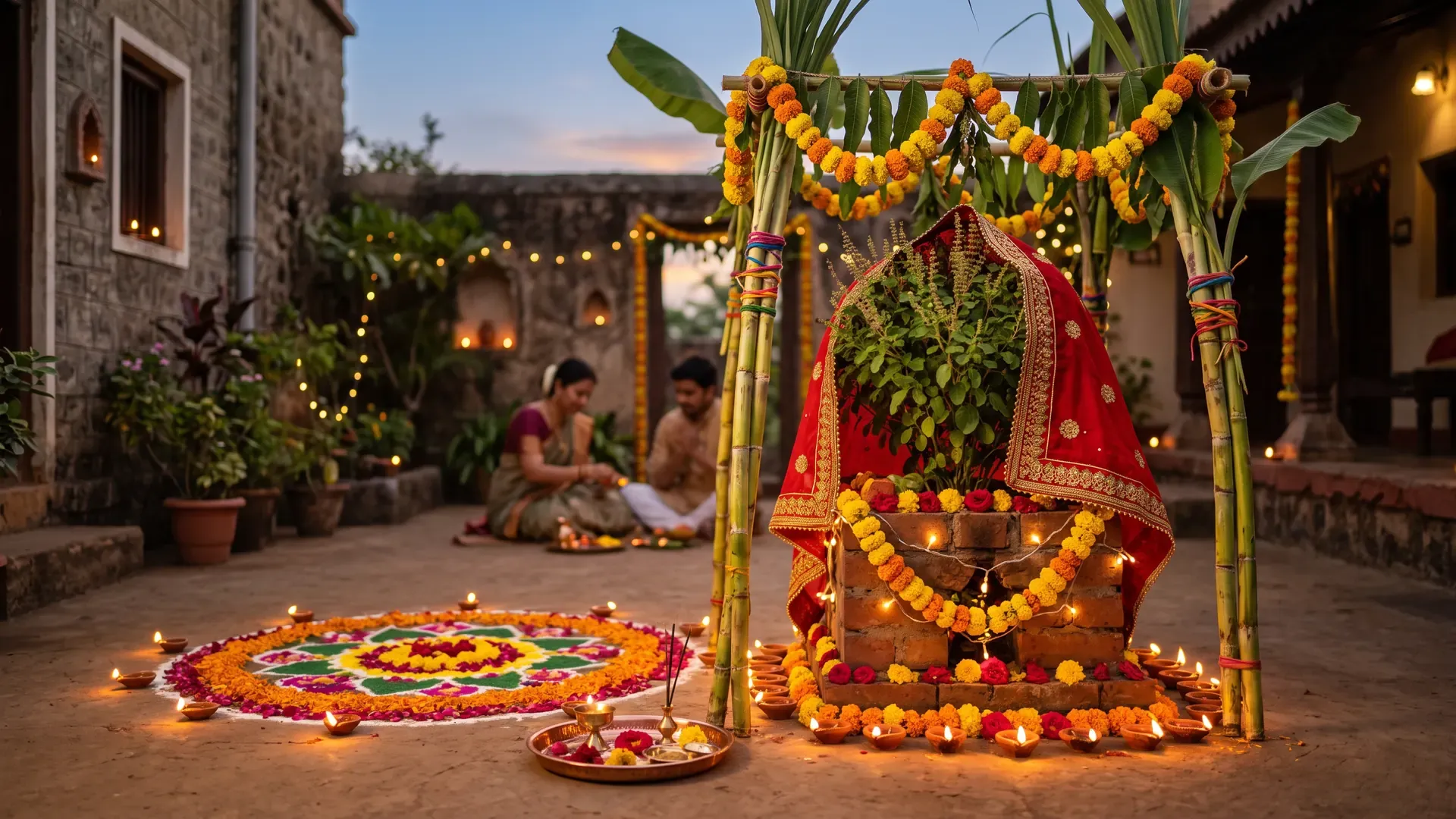
Dev Uthani Ekadashi 2026 is on Friday, 20 November 2026; in New Delhi the Ekadashi tithi is 7:17 AM to 6:33 AM (21 Nov) and the parana is on Saturday, 21 November 2026, 1:11–3:18 PM (Hari Vasara ends 12:09 PM (21 Nov)). The order of the puja: by day make the chowk and Vishnu’s footprints and set out sugarcane, singhada, ber and fruit; in the evening light a ghee lamp and worship Vishnu (and Lakshmi); then wake the Lord by blowing a conch or ringing a bell and singing ‘Utho Deva, Baitho Deva’ (a folk custom; in Gita Press’s Vrat-Parichay the rite belongs to the night); last the prasad and daan. Below are every step, the samagri list and the rules of the fast.
New Delhi: Fast and parana timings, 20 November
- Parana (breaking the fast)On Dwadashi, after Hari Vasara
- 1:11–3:18 PM (21 Nov)
- Hari Vasara ends
- 12:09 PM (21 Nov)
- Ekadashi tithi
- 7:17 AM to 6:33 AM (21 Nov)
- Dwadashi ends
- 4:58 AM (22 Nov)
In Indian Standard Time, SanatanBodh panchang calculation, checked against Drik Panchang. Parana time for your city (on the Ekadashi page)
At a glance: the order of the day
- Morning, 20 November: bath and the sankalpa. Choose the kind of fast (without water, milk and fruit, fruit only or one meal) at the sankalpa, by your own strength (Drik Panchang).
- By day: clean the house; make the chowk and Vishnu’s footprints in the courtyard or the place of worship; set out sugarcane, singhada, ber, fruit and sweets (a folk custom).
- Evening: the ghee lamp and the worship of Vishnu and Lakshmi; then waking the Lord (a folk custom: conch, bell, ‘Utho Deva’).
- Night: katha, kirtan and a vigil; in the text this is the rite of the night (Gita Press, Vrat-Parichay).
- Next morning, Saturday, 21 November 2026: the parana, 1:11–3:18 PM (New Delhi); Hari Vasara ends 12:09 PM (21 Nov), and the fast is broken after it.
The puja vidhi, in order
The order of the home puja below is put together from the descriptions of the custom (Navbharat Live, Amar Ujala, Aaj Tak, Bharatkosh); what Gita Press’s Vrat-Parichay (from the Madanaratna) gives under the name of a text is written apart. The order differs by region and family.
1. Bath and sankalpa
- A bath in the morning, clean clothes (yellow clothes in Amar Ujala).
- Choose the kind of fast at the sankalpa; the fast is under the rules of the fast below.
2. The chowk, the footprints and the sugarcane canopy
- Make a chowk in the courtyard or the place of worship and, beside it, Vishnu’s footprints in geru (Amar Ujala, Navbharat Live, Bharatkosh).
- By Aaj Tak a canopy of sugarcane is made with the chowk in the middle, and a picture or image of Vishnu may be set in the middle of the chowk.
- The sources give no reason for it; do it as a custom of the home.
3. Setting out and covering
- Near the footprints set sugarcane, singhada, ber, seasonal fruit, sweets and flowers (Amar Ujala, Navbharat Live, Aaj Tak, Bharatkosh).
- By Navbharat Live, Amar Ujala and Bharatkosh it is covered with a sieve, basket or parat.
4. The evening puja
- Light a ghee lamp (Aaj Tak: to burn through the night) and worship Vishnu and Lakshmi (Amar Ujala, Navbharat Live).
- By Gita Press the worship is done by the method of the Vishnu puja or the Pancha-deva puja, then the aarti (nirajana) with a ghee wick or camphor.
5. Waking the Lord
- Text (Gita Press, Vrat-Parichay pp. 170–171, from the Madanaratna): on the night of Ekadashi, to wake the sleeping Hari, the singing of bhajans, the hearing of the katha and Puranas, the playing of bell, conch, mridanga, nagare and veena, and the saying of the waking mantras; the mantras and their meaning are on the mantra page.
- Folk custom: the Lord is woken by blowing a conch or ringing a bell and singing ‘Utho Deva, Baitho Deva’ (Navbharat Live, Amar Ujala).
- The sources do not agree on the time: Navbharat Live and Amar Ujala say the evening, Aaj Tak and Bharatkosh dawn. Follow your family’s way.
Custom / belief: This song belongs to folk custom and differs from place to place; we did not find a text of it in a scripture, so we do not print it.
6. Prayer, prasad and daan
- By Gita Press, after the offering of flowers a prayer, then remembrance of devotees such as Prahlada, Narada, Parashara, Pundarika, Vyasa, Ambarisha, Shuka, Shaunaka and Bhishma, and the sharing of charanamrit, panchamrit or prasad.
- After the Lord has awoken a bhog of panchamrit (Navbharat Live); then share the prasad and give clothes, money, grain and yellow things in daan (Navbharat Live).
- Vrat-Parichay also has the rite of seating the Lord in a chariot and taking Him through the town, village or lanes; we have not given its steps on this page.
7. The next day: Tulsi Vivah and the parana
- Tulsi Vivah is on Saturday, 21 November 2026 (Drik Panchang); many families hold it on the evening of Ekadashi. The samagri and the Godhuli muhurat are on the Tulsi Vivah samagri page.
- The parana is on Saturday, 21 November 2026, 1:11–3:18 PM (New Delhi), after Hari Vasara, 12:09 PM (21 Nov).
The rules of the fast, in brief
From Drik Panchang’s Prabodhini Ekadashi page and, where named, Aaj Tak; the full rules are on the Ekadashi vrat-niyam page. Choose the fast by your health.
The kind of fast
- Four kinds: jalahar (water only), ksheerbhoji (milk and milk products), phalahari (fruit, no leafy vegetables) and naktabhoji (one meal before sunset). Choose at the sankalpa by your will and strength (Drik Panchang).
- In naktabhoji no grain, cereal, pulses, wheat or rice; sabudana, singhada, sweet potato, potato and groundnut are allowed (Drik Panchang). Drik Panchang calls kuttu and samak debatable.
- A lighter fast: by Aaj Tak the sick, the old, children and the very busy may take one meal; on this day no onion, garlic, meat, liquor or stale food in the house.
The parana
- In Dwadashi, after sunrise: break the fast within the Dwadashi tithi (unless Dwadashi ends before sunrise). Not in Hari Vasara, the first fourth of Dwadashi (Drik Panchang).
- The better time: Pratahkal is best; avoid Madhyahna, and if Pratahkal is not possible, after Madhyahna (Drik Panchang).
- This year, New Delhi: Saturday, 21 November 2026, 1:11–3:18 PM; Hari Vasara ends 12:09 PM (21 Nov).
- The story of the parana, King Ambarisha and Durvasa (Bhagavata Purana 9.4–9.5), is on the Ekadashi page.
20 or 21 November: Smarta and Vaishnava
- When Drik Panchang gives two dates, a one-day fast is kept on the first (householder Smartas); the second is suggested for sannyasis, widows and those who seek moksha, and it is also the Vaishnava day.
- This year: the Smarta fast on Friday, 20 November 2026, the parana on Saturday, 21 November 2026, 1:11–3:18 PM. The Gauna (Vaishnava) Ekadashi is on Saturday, 21 November 2026, the parana on 22 November, 6:49–8:56 AM.
- Which day to take depends on your family’s, sampraday’s or priest’s tradition.
Dev Uthani Ekadashi puja samagri
By tradition; follow your family’s custom. The chowk and footprints, the offerings, the lamp, the instruments for waking the Lord and the daan; under each item is what it is for. 15 items in all; tick them off as you shop.
sanatanbodh.in/en/festivals/dev-uthani-ekadashi/puja-vidhi/
The chowk and Vishnu’s footprints
Offerings
The new produce and seasonal fruit that the custom names
Puja items
For waking the Lord
Daan
How homes and regions differ
- The sources do not agree on when the Lord is woken: Navbharat Live and Amar Ujala say the evening, Aaj Tak and Bharatkosh dawn; in Gita Press’s Vrat-Parichay (from the Madanaratna) the rite belongs to the night of Ekadashi. Follow your family’s custom.
- Things that only one source names are not in the list: sweet potato (Amar Ujala Agra), tulsi leaves, roli, akshat and dhoop (Navbharat Live 2026), decorating the temple with creepers, fruit, flowers and bandanvar (Vrat-Parichay). The mridanga, nagare and veena are also only in Vrat-Parichay.
- Vrat-Parichay also has a larger rite under the name of the Varaha Purana: a sixteen-petal lotus on a vedi, four kalashas on it and, in the middle, a golden image of Vishnu on Shesha in yellow silk. Its samagri is not in this list; ask your purohit for it.
Checked against these sources and written in our own words; only items named by at least two of them are listed: Navbharat Live: Dev Uthani Ekadashi (2025); Navbharat Live: Dev Uthani Ekadashi 2026; Amar Ujala Agra: Devutthan Ekadashi (2025); Aaj Tak: Devuthani Ekadashi (2024); Bharatkosh: Devutthan Ekadashi; Gita Press, Vrat-Parichay, pp. 170–172 (Prabodha-ekadashi-kritya, from the Madanaratna)
Aartis and chalisas
Frequently asked questions
How is the Dev Uthani Ekadashi puja done?
Bathe in the morning and take the sankalpa. By day make a chowk and Vishnu’s footprints in geru in the courtyard or the place of worship, set sugarcane, singhada, ber, fruit and sweets beside them and cover them. In the evening light a ghee lamp and worship Vishnu and Lakshmi, then wake the Lord with a conch or bell, offer panchamrit and share the prasad. The next morning, Saturday, 21 November 2026, break the fast after Hari Vasara. This is the order of folk custom; in Gita Press’s Vrat-Parichay the waking rite belongs to the night of Ekadashi. Give first place to your purohit’s and family’s practice.
When is the Dev Uthani Ekadashi 2026 parana?
Saturday, 21 November 2026, 1:11–3:18 PM in New Delhi; Hari Vasara ends 12:09 PM (21 Nov) and the Ekadashi tithi is 7:17 AM to 6:33 AM (21 Nov). Drik Panchang (New Delhi, read on 8 November 2026): parana 1:11 PM to 3:18 PM on 21 November, Hari Vasara ends 12:07 PM, Ekadashi from 7:15 AM on 20 November to 6:31 AM on 21 November; our calculation is two minutes later in the tithi times, the parana the same. See the Ekadashi page for your city.
Is Dev Uthani Ekadashi 2026 on 20 or 21 November?
In the Smarta tradition on Friday, 20 November 2026 (the first date, by Drik Panchang), the parana on Saturday, 21 November 2026, 1:11–3:18 PM. In the Vaishnava tradition the Gauna Ekadashi is on Saturday, 21 November 2026, the parana on 22 November, 6:49–8:56 AM. Drik Panchang suggests the first date to householders keeping a one-day fast; follow your family’s or priest’s tradition.
What is ‘Utho Deva, Baitho Deva’, and why are the gods woken?
By tradition Vishnu sleeps in yogic sleep from Ashadha Shukla Ekadashi and wakes on Kartik Shukla Ekadashi, so Chaturmas ends on this day. ‘Utho Deva, Baitho Deva’ is the folk song for waking Him, sung with a conch or bell (Navbharat Live, Amar Ujala); we did not find one fixed text of it in a scripture. The waking verses of the text are on the mantra page.
What can be eaten on Dev Uthani Ekadashi, and is rice allowed?
By Drik Panchang no grain, cereal, pulses, wheat or rice is eaten in the Ekadashi fast. For naktabhoji it names sabudana, singhada, sweet potato, potato and groundnut; in a fruit-only fast, fruit but no leafy vegetables. Choose the kind of fast by your health.
Sources
- Gita Press, Vrat-Parichay, pp. 170–172: the Prabodha-ekadashi-kritya (from the Madanaratna) and the Prabodhini rite under the name of the Varaha Purana (text read on archive.org)
- Drik Panchang: Prabodhini Ekadashi 2026 (New Delhi): the fast and parana times, the rule of the parana, the kinds of fast and the food, the fasting FAQ; Tulasi Vivah 2026
- Navbharat Live: Dev Uthani Ekadashi (1 November 2025 and 31 October 2026)
- Amar Ujala Agra: Devutthan Ekadashi (1 November 2025); Aaj Tak: Devuthani Ekadashi (12 November 2024); Bharatkosh: Devutthan Ekadashi
- Bhagavata Purana 9.4–9.5 (Ambarisha’s parana), as checked on the Ekadashi page
- Tithi and parana: SanatanBodh panchang calculation (Lahiri ayanamsha), checked against Drik Panchang (New Delhi, 2026)
Something wrong? Report a mistake