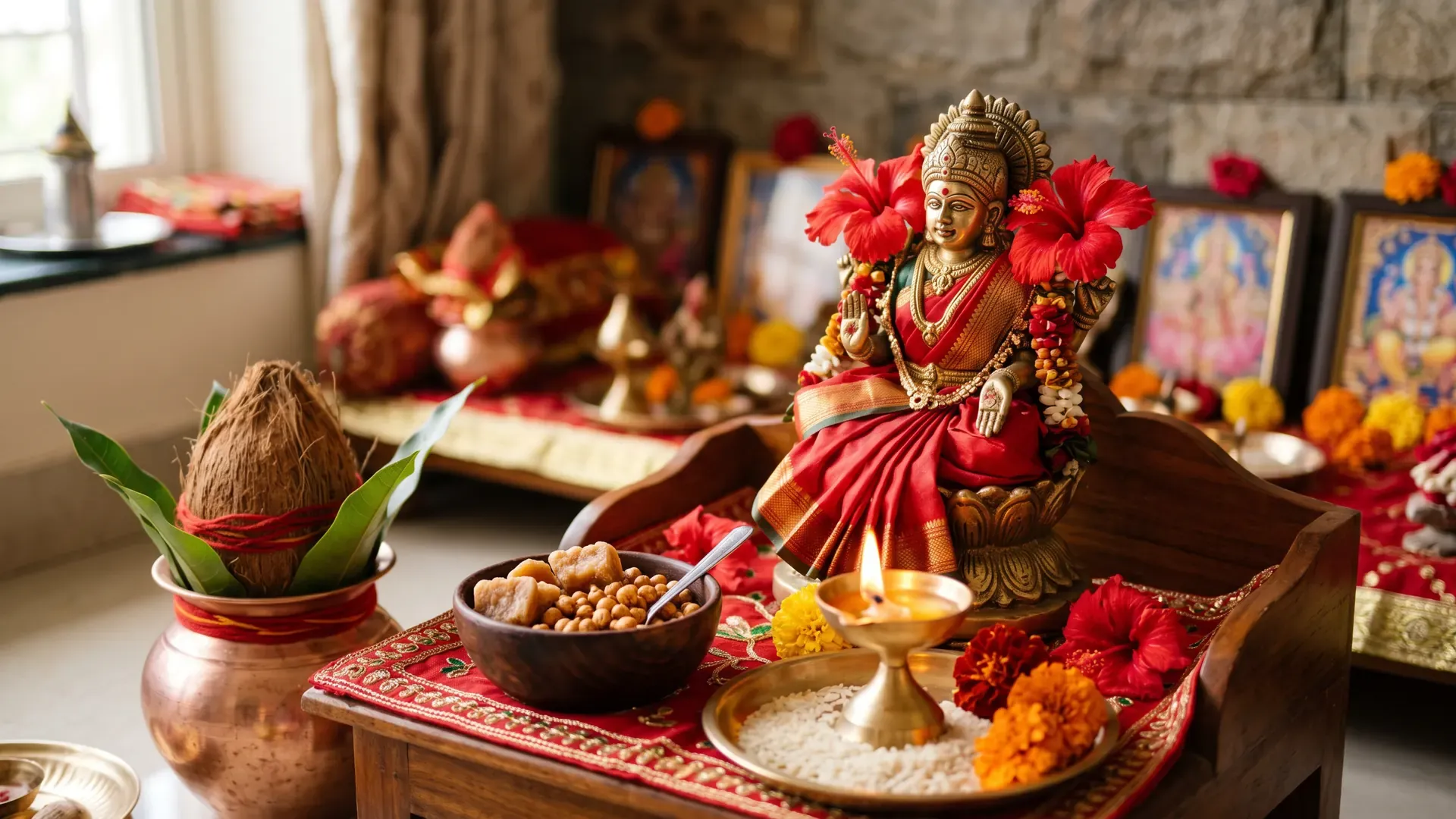
By tradition, the youngest son of an old woman, whom his mother fed on his brothers’ leftovers, goes abroad and grows rich, while his wife, ill-treated at home, keeps the Santoshi Mata vrat on Fridays with jaggery and chana. By the Mother’s grace her husband comes back; at the first udyapan her sister-in-law’s children eat sour food and trouble follows, and when she does the udyapan again with due care, she is blessed with a son.
Hindi in Roman letters: a reading aid, made by a program. The Devanagari text is the original.
The other language could not be loaded. Keep reading here, or try again.
Each morning the tithi, Rahu Kaal and coming festivals, in one short WhatsApp message.Follow the channel
The Santoshi Mata vrat is kept on Fridays, and on the day of the vrat this katha is told or heard after the puja. In the katha, the woman who teaches the vrat says to keep it every Friday until the wish is fulfilled and then do the udyapan; today many people keep it for sixteen Fridays. This is custom.
This katha is not in any Purana; it is a folk katha handed down among the people, and its characters have no names. According to scholars (Philip Lutgendorf, as cited by English Wikipedia), the worship of Santoshi Mata spread in North India in the 20th century through the Friday vrat, small pamphlets of this katha and pictures, and became popular across the country after the 1975 film ‘Jai Santoshi Maa’, which was based on the vrat katha pamphlet. Regarding her as Ganesh’s daughter is folk tradition; the vrat katha does not make this link.
We checked the katha below event by event against Drik Panchang and a printed vrat booklet from Mumbai, and told it in our own words. The differences found in other books and websites are listed under "Other tellings" below.
How the vrat and katha are kept
- Day: Friday. By the katha, every Friday until the wish is fulfilled, without breaking the run; in common practice, sixteen Fridays. The sankalp on Drik Panchang also mentions 7, 11 or 21 Fridays.
- Puja: after bathing, set up a picture or murti of the Mother, with a kalash of water before it and a bowl of jaggery and chana on the kalash; a lamp, flowers, incense. While the katha is told and heard, jaggery and roasted chana are held in the hand and afterwards given to a cow. This is the custom given by Drik Panchang and the vrat booklet.
- In the katha, the woman who teaches the vrat says to take jaggery and chana in a measure and a quarter ("savaya"), as one can afford, and that if no one is there to listen, one may tell the katha before a lit ghee lamp or a pot of water.
- After the katha comes the aarti; then the kalash water is sprinkled in the house and the rest poured on the tulsi, and the jaggery and chana from the bowl are shared as prasad.
- Food: the katha’s rule is that no sour food is eaten in the house that day; Drik Panchang lists lemon, tamarind, curd, tomato, dried mango powder and every other sour thing. Eating only one meal on the vrat is custom. This is the tradition of the vrat.
- Udyapan: by the katha, khaja made from two and a half ser of flour, the same measure of kheer and a chana sag are cooked and eight boys are fed, first the boys of the family (of the husband’s brothers and kin), or else of relatives and neighbours. No one is given sour food that day. By Drik Panchang, the dakshina is a fruit or a sweet rather than money.
Hindi in Roman letters: a reading aid, made by a program. The Devanagari text is the original.
The other language could not be loaded. Keep reading here, or try again.
The old woman’s seven sons, and the youngest goes abroad
By tradition, as checked against Drik Panchang and the vrat booklet
In a village there lived an old woman who had seven sons. Six of them earned a living, but the youngest did no work. The old woman cooked for the six, fed them lovingly, and whatever was left on their plates she gave to the youngest. He was a simple soul and never noticed the difference.
One day he said to his wife, "See how much my mother loves me." His wife replied, "Of course she does: she feeds you what everyone else leaves on their plates." He did not believe it, and said he would not accept it until he saw it with his own eyes.
Some days later a festival came. Many dishes and churma laddus were made at home. To learn the truth, he lay down in the kitchen under a thin cloth and watched from beneath it. His mother laid out fine seats for the six sons and pressed them to eat. When they had risen, she gathered the broken bits of laddu from their plates, pressed them into one laddu, and called the youngest: "Get up, son; your brothers have eaten, now you eat."
Seeing this, his heart broke. He said, "I will not eat; I am going abroad." His mother said angrily, "If you mean to go tomorrow, go today." He left the house at once. On his way out he remembered his wife, who was making dung cakes in the cowshed. He told her he was going abroad for a while and that she should live in contentment and keep to her dharma; she told him to go without worry, that God would be with him, and only not to forget her.
Her husband said, "All I have is this ring; keep it as a token, and give me some token of yours." She had nothing; her hands were covered in cow dung, so she pressed that hand on his back. Carrying its mark, he set off.
Walking on, he reached a distant land and asked for work at a sahukar’s shop. The sahukar said, "You will be paid as your work deserves." He worked with all his heart from morning till night, and within days was handling the dealings, the accounts and the sales. The sahukar’s seven or eight other servants were amazed at his skill. Within three months the sahukar made him a partner in half the profit. In time he became a well-known merchant, and his master handed the whole business over to him and went away.
The suffering wife and the Santoshi Mata vrat
Meanwhile at home, her parents-in-law treated the wife very harshly. After making her do all the housework, they sent her to the forest for firewood, and for food gave her bread made of the husk of the flour and water in a broken coconut shell. One day, on her way to fetch wood, she saw many women keeping the Santoshi Mata vrat and listening to its katha. She asked, "Sisters, whose vrat is this, what fruit does it bring, and how is it kept?"
One of the women told her that it was the vrat of Santoshi Mata, which takes away want from the home and fulfils the wish of the heart. Then she explained the rite: take jaggery and chana in a measure and a quarter, as you can afford; keep the fast every Friday and hear the katha, without breaking the run; if no one is there to listen, tell the katha before a lit ghee lamp or a pot of water; keep the rule until your wish is fulfilled, and do the udyapan only then, not before. At the udyapan, cook khaja from two and a half ser of flour, the same measure of kheer and a chana sag, and feed eight boys, first the boys of the family, then those of relatives and neighbours; give dakshina as you can; and let no one in the house eat anything sour that day.
Hearing this, the wife sold her bundle of wood on the way and bought jaggery and chana with the money. Further on she saw a temple of Santoshi Mata. She fell at the Mother’s feet and wept: "Mother, I know nothing; I do not even know the rules of the vrat. I am in great sorrow; take my sorrow away, I have come to your shelter." The Mother felt compassion for her.
One Friday passed; on the second Friday a letter came from her husband, and on the third the money he had sent arrived too. Seeing this, her elder sister-in-law grew jealous, and her boys began to taunt: now aunt gets letters and money, now aunt will be made much of. The wife would answer simply, "If a letter comes and money comes, it is good for all of us."
Then, with tears in her eyes, she went to the temple and said to the Mother, "Mother, when did I ask you for money? I do not want wealth; I want to see my husband and serve him." The Mother was pleased and said, "Go, daughter, your husband will come." Hearing this, she went home happily and set to her work.
The Mother’s dream and the husband’s return
The Mother thought, "I have told this innocent daughter that her husband will come, but he does not remember her even in his dreams. I shall have to remind him myself." She appeared to the son in a dream in that far land and asked, "Are you asleep or awake?" He said, "Neither asleep nor awake; tell me your command." The Mother asked whether he had a home and family. He said, "Parents, brothers, a wife: I have them all." The Mother said, "Your wife is suffering greatly at home; your parents ill-treat her. Go and take care of her."
He said, "Mother, I know this, but how can I go? This is a foreign land, and all my dealings lie unsettled." The Mother said, "In the morning, bathe, take the name of Santoshi Mata, light a ghee lamp, bow full-length and go and sit in the shop. By evening all the dealings will be settled, the stored goods sold, and wealth heaped up." In the morning he told of the dream and people laughed, but an old man said, "What do you lose by doing as you were told?"
He did just that. Before long his debtors paid what they owed, his creditors were settled, and buyers paid cash and took the goods from the store. By evening the wealth was heaped up. Remembering the Mother in his heart, he bought clothes and jewellery for home and set out for his village.
Meanwhile, every day on her way back from the forest with wood, the wife rested a while at the Mother’s temple. One day she saw dust rising in the distance and asked the Mother what it was. The Mother said, "Daughter, your husband is coming. Make three bundles of wood: put one on the river bank, one at my temple, and carry one on your head. Seeing the dry wood, your husband will stop here, eat and drink, and then go home. Then you carry your bundle home, drop it in the courtyard and call out three times: 'Mother-in-law, take the bundle of wood, give me husk bread and water in a coconut shell; who is the guest today?'"
The wife did just that. Seeing the dry wood, the traveller, her husband, stopped there, cooked and ate, rested a little and reached the village. Just then the wife came with the bundle on her head, dropped it in the courtyard and called out the same words three times. To hide what she had done, the mother-in-law came out and said, "Daughter-in-law, why do you talk like this? It is your husband who has come. Come, eat sweet rice, put on clothes and jewellery."
Hearing her voice, the husband came out, and seeing his ring on her hand he grew uneasy and asked his mother, "Who is this?" His mother said, "This is your wife. Ever since you left she wanders about the village, does no housework and only comes in to eat." The son said, "Mother, I have seen how she lives and how you behave. Give me the keys of the other house; I will live there." His mother gave him the keys. He set up his things on the third floor of the other house and lived there with his wife, and the two lived in comfort.
The slip with sour food at the udyapan, and the second udyapan
One Friday the wife said to her husband, "I want to do the udyapan of the Santoshi Mata vrat." He gladly agreed. She began the preparations and went to invite her elder sister-in-law’s boys to the meal. The sister-in-law quietly taught her children to ask for something sour at the meal, so that the udyapan would not be complete.
The boys ate their fill of kheer and then said, "Give us something sour; we do not like kheer." The wife said, "No one will be given anything sour; this is Santoshi Mata’s prasad." Then the boys asked for money as dakshina. The innocent wife gave it without a thought, and the boys bought tamarind with the money and ate it.
The katha says the Mother was displeased at this. At that very time the king’s men came and took her husband away. Her husband’s elder brother and his wife spoke bitterly, saying he must have gathered his wealth by robbery and now it would all come out. In sorrow the wife went weeping to the temple: "Mother, after giving me happiness, why this sorrow now?" The Mother said, "Daughter, at the udyapan my vrat was broken by you." The wife said, "Mother, I gave the boys money by mistake. Forgive me; I will do your udyapan again." The Mother said, "Do not make the mistake again. Go, your husband will meet you on the way."
On her way home she met her husband coming towards her. When she asked, he said, "The king had asked for tax on all the wealth I earned; I had gone to pay it." The two came home happy.
Some days later another Friday came, and the wife did the udyapan again. This time too her sister-in-law taught her boys to ask for something sour at the very start. The boys asked for it before they ate, and the wife said plainly, "No one will get anything sour; eat if you wish to." They went away. Then she invited brahmin boys, fed them with devotion, and as dakshina gave each one a fruit instead of money. Santoshi Mata was pleased.
The birth of a son, and the Mother comes to the house
By the Mother’s grace, in the ninth month the wife bore a son as lovely as the moon. She began going to the Mother’s temple every day with her son. The Mother thought, "She comes to me every day; today I will go to her house." By the katha, the Mother came to the house in a frightening form: her face smeared with jaggery and chana, her lips like a trunk, and flies buzzing around her.
At the sight of her, the mother-in-law cried out in fear that some frightening woman was coming and should be driven away; her sons, afraid, began shutting the windows. But the young wife looked out of the window and called out with joy, "Today my Mother has come to my house!" and set down the baby she was nursing. The mother-in-law was angry that she was in such a hurry that she put the child aside.
At that moment, by the Mother’s play, the mother-in-law saw children everywhere in the house. The wife said, "Mother-in-law, this is the very Santoshi Mata whose vrat I keep every Friday," and she opened all the doors of the house. Then the whole family fell at the Mother’s feet and said, "Mother, we did not know; we did not know the rite of your vrat, and we broke it. Forgive us." The Mother was pleased and forgave them all.
By Drik Panchang’s telling, from then on the whole family kept the Friday vrat faithfully and all lived happily. The vrat booklet ends the katha with the wish that, as the Mother fulfilled the wife’s wish, so may she fulfil the wishes of all who read or hear the katha.
Other tellings
- In Webdunia’s short telling the old woman has only one son, the wife’s dung-covered handprint falls on her husband’s shoes, and it is a jealous neighbour woman, not the sister-in-law, who teaches the children to ask for sour food.
- Time spent abroad: twelve years in Drik Panchang; "some years" in the vrat booklet.
- The amount for jaggery and chana: a quarter over one anna, five annas or one rupee in the vrat booklet; a quarter over one, five or eleven rupees in Drik Panchang. In both the sense is the same: as one can afford, in a measure and a quarter.
- How many Fridays: "until the wish is fulfilled" in the katha; Drik Panchang’s udyapan, the booklet’s rite page and Webdunia say sixteen Fridays; Drik Panchang’s sankalp also mentions 7, 11 or 21.
- The husband taken away: in Drik Panchang, the vrat booklet and Webdunia he pays the king’s tax and returns the same day; in another printed book the king summons him to court and rewards his skill with a ring; in Wikipedia’s summary he is released from prison.
- The long telling in that other book gives the characters names (the wife Ganga, the husband Gordhan, the village Shrirangpur, the foreign town Madhavpur), and at the end the Mother comes as an old woman of eighty; the wife lets her baby down from an upper window and the old woman catches him. In Drik Panchang’s and the vrat booklet’s katha no one is named.
- The udyapan dakshina: after the first slip, the wife in the katha gives fruit instead of money; Drik Panchang’s rite page also says a fruit or a sweet, and the other book says clothes.
- The story of the 1975 film ‘Jai Santoshi Maa’ is different (the devotee Satyavati, Narada, a test by three goddesses), and it shows the Mother as Ganesh’s daughter. None of this is in the vrat katha.
After the katha
After the katha the Santoshi Mata aarti, "Jai Santoshi Mata", is sung; then the kalash water is sprinkled in the house and the jaggery-and-chana prasad is shared.
Frequently asked questions
For how many Fridays is the Santoshi Mata vrat kept?
In the katha, the woman who teaches the vrat says to keep it every Friday, without a break, until the wish is fulfilled, and then do the udyapan. In common practice it is kept for sixteen Fridays (Drik Panchang, Webdunia); some take a sankalp of 7, 11 or 21 Fridays. This is custom; follow the practice of your own family.
How is the udyapan of the Santoshi Mata vrat done?
By the katha, on the day of the udyapan khaja from two and a half ser of flour, the same measure of kheer and a chana sag are cooked, and after the puja and the katha eight boys are fed: first those of the family, or else of relatives and neighbours. That day no one in the house eats anything sour, and nothing sour is given to anyone. By Drik Panchang the dakshina is a fruit or a sweet rather than money, as the wife does the second time in the katha.
Why is sour food avoided in the Santoshi Mata vrat?
It is the rule of the vrat as the katha gives it: the woman who teaches the vrat says no sour food should be eaten in the house on the day of the udyapan, and in the katha it is the children eating tamarind at the first udyapan that is taken to have broken the vrat. The katha gives no other reason. Avoiding sour things such as lemon, tamarind, curd and dried mango powder on every Friday of the vrat is the custom of this vrat.
Is the Santoshi Mata katha in the Puranas?
No. It is a folk katha, and the story of Santoshi Mata is not found in the Puranas. According to scholars, her worship spread in North India in the 20th century through the Friday vrat, small vrat katha pamphlets and pictures, and became popular across the country after the 1975 film ‘Jai Santoshi Maa’. Regarding her as Ganesh’s daughter is folk tradition popularised by that film; the vrat katha does not make this link.
How do I get the Santoshi Mata vrat katha as a PDF?
Press the "Print / PDF" button on this page; choosing "Save as PDF" in the print dialog of a phone or computer saves the whole katha as a PDF, without the rest of the page.
Sources
- Drik Panchang, "Santoshi Mata Shukravar Vrat Katha" (drikpanchang.com/vrat-katha/weekdays/shukravara/santoshi-mata-shukravara-vrat-katha.html), read 16 October 2026
- Drik Panchang, "Santoshi Mata Shukravar Vrat" (puja and udyapan rite; drikpanchang.com/vrats/weekdays/shukravara/santoshi-mata-shukravara-vrat.html), read 16 October 2026
- "Saptavar Vrat, Vidhi, Katha, Aarti", Manav Vikas Foundation, Mumbai (Acharya Akhilesh Dwivedi), 2021: "Shukravar Vrat Katha (Santoshi Mata Vrat Katha)" and its rite: archive.org/details/m_20240804_20240804_1514, read 16 October 2026
- "Vrat Katha" (a compilation), "Devi Santoshi Maa Vrat Katha", pp. 71–91: archive.org/details/20240806_20240806_0450, read 16 October 2026 (other tellings)
- Bhakti Bharat, "Shukravar Santoshi Mata Vrat Katha" (bhaktibharat.com/katha/shukravar-santoshi-mata-vrat-katha), read 16 October 2026
- Webdunia, "Santoshi Mata vrat katha" (hindi.webdunia.com/religious-stories/santoshi-mata-vrat-katha-121012100107_1.html) and "Shukravar vrat vidhi" (hindi.webdunia.com/religious-article/shukrvaar-vrat-vidhi-120012300063_1.html), read 16 October 2026
- History of her worship: English Wikipedia, "Santoshi Mata" (en.wikipedia.org/wiki/Santoshi_Mata; based on Philip Lutgendorf, Manushi no. 131, 2002), read 16 October 2026
Something wrong? Report a mistake
