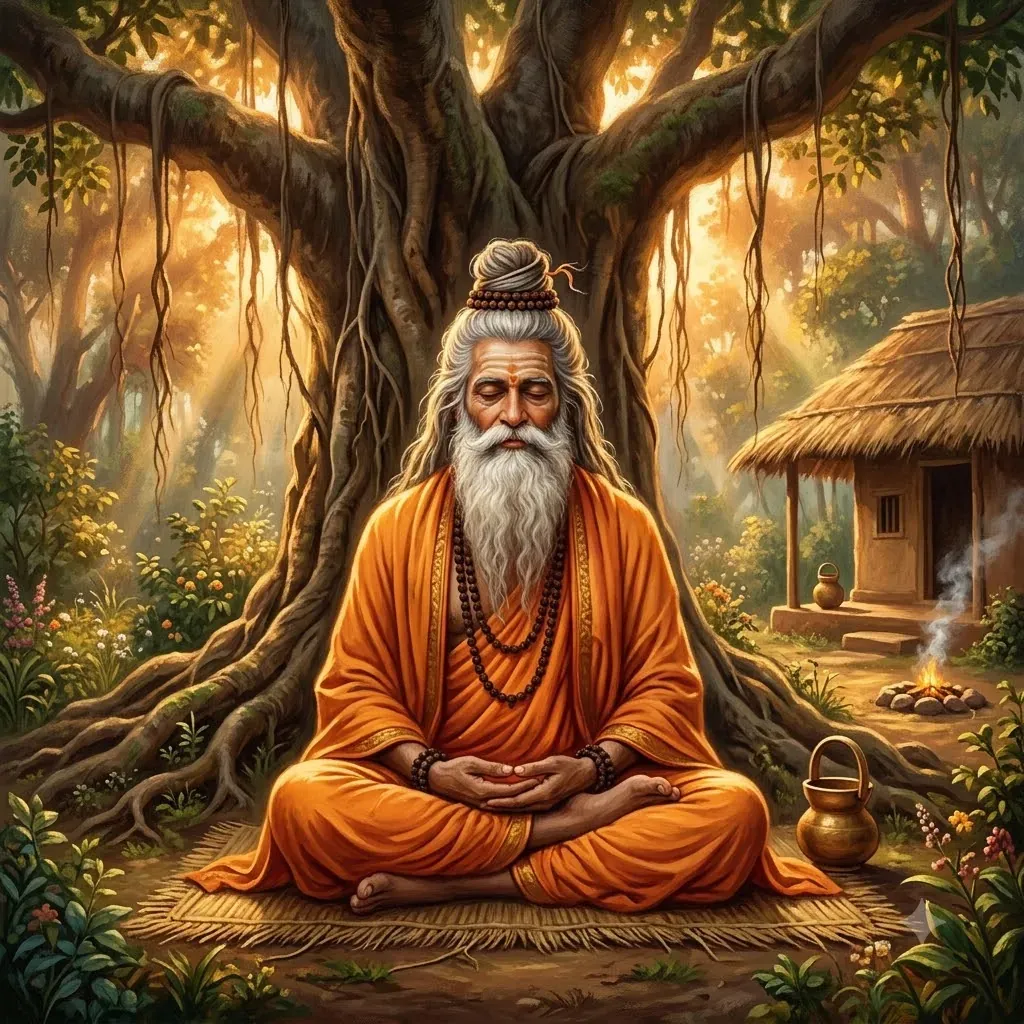
Dattatreya is the son of the sage Atri and Anasuya. By the Bhagavata Purana (4.1), Brahma, Vishnu and Shiva, pleased with Atri’s tapas, granted a boon, and from their portions Soma, Dattatreya and Durvasa were born; Dattatreya is Vishnu’s portion. A widely told folk story also has the three gods come as ascetics to test Anasuya, who by the power of her chastity turned them into infants, after which the three gods were born as her sons.
Each morning the tithi, Rahu Kaal and coming festivals, in one short WhatsApp message.Follow the channel
Dattatreya Jayanti (Datta Jayanti) is kept on the full moon of Margashirsha, above all in Maharashtra, Karnataka, Andhra Pradesh and Gujarat. By tradition Dattatreya was born at pradosh, in the evening, so the puja is done in the evening. The Puranas whose stories are told below give no date; placing his birth on Margashirsha Purnima is tradition. The Purnima times for your city are on the Dattatreya Jayanti page.
On this day the story of Dattatreya’s birth is told, in two forms. The first is the Bhagavata Purana’s (4.1.15-33), which we read and checked in the Sanskrit; the same three sons of Atri and Anasuya are in the Vishnu Purana (1.10) and the Markandeya Purana (chapter 17). The second, the story of Anasuya’s test, is the one told most often; it is not in these Puranas, and it is told in the fourth chapter of the Gurucharitra, a text of the Datta tradition.
How the vrat and katha are kept
- A bath in the morning, a fast through the day, and puja of Dattatreya’s image or picture with flowers, incense and a lamp; this is custom (Bhakti Bharat, Maharashtra Tourism, Wikipedia).
- On the Purnima the puja is done at pradosh, since tradition places the birth in the evening (Aaj Tak, Webdunia).
- The Avadhuta Gita and the Jivanmukta Gita are read on this day, which tradition holds to be Dattatreya’s own words (Swami Sivananda, Wikipedia, Aaj Tak).
- In Maharashtra and north Karnataka the Gurucharitra is read. Datta shrines such as Narsobawadi, Audumbar, Mahur, Karanja and Ganagapur hold large festivals (Incredible India, Wikipedia).
Atri’s tapas and the boon of the three gods: the Bhagavata story
As told in the Bhagavata Purana 4.1.15-33 (Sanskrit text and English translation, vedabase.io); there the sage Maitreya tells it to Vidura. The meaning of the name is from Bhagavata 2.7.4.
Vidura asked the sage Maitreya how the three gods who create, sustain and dissolve the world came to be born as sons in the house of the sage Atri. Maitreya told this story.
Brahma told his son Atri to increase creation. So Atri went with his wife Anasuya to the Riksha mountain to perform tapas. There was a forest full of palasha and ashoka flowers, and the river Nirvindhya flowed murmuring by.
There Atri mastered his mind through pranayama and stood on one leg for a hundred years, living on air alone. In his heart he kept asking that the Lord of the world, in whom he had taken refuge, give him offspring like Himself.
A fire kindled by his pranayama rose from his head and began to scorch the three worlds. Seeing it, Brahma, Vishnu and Shiva all came to his hermitage, while apsaras, gandharvas, siddhas, vidyadharas and nagas sang their glory.
When Atri saw all three together, he came forward on his one leg and lay flat on the ground like a staff in reverence. The light of the three gods, seated on swan, Garuda and bull and each bearing his own emblems, was so bright that his eyes closed. Then, with folded hands, he praised them.
Atri asked: I meditated on one Lord alone for a son; how is it that all three of you have come? Please tell me, for I am greatly amazed.
The three gods smiled and said: Your resolve is true; as you wished, so it will be. The one you were meditating on is the three of us. From our portions you will have sons famous in the world, who will spread your fame. Having given this boon, the three gods departed as husband and wife looked on.
In time Anasuya had three sons: Soma (the Moon) from Brahma’s portion, Datta the great yogi from Vishnu’s, and the sage Durvasa from Shankara’s. The Vishnu Purana (1.10) names the same three sons of Anasuya and calls Dattatreya an ascetic.
The meaning of the name Datta is in the Bhagavata (2.7.4): pleased with Atri, who longed for offspring, the Lord said, “I have given myself to you” (datto mayāham), and so he was called Datta. As the son of Atri he is Atreya, and the two together make Dattatreya.
The Bhagavata (1.3.11) counts Dattatreya as the Lord’s sixth avatar: at Anasuya’s prayer he became Atri’s son, and he taught the knowledge of the self to Alarka, Prahlada and others.
Anasuya’s test: the popular story
The popular story, as Bhakti Bharat, Webdunia, Amar Ujala and Swami Sivananda (Divine Life Society) tell it. The fourth chapter of the Gurucharitra tells this story (by Vasudevananda Saraswati’s chapter-summary verse); we did not read that chapter ourselves. It is not in the Bhagavata, Vishnu or Markandeya Puranas.
Anasuya, wife of the sage Atri, was famed in the three worlds as a devoted wife. Once Narada praised her highly before Saraswati, Lakshmi and Parvati, and said that in devotion to her husband no woman in the three worlds was her equal.
Hearing this, the three goddesses urged their husbands, Brahma, Vishnu and Shiva, to go and test Anasuya’s chastity. At their insistence the three gods agreed.
The three gods took the guise of sadhus and came to the sage Atri’s hermitage. Atri was away at the time. Anasuya bowed to the guests and, welcoming them, offered to serve them food.
But the sadhus set a condition: they would accept alms only if Anasuya served them food without clothes on her body.
Anasuya was caught between two duties: to turn a guest away was against dharma, and this condition was against her vow to her husband. She meditated on her husband, and in that meditation she knew that these sadhus were Brahma, Vishnu and Mahesh themselves.
Then, by the power of her devotion to her husband, Anasuya sprinkled water on them, and the three gods became infants of six months. Now they were no longer guests but her children; like a mother she gave them milk, fed them and rocked them in a cradle.
Meanwhile, when their husbands did not return for a long time, the three goddesses grew anxious. Narada told them that their husbands were playing in a cradle at Atri’s hermitage, turned into infants.
The three goddesses came to the hermitage, begged Anasuya’s pardon and asked her to give back their husbands. Anasuya’s heart softened, and by sprinkling water she restored the three gods to their own forms.
Pleased, the three gods granted Anasuya the boon that they would be born as her sons. In time, from Brahma’s portion the Moon, from Vishnu’s Dattatreya and from Shiva’s Durvasa were born to Anasuya. The day of this birth is kept as Dattatreya Jayanti.
Other tellings
- In the Markandeya Purana (chapters 16-17) the boon comes for another reason. The sage Mandavya cursed a brahmin to die at sunrise; his devoted wife declared that the sun would not rise, and for ten nights there was no day. At the gods’ request Anasuya persuaded the woman, made the sun rise again and brought her dead husband back to life. When the gods offered a boon, Anasuya asked that Brahma, Vishnu and Shiva become her sons.
- The condition differs in the popular telling: in most, serving food unclothed (Bhakti Bharat, Amar Ujala, Swami Sivananda), but in Webdunia’s, seating them on her lap and feeding them.
- How the gods became infants: by Anasuya’s word in Bhakti Bharat and Webdunia; by water from Atri’s kamandalu in Amar Ujala; by the water that had washed her husband’s feet in Swami Sivananda’s telling.
- One son or three: in the Puranas and in Webdunia there are three sons (Soma, Dattatreya, Durvasa). In Swami Sivananda’s telling, when Atri returned and embraced the three infants they became one child with three heads and six arms; Amar Ujala too has the three gods born as Dattatreya.
- Who asked for the boon: in Bhakti Bharat the three gods give it of their own accord, in Webdunia Anasuya asks for it, and in Amar Ujala the gods ask to be born of her.
- Swami Sivananda’s telling opens with Narada asking the three goddesses to roast a grain of iron the size of a gram; they cannot, and Anasuya roasts it with the water that washed her husband’s feet. English Wikipedia has this episode too.
- According to Wilson’s note, the Vayu Purana gives a quite different list of Atri’s sons; we did not check that text.
After the katha
After the katha, Dattatreya’s puja and aarti are done at pradosh, and the name “Shri Gurudev Datta” is chanted (Bhakti Bharat). The Purnima times for your city are on the Dattatreya Jayanti page.
Frequently asked questions
Who were Dattatreya’s parents?
The sage Atri and his wife Anasuya. By the Bhagavata (4.1.15, 33), the Vishnu Purana (1.10) and the Markandeya Purana (17) alike, Anasuya had three sons: Soma (the Moon) from Brahma’s portion, Dattatreya from Vishnu’s and Durvasa from Shiva’s.
What does the name Dattatreya mean?
By the Bhagavata (2.7.4), the Lord said to Atri, “I have given myself to you” (datto mayāham), so he was called “Datta”; as Atri’s son he is “Atreya”. The two together make Dattatreya.
Is the story of Anasuya’s test in the Puranas?
It is not in the Bhagavata, the Vishnu Purana or the Markandeya Purana, which we read. In the Bhagavata the three gods come pleased with Atri’s tapas, and in the Markandeya Purana Anasuya wins the boon for making the sun rise again. The story of the test is widely told and is found in the Gurucharitra (chapter 4), a text of the Datta tradition.
Why is Datta Jayanti kept on Margashirsha Purnima?
By tradition Dattatreya was born on Margashirsha Purnima at pradosh, in the evening, so the puja is done in the evening. The Puranas we read give no date for the birth; the date comes from tradition.
Who were Dattatreya’s 24 gurus?
In the Bhagavata (11.7.33-35) an avadhuta brahmana tells King Yadu of his 24 gurus: the earth, air, sky, water, fire, moon, sun, pigeon, python, sea, moth, honeybee, elephant, honey-gatherer, deer, fish, the courtesan Pingala, the kurara bird, a child, a young girl, an arrow-maker, a serpent, a spider and a wasp. The Bhagavata does not name the avadhuta; the commentator Shridhara Swami and tradition hold him to be Dattatreya.
Sources
- Bhagavata Purana 1.3.11, 2.7.4, 4.1.15-33, 11.7.24-35, 11.9.31-33 (Sanskrit text and A. C. Bhaktivedanta Swami’s English translation, vedabase.io)
- Vishnu Purana 1.10 (H. H. Wilson’s translation and note, wisdomlib.org)
- Markandeya Purana, chapters 16-19 (F. E. Pargiter’s English translation, wisdomlib.org)
- Vasudevananda Saraswati: Shri Gurucharitra Adhyaya Saramsha Shlokas, verse 4 (sanskritdocuments.org)
- Drik Panchang: Dattatreya Jayanti 2026, New Delhi
- Bhakti Bharat: the story of Sati Mata Anasuya; Datta Jayanti
- Webdunia (2014, 2024), Amar Ujala (2019, 2023) and Aaj Tak (2022): Dattatreya Jayanti
- Swami Sivananda, Divine Life Society: Dattatreya Jayanthi; Dattatreya
- Incredible India and Maharashtra Tourism: Shree Datta Jayanti; Gurumandir, Karanja
- English Wikipedia: Datta Jayanti, Dattatreya, Anasuya, Shri Guru Charitra
Something wrong? Report a mistake