Advertisement
Download the Saraswati Aarti PDF
Advertisement
Meaning, sources and more prayers: sanatanbodh.in/en/prayers/saraswati-aarti/
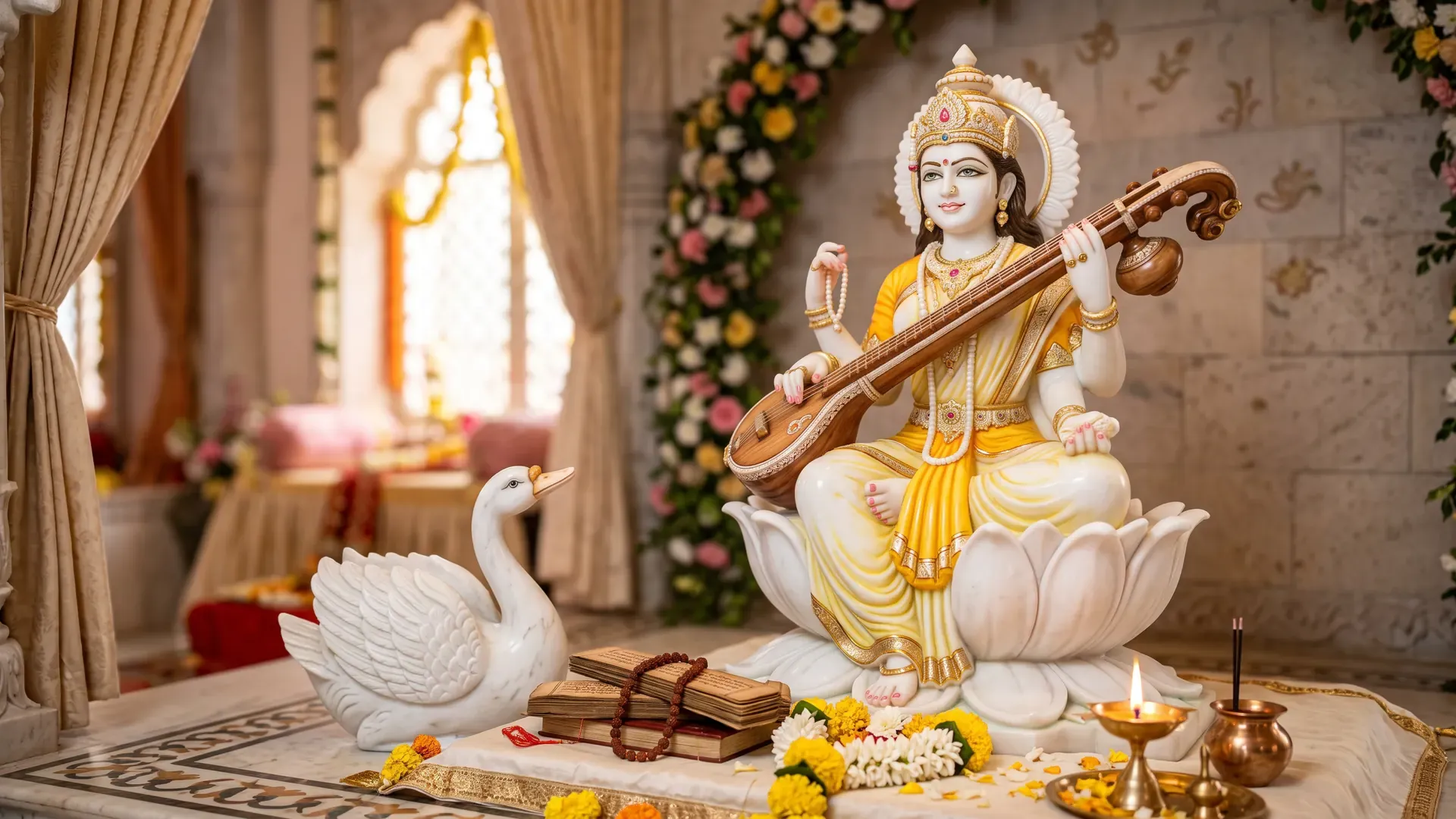
“Jai Saraswati Mata” is the most widely sung aarti of Saraswati, Goddess of learning, speech and music. It describes her swan mount, her veena, rosary and crown, and prays to her to drive away the darkness of ignorance. It is sung on Vasant Panchami, at the Saraswati Puja of Sharad Navratri, when a child begins learning, and in schools. Its author is not known.
The common text is given here. In many books and recordings the aarti begins ‘Om jai Saraswati Mata, jai jai Saraswati Mata’, which is why it is widely known as ‘Om Jai Saraswati Mata’. Some texts read verse 3 as ‘daayein kar mein mala’. When sung, the first line (the refrain) is repeated after every verse. No verse carries a poet’s name.
After the aarti, most homes recite: कर्पूरगौरं करुणावतारं संसारसारं भुजगेन्द्रहारम्।
Each morning the tithi, Rahu Kaal and coming festivals, in one short WhatsApp message.Follow the channel
Frequently asked questions
When is this Saraswati aarti sung?
On Vasant Panchami, on the days of Saraswati Avahan and Saraswati Puja during Sharad Navratri, at the Vidyarambha ceremony when a child begins learning, and at school assemblies.
What does “Paithi Manthara dasi, Ravan sanhar kiya” mean?
According to the Ramcharitmanas (Ayodhya Kand, dohas 11 and 12), before Ram’s coronation the gods pleaded with Sharada (Saraswati), and she turned the mind of Manthara, Kaikeyi’s maid. This led to Ram’s exile, which in time led to the slaying of Ravana. The aarti recalls this episode.
Who wrote this aarti?
The author is not known. No verse carries a poet’s name.
How is it different from “Ya Kundendu Tushara Hara Dhavala”?
“Ya Kundendu Tushara Hara Dhavala” is a Sanskrit verse of salutation to Saraswati, usually recited at the start of worship or study. “Jai Saraswati Mata” is a Hindi aarti, sung while waving the lamp at the end of worship. “Om Jai Veene Wali” is another, separate aarti of Saraswati.
How many verses does this aarti have?
The common text has seven verses, including the opening refrain.
Sources
- Traditional aarti text
- The Manthara episode: Ramcharitmanas, Ayodhya Kand, dohas 11 and 12
Something wrong? Report a mistake
Text checked against: drikpanchang.com, bhaktibharat.com, hindi.webdunia.com, sanskritdocuments.org