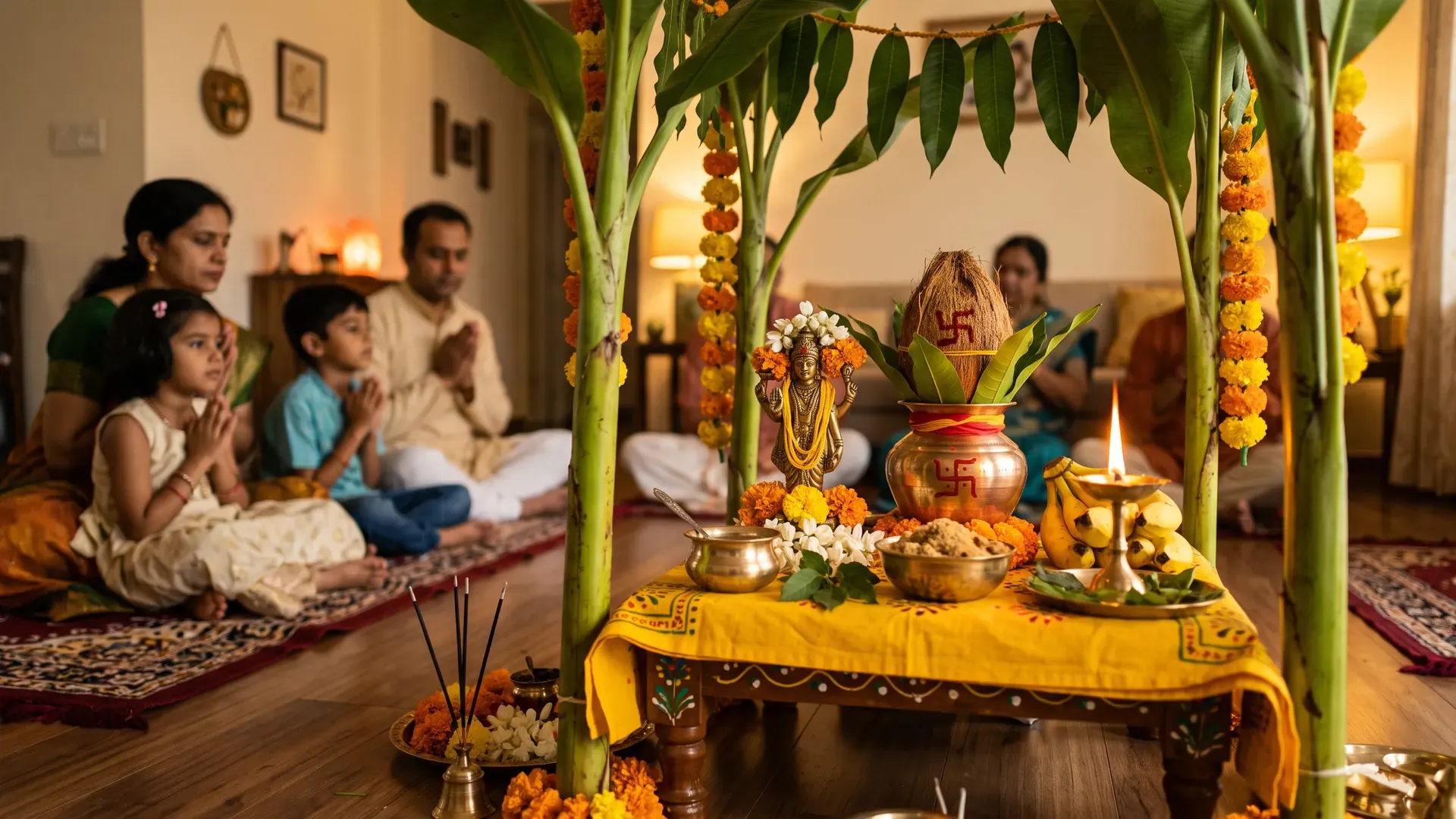
You sit on a throne studded with jewels, and your form is wondrous. Narada performs your aarti (nirajan) as the bells ring.
Verse 3
प्रगट भये कलि कारण, द्विज को दर्श दियो।
बूढ़ो ब्राह्मण बनकर, कंचन महल कियो॥
Pragat bhaye kali karan, dvij ko darsha diyo.
Boodho brahman bankar, kanchan mahal kiyo ||
You appeared for the sake of the people of the Kali age and gave your darshan to a (poor) brahmin. Taking the form of an old brahmin, you turned his home into a golden palace. This is the story of the poor brahmin in the Satyanarayan katha.
Verse 4
दुर्बल भील कठारो, इन पर कृपा करी।
चन्द्रचूड़ एक राजा, जिनकी विपत्ति हरी॥
Durbal bhil katharo, in par kripa kari.
Chandrachood ek raja, jinki vipatti hari ||
You showed mercy to a poor Bhil woodcutter (katharo), and you ended the troubles of a king named Chandrachud.
Verse 5
वैश्य मनोरथ पायो, श्रद्धा तज दीनी।
सो फल भोग्यो प्रभुजी, फिर स्तुति कीनी॥
Vaishya manorath payo, shraddha taj dini.
So phal bhogyo prabhuji, phir stuti kini ||
A merchant (vaishya) had his wish fulfilled, but then gave up his faith and forgot his promise of the vrat. He suffered the result, and then sang the Lord’s praise again. This is the story of the merchant Sadhu in the katha.
Verse 6
भाव भक्ति के कारण, छिन-छिन रूप धर्यो।
श्रद्धा धारण कीनी, तिनको काज सर्यो॥
Bhav bhakti ke karan, chhin-chhin roop dharyo.
Shraddha dharan kini, tinko kaj saryo ||
Moved by your devotees’ feeling and devotion, you took form again and again. Those who kept faith saw their work fulfilled.
Verse 7
ग्वाल बाल संग राजा, वन में भक्ति करी।
मनवांछित फल दीनो, दीनदयाल हरी॥
Gval bal sang raja, van mein bhakti kari.
Manvanchhit phal dino, dinadyal hari ||
Together with the cowherd boys, the king worshipped in the forest, and Hari, kind to the humble, granted him his heart’s wish. This is the story of King Tungadhwaj in the katha, who had at first refused the prasad offered by the cowherds.
Verse 8
चढ़त प्रसाद सवायो, कदली फल मेवा।
धूप दीप तुलसी से, राजी सत्यदेवा॥
“Jai Lakshmi Ramana” is the aarti of Lord Satyanarayan (Vishnu), sung after the Satyanarayan vrat katha. It recalls the figures of the katha: the poor brahmin, the woodcutter, the merchant and the king who worshipped with the cowherds. The Satyanarayan puja held on Purnima, Sharad Purnima, Kartik Purnima, at a griha pravesh and on other auspicious occasions ends with this aarti.
The wording differs slightly between versions: ‘Shri jai Lakshmi Ramana’ in place of ‘Swami jai Lakshmi Ramana’ in the first line, an opening ‘Om’ in many places, ‘jin par kripa kari’ and ‘tinki vipatti hari’ in verse 4, and ‘savaya’ in place of ‘savayo’ in verse 8. Some versions replace the last line ‘kahat Shivanand Swami, manvanchhit phal pave’ with ‘Riddhi-siddhi sukh-sampatti, sahaj roop pave’. The name ‘Shivanand Swami’ also appears in “Om Jai Shiv Omkara” and “Jai Ambe Gauri”, but there is no firm information about the author. When sung, the first verse (the refrain) is repeated after every verse.
Each morning the tithi, Rahu Kaal and coming festivals, in one short WhatsApp message.Follow the channel
Frequently asked questions
When is the Satyanarayan aarti sung?
When the Satyanarayan vrat katha is complete, at the end of the puja. This puja is held on every Purnima, especially Sharad Purnima and Kartik Purnima, and on auspicious occasions such as a griha pravesh or a wedding.
Which stories does the aarti refer to?
Episodes of the Satyanarayan vrat katha: the poor brahmin, the woodcutter, the merchant Sadhu, and King Tungadhwaj who worshipped with the cowherds. Tradition links this katha to the Reva Khanda of the Skanda Purana.
Who wrote this aarti?
The last verse of the common text says ‘kahat Shivanand Swami’, but some versions do not carry this name. No reliable information about the author is available.
Is this aarti different from “Om Jai Jagdish Hare”?
Yes. Both are aartis of Vishnu and both are often sung at the Satyanarayan puja, but “Jai Lakshmi Ramana” belongs specially to the Satyanarayan katha and recalls its episodes.
Add SanatanBodh to your phone as an appToday’s panchang and choghadiya in one tap. Free, no app store needed.Tap the Share button below, then “Add to Home Screen”. How?