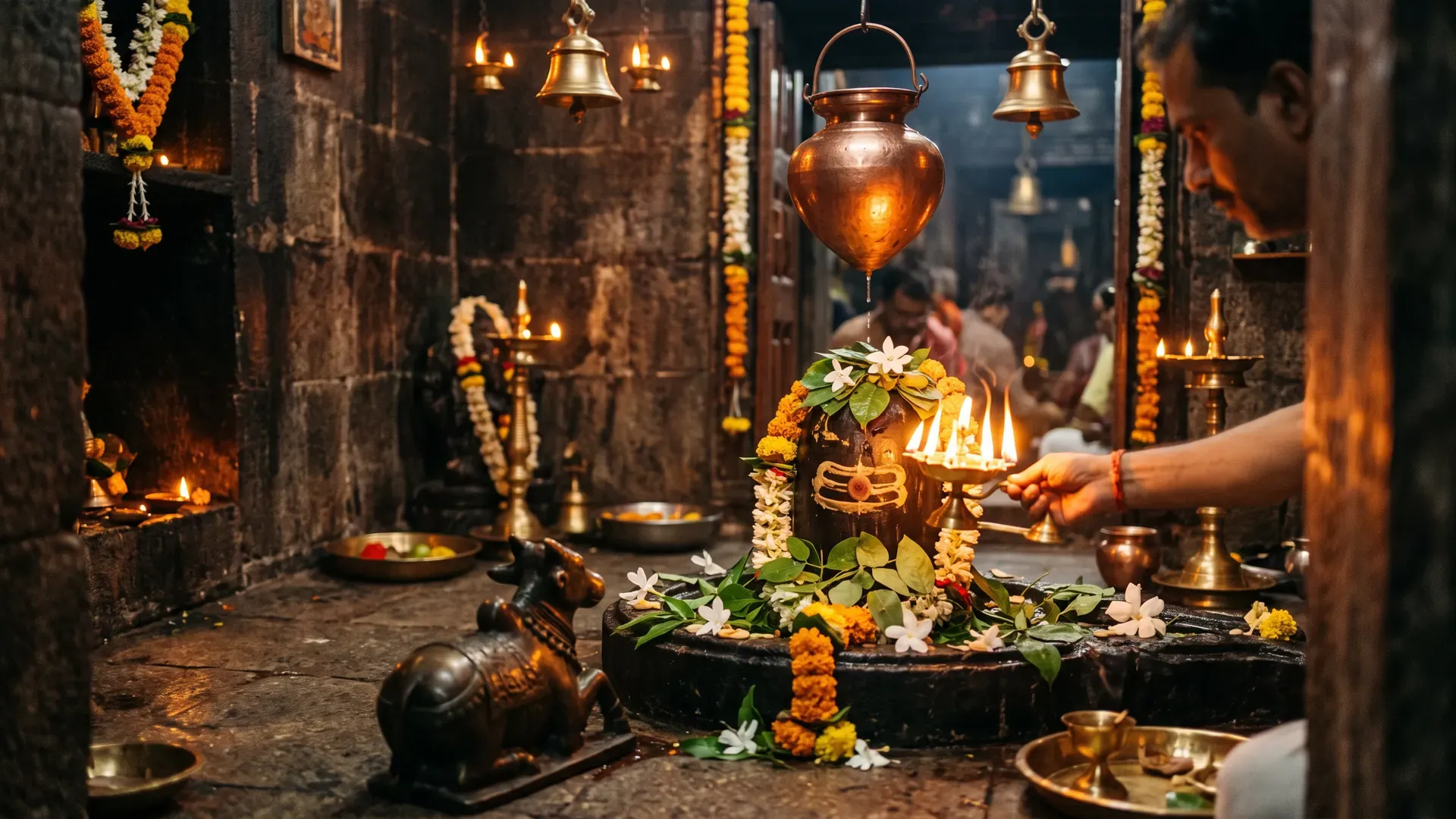
In the Monday katha as tradition tells it, a childless merchant keeps the Monday vrat; at Parvati’s request Shiva grants him a son, but one who will live only twelve years. At twelve the boy dies in Kashi, and at Parvati’s plea Shiva gives him life again. In the Solah Somvar katha a priest who fell ill under Parvati’s curse is healed by keeping sixteen Mondays, and the same vrat then passes to Parvati, Kartikeya, his friend and, in the end, a queen.
Hindi in Roman letters: a reading aid, made by a program. The Devanagari text is the original.
The other language could not be loaded. Keep reading here, or try again.
Each morning the tithi, Rahu Kaal and coming festivals, in one short WhatsApp message.Follow the channel
Monday is held to be Shiva’s day, and on it the vrat is kept with the worship of Shiva and Parvati. The Manav Vikas Foundation booklet names three Monday vrats: the ordinary vrat of every Monday, Som Pradosh and Solah Somvar; the worship is the same for all three, but each has its own katha. This page has the first two; the Som Pradosh katha is on its own page.
Both are told by tradition: we found no Purana chapter for either. The Solah Somvar katha is also in a printed booklet of 1958 (Khemraj Shrikrishnadas, Mumbai), whose compiler writes that he rendered it into simple Hindi from old manuscripts in Sanskrit, Hindi and Marathi. We checked both kathas event by event against printed booklets and Drik Panchang and told them in our own words; where the tellings differ, it is given at the end under "Other tellings".
How the vrat and katha are kept
- By the Manav Vikas Foundation booklet, the Monday fast usually lasts until the third prahar of the day; there is no fixed rule about fruit, but only one meal is taken in the day and night. The worship is of both Shiva and Parvati.
- By the same booklet, Shiva is worshipped at Pradosh kaal (around sunset) with sandal paste, akshat, flowers, incense, a lamp, the food offering, supari, bel leaves and a sacred thread, and then the katha is heard. The Khemraj booklet says to fast all day and in the evening, at Pradosh, worship Shiva with Parvati and chant "Om Namah Shivaya".
- By Gita Press’s "Vrat Parichay" (Pt. Hanuman Sharma), the Monday vrat is kept in Chaitra, Vaishakha, Shravan, Kartika and Margashirsha, most of all in Shravan: a morning bath and a sankalpa, worship of Shiva with "Om Namah Shivaya" and of Parvati with "Om Namah Shivayai", then a single meal.
- Solah Somvar (the Khemraj and Manav Vikas Foundation booklets): half a ser of wheat flour is baked into unsalted rot or bati and mixed with ghee and jaggery into churma, which is offered in three parts. One part is given to Shiva; the rest is shared as prasad and taken oneself (the booklets divide it a little differently; see below).
- When the sixteen Mondays are done, the udyapan is held on the seventeenth Monday: churma is made again for the puja, the offering and the prasad (both booklets); the Khemraj booklet also lists abhishek, havan and the katha. For the full udyapan, ask your family’s custom or your purohit.
Hindi in Roman letters: a reading aid, made by a program. The Devanagari text is the original.
The other language could not be loaded. Keep reading here, or try again.
The Monday katha: the merchant’s son
As tradition tells it; checked against Drik Panchang and the Manav Vikas Foundation booklet. This is the katha read on the ordinary Monday vrat.
In a certain town lived a very rich merchant. He was a true devotee of Shiva and his house lacked nothing, but he had no child. This one sorrow stayed with him day and night: all his wealth had no one to inherit it. Wishing for a son, he kept the Monday vrat with due rite every week, and every evening he lit a lamp before Shiva in the temple and prayed.
Seeing his devotion, Parvati said to Shiva one day, "Lord, this merchant keeps your vrat and worships you every Monday with a true heart. Grant his wish." Shiva said, "Devi, this world is a field of action; as one sows, so one reaps. Because of his past deeds, a son is not in his fate." Parvati pleaded again, "You always take away your devotees’ sorrow. He is your devotee; take away his sorrow too."
Then Shiva said, "At your word I grant him the boon of a son, but the boy will live only twelve years." The merchant, sitting in the temple, heard this. He was neither glad nor grieved, and went on keeping the vrat and the worship as faithfully as before.
In time the merchant’s wife gave birth to a handsome son. Songs of joy were sung at home, but in his heart the merchant knew how short the boy’s life was to be; he told this secret to no one. When the boy was eleven, his wife began to speak of his marriage. The merchant said, "First he will go to Kashi to study."
The merchant called his wife’s brother, the boy’s maternal uncle, gave him a great deal of money and said, "Take him to Kashi to study. Wherever you halt on the way, hold a yajna and give food and dakshina to the brahmins." So uncle and nephew set out for Kashi, holding yajnas and feeding brahmins as they went.
On the way they came to a town where the king’s daughter was to be married that day. The prince who had come as the groom was blind in one eye, and his father had hidden this from the bride’s family, fearing the marriage would be called off if the truth came out. Seeing the merchant’s handsome son, he thought: why not dress this boy as the groom and have the rites done with him?
He spoke to the uncle and, promising much wealth, won him over. The merchant’s son was dressed as the groom and married to the princess. But the boy did not think this deceit right. Before leaving, he wrote on the edge of the princess’s chunari: "You have been married to me, but the prince with whom you will be sent away is blind in one eye. I am not a prince but a merchant’s son, going to Kashi to study."
When the princess read what was written on her chunari, she refused to go with that prince: "I was not married to him; my husband has gone to Kashi to study." Learning the truth, the king did not send his daughter away, and the wedding party went back.
Meanwhile uncle and nephew reached Kashi. The boy took to his studies and the uncle went on holding yajnas. On the day the boy turned twelve, a yajna was being held as well. The boy said to his uncle, "I do not feel well today." The uncle told him to go in and rest. He went and lay down, and after a little while, as Shiva had said, his life left him. When the uncle went in and found him, he was overcome. In Drik Panchang’s telling he first completed the yajna and sent the brahmins off with respect, and only then wept for his nephew.
Just then Shiva and Parvati were passing that way. Hearing the weeping, Parvati said, "Lord, someone is weeping in great sorrow; take his sorrow away." Coming to the place, Parvati knew the boy: "This is the son of that same merchant, born by your boon." Shiva said, "Yes, Devi, this was the span of his life, and it is complete."
Parvati pleaded, "Lord, give him more years, or his mother and father will not be able to live without him. Nothing is impossible for you." At Parvati’s repeated plea Shiva gave the boy life again, and he sat up, well as before. Then Shiva and Parvati went on to Kailasa.
When the studies were done, uncle and nephew turned homeward, holding yajnas on the way. They came to the same town where the wedding had been. There too they held a yajna, and the king recognised his son-in-law. He took them to the palace with honour, welcomed them warmly, and sent his daughter away with the boy, along with much wealth and servants.
Near home the uncle went ahead with the news. The merchant and his wife had been watching the road for their son; they had resolved in their hearts that if bad news came of him, they would not live either. The uncle told them that by Shiva’s grace their son had come back safe, with a princess for a bride and much wealth. At first they could not believe it; then the two of them welcomed their son and daughter-in-law with joy, and the whole family lived happily.
The katha says that whoever keeps the Monday vrat with devotion and reads or hears this katha receives the grace of Shiva and Parvati, and has their wishes fulfilled.
The Solah Somvar (sixteen Mondays) katha
As tradition tells it; checked against the Khemraj Shrikrishnadas booklet (1958), the Manav Vikas Foundation booklet and a third printed booklet.
Once Shiva and Parvati, wandering the earth, came to a fair city named Amaravati (in the land of Vidarbha, by the older booklet). There stood a grand temple of Shiva that brought peace to the mind, and the two stayed there. Parvati said, "Lord, come, let us play chausar here today." The game began.
During the game the temple priest came to do the worship. Parvati asked him, "Priest, tell me, who will win this round?" The priest said, "No one equals Mahadev at this game, so he will win." But Parvati won the round. Because he had said what was not true, Parvati laid a curse on the priest that he would suffer from leprosy (kodh), and Shiva and Parvati went away. The disease spread over the priest’s body and he lived in great distress.
Some time later the apsaras of heaven came to the temple to worship Shiva. They asked the priest the cause of his illness, and he told them everything. The apsaras said, "Do not despair. Keep the vrat of sixteen Mondays with faith; Shiva will be pleased and take your suffering away." When he asked, they told him the whole rite of the vrat and of its udyapan: a fast through the Monday, the worship of Shiva and Parvati at Pradosh in the evening, an offering of wheat churma in three parts, and, when the sixteen Mondays are done, the udyapan on the seventeenth.
The priest kept the vrat with faith and at the end held the udyapan as well. By the power of the vrat his illness left him and his body became clean as before. Some days later Shiva and Parvati came to the temple again. Seeing the priest well, Parvati asked, "How were you freed from my curse?" The priest folded his hands and said, "Mother, by the sixteen Monday vrat the apsaras taught me, Shiva was gracious and my suffering ended."
Hearing this, Parvati too kept the sixteen Monday vrat. In those days her son Kartikeya had gone away from her, displeased. As soon as the vrat was complete, a longing to see his mother rose in Kartikeya’s heart of its own accord, and he came back and bowed at her feet. He asked, "Mother, what happened that my heart was drawn back to you?" Parvati told him the greatness and the rite of the sixteen Monday vrat.
Kartikeya had a dear brahmin friend who had gone away to distant lands long before. Wishing to see him, Kartikeya too kept the vrat, and as soon as it was complete the friend met him. When the friend asked the reason for this sudden meeting, Kartikeya told him of the vrat. Then the brahmin kept the vrat himself, wishing to be married.
Travelling, the brahmin came to another land, where a swayamvar was being held for the king’s daughter. The king had vowed that the princess would marry the man round whose neck a decorated she-elephant placed the garland. The brahmin too stood to one side to watch. The elephant went round and placed the garland round that very brahmin’s neck. The king married the princess to him with great celebration and gave him much wealth, and the two lived happily.
One day the princess asked, "What merit had you earned that the elephant chose you?" The brahmin said, "I kept the sixteen Monday vrat my friend Kartikeya taught me; that is how you came to me." Then the princess too kept the vrat, wishing for a good son, and in time she had a son, gifted and gentle.
Grown up, the son asked his mother by what penance she had been given him. She told him of the sixteen Monday vrat, and he kept it, wishing for a kingdom. In those days an old king who had only a daughter gave her in marriage to this brahmin youth, and in due course the kingdom came to him as well. Even as king he went on keeping the vrat.
One day (on the seventeenth Monday, the day of the udyapan, by the older booklet) the king asked the queen to come with him to Shiva’s temple with the things for the puja. The queen did not go herself and sent the things with her maids. After the puja a voice spoke from the sky: "King, send this queen out of the palace, or your kingdom will not last." With a heavy heart the king obeyed and sent the queen away from the palace.
Lamenting her fate, the queen set out on foot and came to an old woman’s house. The old woman gave her work and sent her to the market with a bundle of yarn, but on the way such a storm blew that the bundle flew away. The old woman told her to leave her house.
In the older booklet her troubles go further: she stayed at an oilman’s house and the oil in his pots vanished, so he too sent her away; she came to a river bank and the river dried up; she went to a lake and its water was no longer fit to drink. All the while the queen thought that this was the fruit of her own fault.
Wandering, she came to an ashram. The Gusain there saw at once that she was a woman of a high house fallen into misfortune. He said, "Daughter, you are like my own daughter; stay here and do not worry about anything." The queen stayed in the ashram and served, but whatever she touched spoiled. The Gusain asked, "Daughter, which god have you offended that this happens?" The queen told him that she had disregarded her husband’s word and had not gone to Shiva’s temple for the puja.
The Gusain prayed to Shiva for her good and said, "Daughter, keep the sixteen Monday vrat with due rite." (By the older booklet, Shiva, pleased by the Gusain’s penance, appeared himself and told him that the queen had broken his vrat, and that when she kept it fully her husband would come for her.) The queen completed the vrat with faith.
By the power of the vrat the king remembered the queen and sent messengers in every direction. They found her at the Gusain’s ashram and told the king. The king came to the ashram himself and said humbly to the Gusain, "Maharaj, she is my wife. I had sent her away; now give her leave to come with me." The Gusain gave his leave, and the king took the queen back to his city, where every house celebrated.
After this the king and queen kept the sixteen Monday vrat every year, lived in joy, and at the end went to Shiva’s world. The katha says that whoever keeps this vrat with faith and due rite, and hears or tells this katha, has the favour of Uma and Maheshvara.
Other tellings
- The son’s span: in Drik Panchang and the Manav Vikas Foundation booklet Shiva grants twelve years and the boy is sent to Kashi at eleven; in Bhakti Bharat’s telling the span is sixteen years and he goes to Kashi at twelve.
- How the merchant learns of the boon: in Drik Panchang and the Manav Vikas Foundation booklet he overhears Shiva and Parvati in the temple; in Bhakti Bharat Shiva tells him in a dream.
- At the end, in the Manav Vikas Foundation booklet and Bhakti Bharat, Shiva tells the merchant in a dream that same night that, pleased by his Monday vrat and his hearing of the katha, he gave the son a long life; Drik Panchang’s telling has no such dream.
- The message for the princess: Drik Panchang has it written on the edge of her chunari, the Manav Vikas Foundation booklet on her dupatta, Bhakti Bharat on her odhni. In Drik Panchang the boy is first made the groom only for the procession and the rites at the door, and then for the whole wedding.
- The dice game: in the Manav Vikas Foundation booklet and Bhakti Bharat (the two have the same text) Parvati asks mid-game who will win and the priest names Mahadev; in the Khemraj booklet Parvati wins twice, Shiva claims the round each time, and when asked the priest (whom the booklet calls "Gurav") says Shiva won.
- In the Khemraj booklet a single apsara teaches the priest the vrat; in the other tellings it is several apsaras.
- The queen’s fault: in the Khemraj booklet, on the seventeenth Monday the king asks her to come with churma made of five ser of flour; thinking this miserly, the queen sends a plate of five ser of rupees with her maids and does not go herself. There it is not a voice from the sky: Shiva comes as an ascetic (yati) and tells the king to send her away, and the old ministers object that the kingdom was given by the queen’s father.
- In the Khemraj booklet the old king holds a swayamvar, his daughter chooses the brahmin youth, and the king hands over the kingdom and goes to the forest for penance; in the other tellings the kingdom comes after the old king’s death.
- At the old woman’s: cotton in the Khemraj booklet, a bundle of yarn in the others. The oilman, the river and the lake are in the Khemraj booklet and the third booklet; in the third the oil pots crack, in Khemraj the oil vanishes. The Manav Vikas Foundation booklet and Bhakti Bharat do not have these episodes.
- Dividing the churma: in the Khemraj booklet, every Monday one part goes into Shiva’s jaladhari, one to brahmachari boys and one is taken oneself; in the Manav Vikas Foundation booklet one part goes to Shiva and two are shared as prasad and taken oneself. For the udyapan churma the Khemraj booklet says five ser of flour, the Manav Vikas Foundation booklet and the third booklet a quarter ser.
- By the Khemraj booklet, in parts of Saurashtra, Rajasthan and Madhya Pradesh this vrat is called "Shiv Mansa vrat" and is kept on the Mondays from Shravan Shukla Chaturthi to Kartika Shukla Chaturthi, with the udyapan on Kartika Shukla Chaturthi. This is a local custom.
After the katha
After the katha the Shiva aarti "Jai Shiv Omkara" is sung (the Manav Vikas Foundation booklet gives this aarti after the Monday kathas), and then the prasad is shared.
Frequently asked questions
When should the Monday vrat be started?
By Gita Press’s "Vrat Parichay", the Monday vrat is kept in Chaitra, Vaishakha, Shravan, Kartika and Margashirsha, most of all in Shravan. By Drik Panchang’s Shravan Somvar page (which it gives as from the Shravan Mahatmya of the Skanda Purana), the vrat is begun with a sankalpa on the first Monday of the bright half of Shravan. The booklets do not agree on when to begin Solah Somvar; ask your family’s custom or your purohit.
What is the Solah Somvar vrat, and when is the udyapan?
A vrat kept on sixteen Mondays in a row; its katha is the second story above. By the booklets, each Monday Shiva and Parvati are worshipped at Pradosh kaal and churma of half a ser of flour is offered in three parts, and when the sixteen are done the udyapan is held on the seventeenth Monday.
When is the meal taken on the Monday vrat?
By the Manav Vikas Foundation booklet the fast usually lasts until the third prahar of the day, and only one meal is taken in the day and night. "Vrat Parichay" says one meal after the puja (ekabhukta), and Drik Panchang’s Shravan Somvar page one meal at night (nakta). Keep it as your strength allows; if your health is not good, ask your doctor.
Which Purana has the Somvar vrat katha?
For both the story of the merchant’s son and the Solah Somvar story we found no Purana chapter; they are told by tradition and have come down in printed booklets. Gita Press’s "Vrat Parichay" gives the rite of the Monday vrat as from the Skanda Purana, and Drik Panchang gives the Shravan Monday rite as from the Shravan Mahatmya of the Skanda Purana; these concern the rite, not these two stories.
How do I get the Somvar vrat katha as a PDF?
Press the "Print / PDF" button on this page; choosing "Save as PDF" in the print dialog of a phone or computer saves both kathas as a PDF, without the rest of the page.
Sources
- Drik Panchang, "Shiva Somavara Vrat Katha" (drikpanchang.com/vrat-katha/weekdays/somavara/shiva-somavara-vrat-katha.html), read 16 October 2026
- Drik Panchang, "Sawan Somvar Vrat Katha", the Shravan Monday rite (drikpanchang.com/vrat-katha/shravana-somavara/shravana-somavara-vrat-katha.html), read 16 October 2026
- "Solah Somvar Vrat Katha arthat Shiv Mansa Vrat Katha", compiled by Pt. Siddhanath Sharma Shastri (preface 1958), Khemraj Shrikrishnadas, Shri Venkateshwar Press, Mumbai, December 2017 edition (archive.org/details/16-somvar-vrat-katha-khemraj), read 16 October 2026
- "Saptavar Vrat, Vidhi, Katha, Aarti", Manav Vikas Foundation, Mumbai (Acharya Akhilesh Dwivedi): the Monday rite, the Monday katha and the Solah Somvar katha (archive.org/details/vrat-katha-book_202601), read 16 October 2026
- A scan of a printed Solah Somvar booklet (publisher not named), in the compilation "Vrat Katha Book", pp. 200–203 (archive.org/details/vrat-katha-book), read 16 October 2026
- "Vrat Parichay", Pt. Hanuman Sharma, Gita Press, Gorakhpur, appendix pp. 249–250: the Monday vrat, the Mondays of Shravan (archive.org/details/vrat-katha-book), read 16 October 2026
- Bhakti Bharat, "Somvar Vrat Katha" (bhaktibharat.com/katha/somvar-vrat-katha), read 16 October 2026
- Bhakti Bharat, "Solah Somvar Vrat Katha" (bhaktibharat.com/katha/solah-somvar-vrat-katha), read 16 October 2026
Something wrong? Report a mistake
