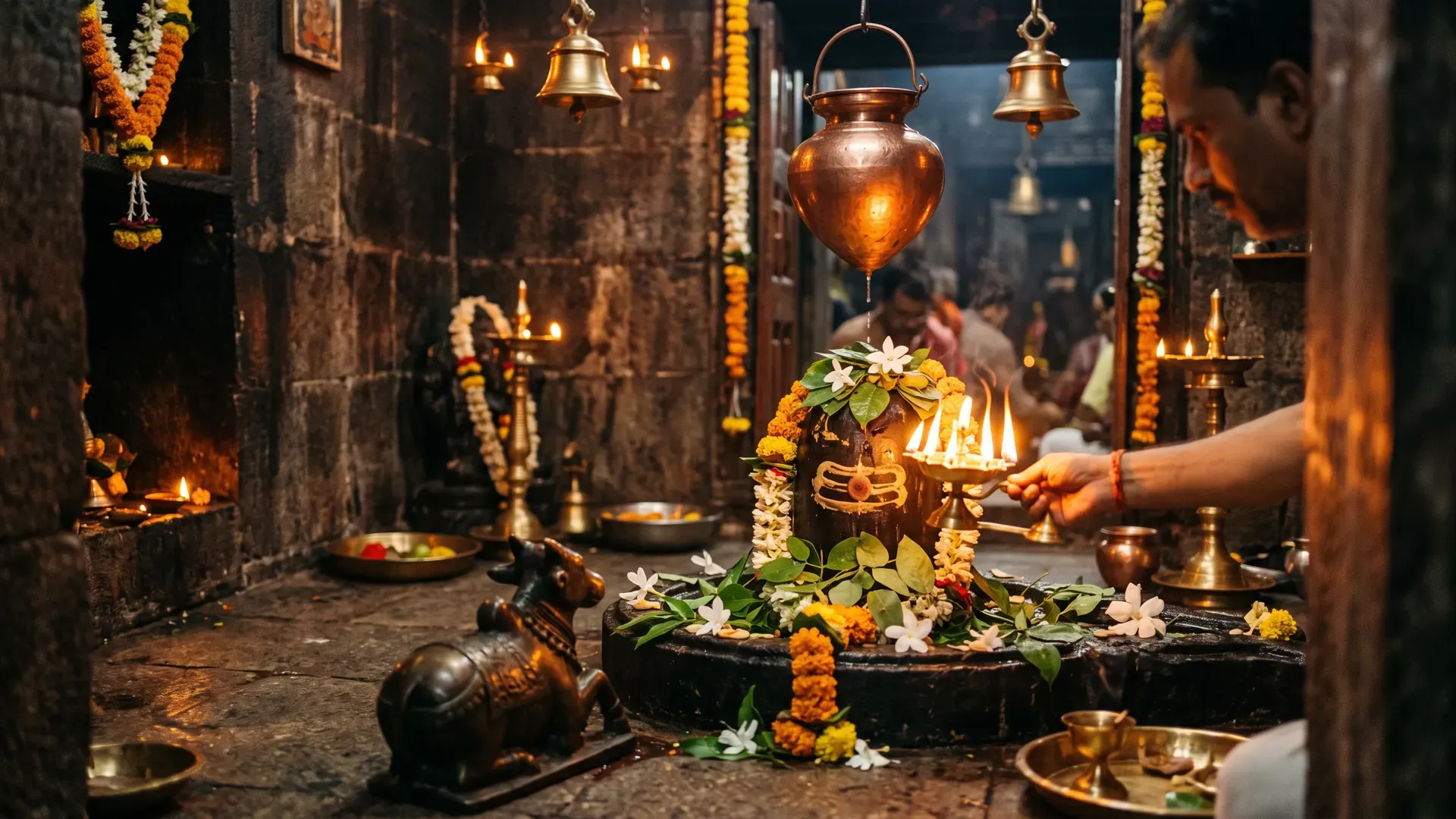
You wear the rosary of beads, the garland of forest flowers and the garland of skulls. Sandal paste and musk adorn you, and the moon rests on your forehead.
You wear white garments, yellow garments and a tiger skin. With you are Sanaka and the other sages, Garuda and his companions, and the bhutas (Shiva’s attendants).
Verse 6
कर के मध्य कमण्डलु, चक्र त्रिशूलधारी।
सुखकारी दुखहारी जगपालन कारी॥
Kar ke madhya kamandalu, chakra trishooldhari.
Sukhkari dukhhari jagpalan kari ||
In your hands are the water pot (kamandalu), the discus and the trident. You give happiness, remove sorrow and sustain the world.
Verse 7
ब्रह्मा विष्णु सदाशिव जानत अविवेका।
प्रणवाक्षर मध्ये ये तीनों एका॥
“Om Jai Shiv Omkara” is the most widely sung aarti of Lord Shiva. By describing the faces, mounts, garments and ornaments of Brahma, Vishnu and Shiva side by side, it teaches that the three are one in Omkara (the Pranava). It is sung on Mondays, in the month of Sawan, on Pradosh, on Mahashivratri and in daily worship of Shiva.
The eight core verses of the aarti are given here. Many popular versions add four more verses, beginning with these lines: ‘Lakshmi va Savitri Parvati sanga’, ‘Parvat sohain Parvati’, ‘Jata mein Ganga bahat hai’ and ‘Kashi mein viraje Vishwanath’. Some versions read the second line of verse 4 as ‘Tripurari Kansari kar mala dhari’, the second line of verse 6 as ‘Jagkarta jagbharta jagsanharkarta’, and the last line as ‘sukh sampati pave’. When sung, the first line (the refrain) is repeated after every verse.
Each morning the tithi, Rahu Kaal and coming festivals, in one short WhatsApp message.Follow the channel
Frequently asked questions
Who wrote the aarti “Om Jai Shiv Omkara”?
The last verse says ‘kahat Shivanand Swami’. No further reliable information about the author is available.
Why does this aarti describe Brahma and Vishnu?
Its central idea is that Brahma, Vishnu and Sadashiva are one in Omkara, and only those without discernment see them as separate. That is why the verses list the faces, mounts, garments and weapons of all three side by side.
When is this aarti sung?
On Mondays, in the month of Sawan, on Pradosh vrat, on Mahashivratri, and at the end of daily worship of Shiva.
How many verses does this aarti have?
The core text has eight verses. Many versions add four more, which are listed in the note above.
Add SanatanBodh to your phone as an appToday’s panchang and choghadiya in one tap. Free, no app store needed.Tap the Share button below, then “Add to Home Screen”. How?