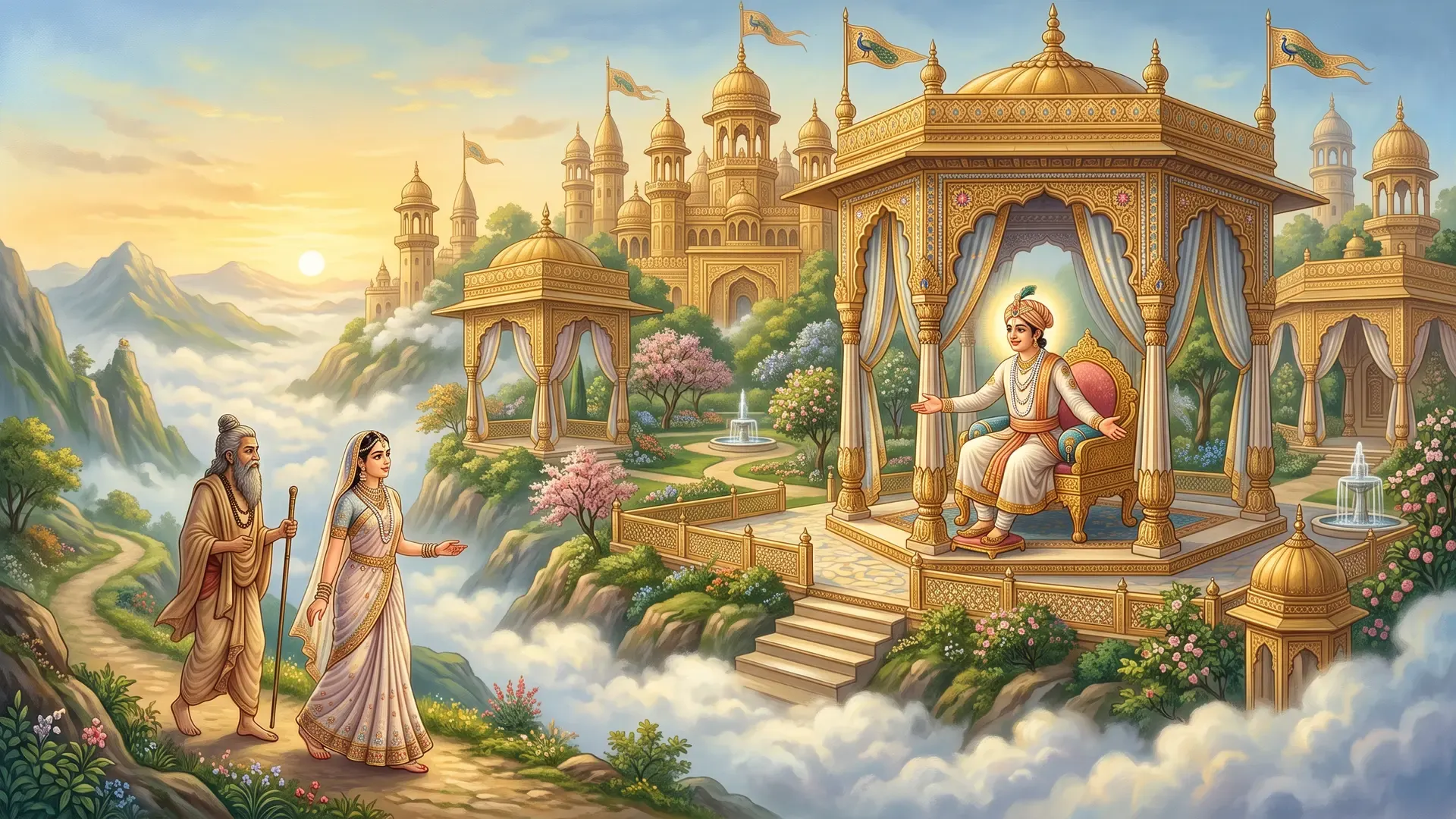
The Rama Ekadashi katha is in the Padma Purana (Uttara Khanda). Shobhana, King Muchukunda’s son-in-law, keeps this fast at his in-laws’ home though he is weak, and dies the next morning; by its merit he gains a divine city on Mount Mandara, but it is not lasting, because he fasted without faith. His wife Chandrabhaga, who has kept every Ekadashi with faith since she was past eight, makes the city lasting by that merit and joins him there.
Each morning the tithi, Rahu Kaal and coming festivals, in one short WhatsApp message.Follow the channel
Rama Ekadashi falls on Kartik Krishna Ekadashi (Purnimanta calendar; Ashwin Krishna in the Amanta calendar), a few days before Diwali. Lord Vishnu is worshipped and a fast is kept, and this katha is read or heard after the puja.
The katha is in the Uttara Khanda of the Padma Purana, where Krishna tells it to Yudhishthira at his request; the whole Uttara Khanda is framed as a dialogue between Lord Shiva and the sage Narada. We have written it in our own words from the Sanskrit, its English translation and the Gita Press Hindi translation. Its lesson is faith: Shobhana kept the fast without faith and its fruit did not last, while Chandrabhaga’s faithful fasts made it lasting.
How the vrat and katha are kept
- In the katha, a drum is beaten in King Muchukunda’s realm on Dashami to proclaim that no one is to eat on Hari’s day, the Ekadashi.
- In that realm no one takes food or water on Ekadashi; by the katha even the elephants, horses and other animals get no grass, grain or water that day.
- At night Lord Hari is worshipped and a vigil is kept, and the fast lasts until the next morning, Dwadashi.
- The katha’s chief teaching is that the fast be kept with faith: Chandrabhaga had kept every Ekadashi by its rules and with faith since she was past eight.
Shobhana and Chandrabhaga
As told in the Padma Purana, Uttara Khanda, chapter 60 (numbered two higher in the Gita Press edition), checked against the Sanskrit, Deshpande’s English translation and the Gita Press Hindi.
Yudhishthira asked with affection, “Janardana, out of your love for me, tell me this too: what is the name of the Ekadashi in the dark half of Kartik?” Krishna said, “Listen, best of kings. The Ekadashi of the dark half of Kartik is called Rama. It is most auspicious and takes away great sins. I will tell you its glory through a story.”
Long ago there was a famous king named Muchukunda. He was a friend of Indra, king of the gods, and Yama, Varuna, Kubera and Vibhishana were his friends too. He was devoted to Lord Vishnu and true to his word, and he ruled a kingdom cleared of all troublemakers.
A daughter was born in the king’s house who bore the name of Chandrabhaga, best of rivers. The king gave her in marriage to Shobhana, son of Chandrasena.
Once Shobhana had come to stay at his father-in-law’s house when the holy day of Ekadashi arrived. Chandrabhaga grew anxious. “O Lord, what will happen now?” she thought. “My husband is very weak and cannot bear hunger, and my father’s rule is stern.”
In King Muchukunda’s realm a drum was beaten on Dashami itself, proclaiming: “No one shall eat on Hari’s day, no one shall eat, no one shall eat!” Hearing the drum, Shobhana asked his wife, “My dear, what am I to do? You must show me the way.”
Chandrabhaga said, “My lord, in my father’s house no one eats today. On Hari’s day even the elephants, horses, their young and the other animals here get no grass, grain or even water; how then could people eat? If you eat anything today, people will blame you. So think it over and make your mind firm.”
Shobhana said, “You are right, my dear. I too will fast today; what fate has ordained will come to pass.” With his mind made up, he took the vow.
As the day wore on, his body ached with hunger and he was in great distress. While he brooded, the sun set. The night that fills Vishnu’s devotees with joy, as they worship Hari and keep vigil, was one of deep suffering for Shobhana.
At sunrise Shobhana passed away. King Muchukunda had him cremated with wood fit for a king. Chandrabhaga did not give up her own life after her husband; she performed all his last rites and went on living in her father’s house.
By the power of the Rama Ekadashi fast, Shobhana gained a beautiful city, a city fit for the gods, on the heights of Mount Mandara. It was matchless and unconquerable, with virtues beyond counting. Its mansions had pillars of gold set with gems and lapis, and crystal of many shapes adorned them.
There Shobhana sat on a lion-throne, with a white umbrella above him and chowries waving. He wore a crown, earrings, a necklace and armlets; gandharvas sang his praise and apsaras waited on him. He shone there like a second Kubera.
In Muchukunda’s city lived a brahmin named Somasharma. Wandering on pilgrimage, he came to that place and saw Shobhana. Recognising the king’s son-in-law, he went up to him. Shobhana knew him too; he rose quickly from his seat, bowed to the brahmin, and asked after his father-in-law, his wife Chandrabhaga and the whole city.
Somasharma said, “O prince, all is well in your father-in-law’s house; Chandrabhaga is well, and all is well in the city. But now tell me your own story. Never have I seen a city so lovely and so strange; it is a wonder. How did you come by it?”
Shobhana said, “Best of brahmins, I gained this city by fasting on Rama Ekadashi in the dark half of Kartik. But it is not lasting. Please do something to make it last.” The brahmin asked, “Why does it not last, and how can it be made to? Tell me plainly, and I will do exactly as you say.”
Shobhana said, “O brahmin, I kept that excellent vow without faith, and so I think its fruit will not last. Now hear how it can be made to: tell all this to Chandrabhaga, King Muchukunda’s daughter. Then this city will become lasting.”
Krishna says that on hearing this, Somasharma returned to Muchukunda’s city and told Chandrabhaga everything: “Good lady, I have seen your husband with my own eyes, and his city too, like Indra’s city and beyond anyone’s conquest. But he says it is not lasting. You must make it last.”
Chandrabhaga said, “Brahmin sage, take me there; I long to see my husband. By the merit of my own vows I will make that city last. Help us two to meet again; great merit comes from uniting those who have been parted.”
Hearing this, Somasharma took Chandrabhaga with him to the ashram of the sage Vamadeva near Mount Mandara. The sage heard the whole account from them both and consecrated Chandrabhaga with Vedic mantras. By the power of the sage’s mantras and the merit of her Ekadashi fasts, her body became divine and she attained a divine state.
Her eyes bright with joy, she went to her husband. Seeing his wife arrive, Shobhana was overjoyed; he called her to him and seated her at his left side.
Then Chandrabhaga said lovingly, “My lord, hear something for your good. In my father’s house, ever since I passed the age of eight, I have kept every Ekadashi by its rules and with all my heart’s faith. By the power of that merit this city will become lasting, and stay rich in all one could wish for until the dissolution of the world.”
So, by the power of the Rama vow, Chandrabhaga, divine in form, in pleasures and in ornaments, lived happily with her husband on the heights of Mount Mandara, and Shobhana, now in a divine body, lived joyfully with her.
At the end Krishna says that Rama Ekadashi is like the wish-granting chintamani gem or the wish-granting cow Kamadhenu. No difference should be made between the Ekadashis of the two fortnights: as a white cow and a black cow give the same milk, so the Ekadashis of the dark and the bright half give the same fruit. According to the katha, the Ekadashi fast gives both the joys of this world and liberation, and whoever hears the glory of the Ekadashi vows is freed of all sins and honoured in the world of Vishnu.
Other tellings
- In the Padma Purana, Gita Press, the ISKCON book and Webdunia, Krishna tells this katha to Yudhishthira; in Drik Panchang’s telling, to Arjuna. That is a popular variant, not the Padma Purana’s frame.
- In the Padma Purana and Gita Press King Muchukunda has Shobhana cremated. Only in Drik Panchang’s telling does the king have the body set afloat in water, from which Shobhana later rises by the power of the Ekadashi; this is not in the Padma Purana. Drik Panchang also has him die just before sunrise, where the Sanskrit and Gita Press say at sunrise.
- Webdunia (and Hindi Wikipedia), Drik Panchang and the ISKCON book say Chandrabhaga did not give up her life with her husband because her father told her not to; the Sanskrit Padma Purana, its English translation and Gita Press do not mention his order.
- In Drik Panchang and Webdunia Chandrabhaga also tells Shobhana to go elsewhere if he cannot fast, and he refuses to leave; this is not in the Padma Purana.
- The Sanskrit compares Shobhana in his divine city to “Rajaraja”, that is Kubera (Gita Press: “a second Kubera”); Drik Panchang and Webdunia call him “a second Indra”. Gita Press, Drik Panchang and Webdunia write the city’s name as “Devapura”; the Sanskrit word can also simply mean “a city of the gods”, and Deshpande’s translation calls it a charming divine city.
- The Sanskrit word “saridvara” (best of rivers) is read in different ways: in Gita Press the river Chandrabhaga herself was born as the king’s daughter; in Deshpande’s translation she resembled the river; in the ISKCON book she was named after it.
- How long the city will last is “until the dissolution of beings” in the Sanskrit and “until the end of the kalpa” in Gita Press. In the ISKCON book and Webdunia Chandrabhaga hands her merit over to her husband; the Sanskrit says only that her merit will make the city lasting. Drik Panchang’s English has her fasting “from age eight”; the Sanskrit says “since she was past eight”.
- The ISKCON book and Webdunia say this fast removes even the sin of killing a brahmin; that line is not in the Sanskrit Padma Purana.
- The katha does not say this is the same King Muchukunda whose story of the cave and Kalayavana is in the Bhagavata Purana, so we have not linked the two.
After the katha
After the katha the aarti of Lord Vishnu and the Ekadashi Mata aarti are sung. The fast is broken on Dwadashi at the parana time; the parana time for your city is on the Rama Ekadashi page. Those who are weak, unwell or elderly should decide how to keep the fast with their purohit and their doctor.
Ekadashi Aarti: Om Jai Ekadashi MataFrequently asked questions
Which Purana has the Rama Ekadashi katha?
The Uttara Khanda of the Padma Purana, where Krishna tells it to Yudhishthira. It is chapter 60 on Sanskrit Wikisource and in N. A. Deshpande’s English translation; the Gita Press edition numbers its chapters two higher.
Why was Shobhana’s city not lasting?
Shobhana says himself that he kept this excellent vow without faith, and so its fruit does not last; in the katha he fasts because his wife urges him and the realm requires it. The merit of Chandrabhaga’s faithful Ekadashi fasts made the city lasting.
Was Shobhana’s body set afloat in water?
Not in the Sanskrit Padma Purana, its English translation or Gita Press: there King Muchukunda has him cremated with wood fit for a king. Setting the body afloat is found only in Drik Panchang’s telling.
When is the Rama Ekadashi katha read?
By tradition, on the Ekadashi after the worship of Lord Vishnu and before the aarti. At the end of the katha Krishna says that whoever hears the glory of the Ekadashi vows is freed of all sins and honoured in the world of Vishnu.
Sources
- Padma Purana, Uttara Khanda, chapter 60, Sanskrit Wikisource (chapter numbers vary by edition; the Gita Press edition numbers two higher)
- Padma Purana, Uttara Khanda, chapter 60, N. A. Deshpande’s English translation (Motilal Banarsidass; wisdomlib.org)
- Gita Press, Gorakhpur: Ekadashi-vrat ka Mahatmya (the stories of 26 Ekadashis), compiled by Radheshyam Khemka, pp. 64–67
- ISKCON’s Ekadasi book text: Rama Ekadasi (iskcondesiretree.com)
- Drik Panchang: Rama Ekadashi Vrat Katha (Hindi and English), drikpanchang.com
- Webdunia (hindi.webdunia.com): Rama Ekadashi vrat katha; Hindi Wikipedia carries the same text
Something wrong? Report a mistake