The Mokshada Ekadashi katha is in the Padma Purana (Uttara Khanda). King Vaikhanasa of Champaka saw in a dream his father and forefathers suffering in hell. The sage Parvata, after meditating, told him that in a former birth his father had failed in his duty as a husband to his wife, and gave the remedy: keep the fast of Mokshada Ekadashi in the bright half of Margashirsha and give its merit to your father. The king did so, and the moment the merit was given his father was freed from hell and went to heaven.
Each morning the tithi, Rahu Kaal and coming festivals, in one short WhatsApp message.Follow the channel
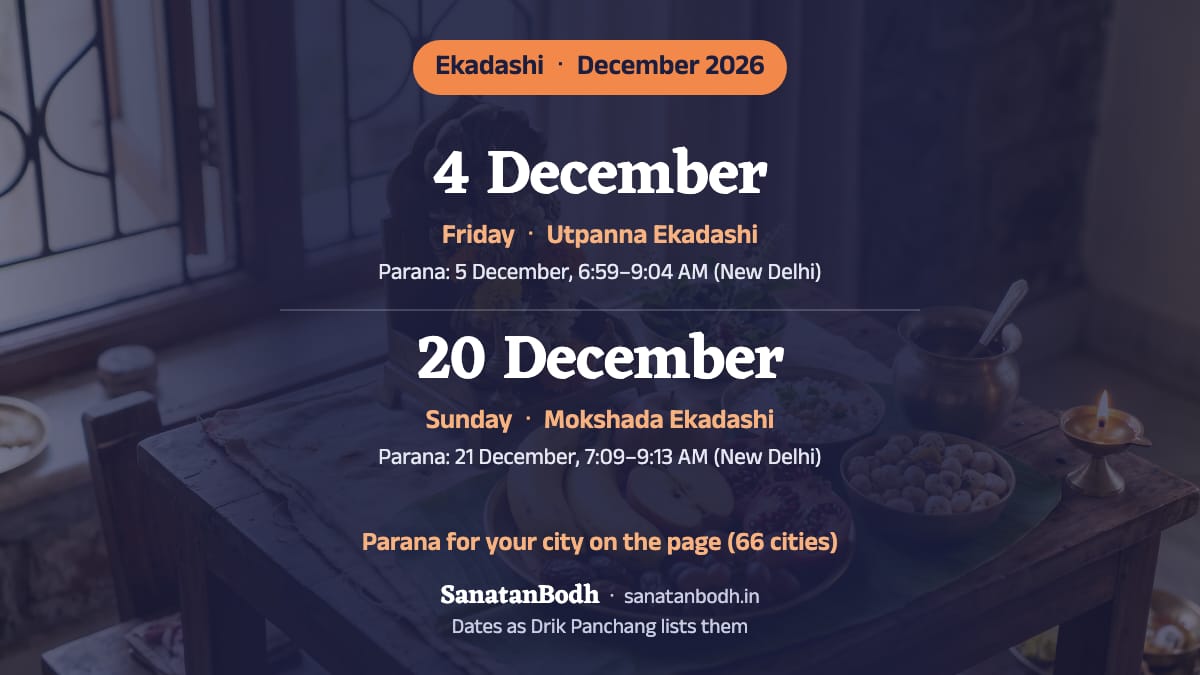
Mokshada Ekadashi falls on Margashirsha Shukla Ekadashi. The Padma Purana calls it the Ekadashi that takes away all sins and grants liberation, and says that by giving its merit even forefathers who have fallen into hell through their sins are set free. Lord Damodara is worshipped and a fast is kept on the day, and the katha is read or heard after the puja. By tradition Gita Jayanti is kept on the same day, though this chapter of the Padma Purana does not mention the Gita.
The katha is in the Uttara Khanda of the Padma Purana, where Krishna tells it to Yudhishthira at his request. We have written it in our own words from the Sanskrit, Deshpande’s English translation and the Gita Press Hindi translation, compared with Drik Panchang, Bhakti Bharat and the ISKCON book.
How the vrat and katha are kept
- By the Padma Purana, Lord Damodara is worshipped with care on this day with tulsi buds, incense and lamps; the rules of Dashami and Ekadashi are kept as for any Ekadashi fast.
- The text asks for a night vigil with dance, song and hymns to the Lord.
- In the katha the king keeps the fast as the sage told him and offers its merit to his father; in Drik Panchang’s telling this is done with a sankalpa (a stated resolve). For the way to offer merit to one’s forefathers, it is best to ask one’s own family purohit.
The story of King Vaikhanasa
As told in the Padma Purana, Uttara Khanda, chapter 39 (the Gita Press edition numbers its chapters two higher), checked against the Sanskrit, Deshpande’s English translation and the Gita Press Hindi, and compared with Drik Panchang, Bhakti Bharat and the ISKCON book.
Yudhishthira bowed to Lord Vishnu and said to Krishna, “O God of gods, for the good of all people and for the ending of sins, I ask you this. The Ekadashi that comes in the bright half of Margashirsha: what is its name, what is its rite and which deity is worshipped that day? Lord, tell me all of it in full.”
Krishna said, “O king, you have asked well. I have already told you of Utpanna Ekadashi, in the dark half of Margashirsha. Now hear of the Ekadashi of the bright half. It is known as Mokshada, and it takes away all sins. On this day Lord Damodara should be worshipped with care, with tulsi buds, incense and lamps.”
“By giving away the merit of this Ekadashi, even forefathers who through their sins have fallen into hell or into a lowly birth attain liberation; of this there is no doubt. Now hear its ancient, sacred story.”
In the lovely city of Champaka, graced by devotees of Vishnu, ruled a king named Vaikhanasa. He cared for his subjects as if they were his own children. Many brahmins learned in the Vedas lived in his city.
One night the king saw in a dream that his father and forefathers were suffering in hell. Weeping again and again, they were saying to him, “You are our son; free us from this suffering.” Seeing this, the king’s mind was filled with wonder and distress. In the morning he told the brahmins all that he had seen in the dream.
The king said, “Brahmins, since I saw this I have had no peace. This great kingdom, these elephants and horses, my wife and my sons, nothing pleases me now. What shall I do, where shall I go? My heart is choking. Of your kindness, tell me the vow, the austerity or the practice by which my forebears may be freed at once. If a son is alive and strong and yet his father lies in a dreadful hell, what use is such a son?”
The brahmins said, “O king, close by is the great ashram of the sage Parvata. He knows both the past and the future. Go to him.”
Hearing this, King Vaikhanasa went at once to the ashram of the sage Parvata. Many sages versed in the Vedas were there, and among them Parvata looked like a second Brahma. The king lay full length before him in salutation. The sage asked after the seven limbs of his kingdom, that is, the state of the whole realm, and whether it was free of trouble and the king at ease.
The king said, “Lord, by your grace all is well in my kingdom. But in a dream I have seen my forefathers lying in hell. Tell me, by the power of what merit will they be freed? It is to ask this that I have come to you. Show me some way.”
Hearing this, the sage Parvata fixed his eyes and sat in meditation. After a short while in meditation he said, “O king, I have come to know your father’s past deeds. In his former birth he did not keep his duty as a husband to his wife: in her season, when a wife has the right to her husband’s company, he denied her that right. It is because of that sin that your father lies in hell.”
King Vaikhanasa asked again, “O sage, by the power of which vow will they be freed?” The sage said, “In the bright half of Margashirsha comes the Ekadashi called Mokshada. Keep its fast and give its merit to your father. By the power of that merit he will be set free.”
Hearing the sage’s words, the king returned home. When the month of Margashirsha came, he kept the fast of Mokshada Ekadashi with his family as the sage had told him, and offered all its merit to his father.
The moment the merit was offered, flowers began to rain from the sky. The king’s father, together with the forefathers, was freed from hell. As he went on his way to heaven he blessed his son from the sky: “Son, may it be well with you, may it be well with you.” With these words he went to heaven.
At the end Krishna says, “O king, whoever keeps the auspicious Mokshada Ekadashi in this way loses his sins and after death attains liberation. There is no Ekadashi greater than this for giving liberation. For people it is like the wish-granting chintamani gem.” By the Padma Purana the merit of this fast cannot be counted, and reading and hearing its katha bring the fruit of a Vajapeya sacrifice.
Other tellings
- The king’s city is Champaka in the Sanskrit Padma Purana, Gita Press and the ISKCON book; Gokul in Bhakti Bharat; Drik Panchang names no city. The Sanskrit and Gita Press mostly call this Ekadashi “Moksha”; the chapter’s closing line names it “Mokshada”.
- In the Sanskrit and Gita Press the king sees his forefathers in hell in his dream, and later his father is said to be there with the forefathers; in Drik Panchang, Bhakti Bharat and the ISKCON book he sees only his father.
- The father’s wrong is told differently. In the Sanskrit, in his former birth he was a kshatriya proud of his kingdom who left his wife in her season and went off to another village on business. In Drik Panchang and Bhakti Bharat, at the word of his elder queen he denied his second wife her right. The ISKCON book names a different, harsher wrong against his wife. The Gita Press text gives no cause at all. We have kept what the sources share.
- In the Sanskrit the sage says “all” should keep this vow, and the king gives the merit “along with all”; Deshpande reads it so, while in Gita Press the king gives the merit “to his father together with all the forefathers”. In Drik Panchang, Bhakti Bharat and the ISKCON book the king keeps the fast with his family.
- The rain of flowers is in the Sanskrit, Gita Press and the ISKCON book, not in Drik Panchang or Bhakti Bharat. The fruit of hearing the katha is a Vajapeya sacrifice in the Sanskrit and Gita Press, a horse sacrifice in the ISKCON book, and “endless fruit” in Drik Panchang.
- In Drik Panchang’s telling Krishna tells the katha to Arjuna. The ISKCON book places it in the Brahmanda Purana (we have not checked that text). The ISKCON book and Bhakti Bharat give this day as Gita Jayanti; this chapter of the Padma Purana does not mention the Gita.
After the katha
After the katha the aarti of Lord Vishnu and the Ekadashi Mata aarti are sung, and a vigil is kept at night. The fast is broken the next day, Dwadashi, at the parana time; the parana time for your city is on the Mokshada Ekadashi page.
Ekadashi Aarti: Om Jai Ekadashi MataFrequently asked questions
Which Purana has the Mokshada Ekadashi katha?
The Uttara Khanda of the Padma Purana, where Krishna tells it to Yudhishthira. It is chapter 39 on Sanskrit Wikisource and in Deshpande’s English translation; the Gita Press edition numbers its chapters two higher. The ISKCON book places it in the Brahmanda Purana.
Why is it called Mokshada Ekadashi?
Mokshada means “giver of liberation”. By the Padma Purana it grants liberation after death to the one who keeps it, and by giving its merit even forefathers in hell are freed, as King Vaikhanasa’s father is in the katha.
Does the Mokshada Ekadashi katha mention the Gita?
No. This chapter of the Padma Purana, and the katha in Gita Press and Drik Panchang, say nothing of the Gita or Gita Jayanti. By tradition Gita Jayanti is kept on this same day, and the ISKCON book and Bhakti Bharat link the day with the Gita.
Can the merit of this fast be given to one’s forefathers?
In the katha King Vaikhanasa, on the sage Parvata’s advice, keeps the fast and offers its merit to his father, and the Padma Purana says that the gift of this Ekadashi’s merit frees forefathers. Ask your own family purohit how to make such a resolve.
Sources
- Padma Purana, Uttara Khanda, chapter 39, Sanskrit Wikisource (chapter numbers vary by edition)
- Padma Purana, Uttara Khanda, chapter 39, N. A. Deshpande’s English translation (Motilal Banarsidass; wisdomlib.org)
- Gita Press, Gorakhpur: Ekadashi-vrat ka Mahatmya, compiled by Radheshyam Khemka, pp. 11–13 (based on the Padma Purana)
- ISKCON’s Ekadasi book text: Mokshada Ekadasi (iskcondesiretree.com)
- Drik Panchang: Mokshada Ekadashi Vrat Katha (Hindi and English), drikpanchang.com
- Bhakti Bharat: Mokshada Ekadashi Vrat Katha, bhaktibharat.com
Something wrong? Report a mistake