The Utpanna Ekadashi katha is in the Padma Purana (Uttara Khanda), where Krishna tells Yudhishthira how the Ekadashi tithi came to be. In the Satya Yuga the demon Mura drove the gods out of heaven; Lord Vishnu fought him for a thousand divine years and then lay down to sleep in a cave at Badarikashrama. When Mura came to kill him, a radiant maiden came forth from Vishnu’s body and put an end to Mura. Pleased, Vishnu granted that whoever fasts on her day will gain dharma, wealth and liberation; that maiden is Ekadashi.
Hindi in Roman letters: a reading aid, made by a program. The Devanagari text is the original.
The other language could not be loaded. Keep reading here, or try again.
Each morning the tithi, Rahu Kaal and coming festivals, in one short WhatsApp message.Follow the channel
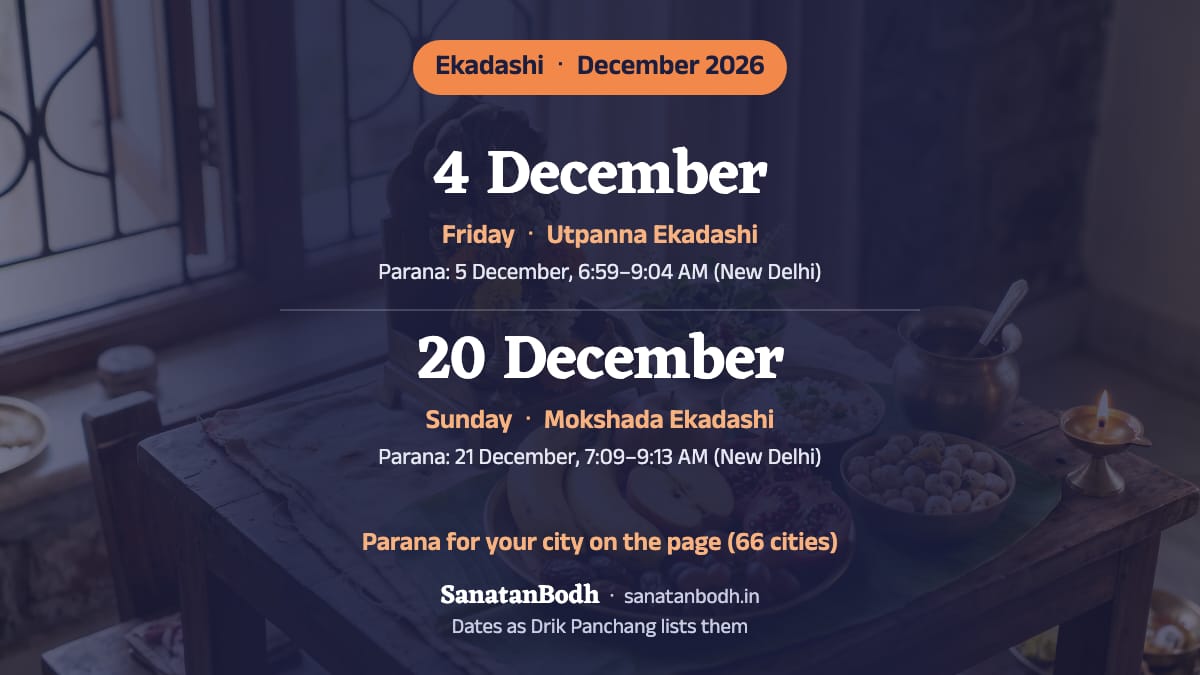
Utpanna Ekadashi falls on Margashirsha Krishna Ekadashi (Purnimanta calendar; Kartika Krishna in the Amanta calendar). “Utpanna” means “she who came into being”: its katha tells how the goddess Ekadashi came forth from Lord Vishnu’s body. Drik Panchang and the ISKCON book say that one who wishes to begin keeping Ekadashi fasts should begin with this one. Lord Vishnu is worshipped and a fast is kept on the day, and the katha is read or heard after the puja.
The katha is in the Uttara Khanda of the Padma Purana, where the chapter itself is titled “the origin of Ekadashi and the slaying of Mura”. We have written it in our own words from the Sanskrit, Deshpande’s English translation and the Gita Press Hindi translation, compared with Drik Panchang, the ISKCON book and Bhakti Bharat. Where these tellings differ, the differences are given below under the variants.
How the vrat and katha are kept
- In the katha Krishna gives this rite: on Dashami eat only once, with a steady mind. On the morning of Ekadashi take the vow, and at midday bathe after smearing the body with earth, praying to Mother Earth to take away past sins.
- That day give up anger and greed, and do not talk with liars, hypocrites, slanderers, thieves or the wicked. Worship Lord Keshava, offer naivedya and light a lamp in the house with devotion. Do not sleep by day, and keep celibate.
- At night keep a vigil with devotion, and give dakshina to brahmins, bow to them and ask forgiveness for any faults. According to the katha the Ekadashis of the dark and bright halves are equal; the same rite holds for both.
Hindi in Roman letters: a reading aid, made by a program. The Devanagari text is the original.
The other language could not be loaded. Keep reading here, or try again.
The birth of Ekadashi and the end of Mura
As told in the Padma Purana, Uttara Khanda, chapter 38 (the Gita Press edition numbers its chapters two higher), checked against the Sanskrit, Deshpande’s English translation and the Gita Press Hindi, and compared with Drik Panchang, the ISKCON book and Bhakti Bharat.
Once Yudhishthira, the king of dharma, asked Krishna, “Janardana, what is the merit and the fruit of a full fast, of eating only in the evening (nakta), and of eating once a day? Tell me all of it.”
Krishna said, “In the cold season, when the auspicious month of Margashirsha comes, one should keep the fast of Hari’s day in its dark half.” Then he gave the rite of the fast: one meal on Dashami, the vow on the morning of Ekadashi, a midday bath after smearing the body with earth, the worship of Lord Keshava, a lamp in the house, no sleep by day, a vigil at night, and dakshina to brahmins with a request for their forgiveness. He said that no difference should be made between the Ekadashis of the dark and bright halves.
Krishna went on, “Even the merit of bathing at the holy place of Shankhoddhara and seeing Lord Gadadhara there is not a sixteenth part of the Ekadashi fast. The Ekadashi fast bears a hundred times the fruit of a horse sacrifice. One who eats only in the evening gains half its merit, and one who eats once a day half of that. Holy places, gifts and vows boast of their greatness only until a person fasts on the day dear to Lord Vishnu.”
Hearing this, Yudhishthira asked, “Lord, how did this holy Ekadashi tithi come into being? Why is it held so pure in the world, and why is it so dear to the gods?”
Krishna said, “Son of Pritha, long ago in the Satya Yuga there was a demon named Mura. He was strange and fearsome, and all the gods were afraid of him. He conquered Indra and all the gods and drove them out of heaven. In fear the gods wandered over the earth. Then they all went to Mahadeva, and Indra told him everything: ‘Great lord, the gods, fallen from heaven, wander among mortals and have lost all their glory. Tell us what to do.’”
Mahadeva said, “King of the gods, go to where Lord Vishnu is, he who bears Garuda on his banner, the lord of the world and the refuge of all. He will protect you.” Hearing Mahadeva, Indra went there with all the gods. They saw Lord Gadadhara asleep on the waters of the Ocean of Milk. Indra joined his palms and praised him: “God of gods, lotus-eyed Madhusudana, salutations to you. Afraid of the demon named Mura, we have all come to your refuge. You are the master, you are the maker and the cause, you are the mother of all the worlds and the father of the universe. Protect us.”
Lord Vishnu asked, “Indra, what is this demon like? What are his form and his strength, and where does he live?” Indra said, “Lord of the gods, long ago a great and terrible asura named Talajangha was born in Brahma’s line. His son is Mura, who is very mighty and has become a terror to the gods. He lives in a city named Chandravati. He has driven all the gods out of heaven and set others in the places of Indra, Agni, the Sun, the Moon, Vayu and Varuna. The gods are left with no place of their own.”
Hearing this, Lord Vishnu grew angry and resolved to slay the wicked demon. He went with the gods to the city of Chandravati. There Mura, the king of the demons, was roaring again and again. Beaten by him, the gods fled in all ten directions. Then the Lord struck down the demons before him with his divine arrows and loosed his discus on the demon army, and hundreds of demons fell.
But Mura alone stood his ground and fought on and on; the text says that even the Lord could not overcome him. Then the two fought hand to hand, and that fight went on for a thousand divine years. At last Lord Vishnu went to Badarikashrama. There was a cave there named Simhavati, twelve yojanas long, with a single door. Weary from the long battle, the Lord entered the cave and lay down in yogic sleep.
Mura followed close behind him and entered the cave. Seeing the Lord asleep he was overjoyed and thought, “This terror of the demons is now in my hands; today I will surely kill him.”
At that very moment a maiden came forth from Lord Vishnu’s body. She was beautiful and auspicious, she bore divine weapons, and she was born of a portion of the Lord’s own radiance. Great were her strength and valour. Mura saw her, and the maiden challenged him to battle. They fought, and the Padma Purana says that at a single cry of “hum” from the maiden the great demon Mura was burnt to ashes.
As soon as the demon died, the Lord awoke. Seeing Mura lying on the ground he was astonished and said, “Who has slain this fierce enemy of mine? Who has done this hard deed to protect me?” The maiden said, “Lord, he had conquered all the gods with Indra, the Gandharvas, the Yakshas and the Nagas, and driven them out of heaven. I saw that you were asleep and that Mura had followed you here. I feared that while you slept he would destroy the three worlds, so I slew him.”
The Lord asked, “How did you overcome the one who had overcome even me?” The maiden said, “Lord, it is by your grace alone that I slew this great demon.” Pleased, the Lord said, “Blessed one, by this deed of yours the sages and gods of the three worlds rejoice. Ask whatever boon is in your heart; even if it is rare for the gods, I will give it to you.”
The maiden said, “Lord, if you are pleased, then grant that by your grace I become the goddess who is first among all holy places, who destroys every obstacle and gives every attainment. May those who fast on my day with devotion to you gain every attainment. Madhava, to one who on my day keeps a full fast, or eats once in the evening, or eats once in the day, give dharma, wealth and liberation.”
Lord Vishnu said, “Blessed one, all that you say shall be. You will fulfil the wishes of all. My devotees in the world who keep the Ekadashi vow and worship me will surely reach liberation. I look upon you as my own power. Tritiya, Ashtami, Navami and Chaturdashi are dear to me, but Ekadashi is dearest of all; the merit of her fast is greater than that of every holy place.” Receiving this boon, Ekadashi rejoiced.
So the maiden who came forth from the Lord’s body is Ekadashi. In the next chapter Krishna says that this Ekadashi of the dark half of Margashirsha is called “Utpanna”, because she was born of his body. In the popular telling the Lord says to her, “You appeared on the eleventh tithi, so your name shall be Ekadashi.” According to the katha, the enemies and obstacles of one who keeps the Ekadashi fast are destroyed, and that person reaches the highest state.
At the end Krishna says, “The Ekadashi of both halves of the month is equally auspicious; no difference should be made between the bright and the dark. Those who fast on Ekadashi go to where Lord Vishnu, who bears Garuda on his banner, dwells. There is no vow like Ekadashi for destroying sin.” According to the katha, one who hears this glory of Ekadashi with devotion, by day or by night, is freed even from sins such as killing a brahmin.
Other tellings
- Mura’s father is “Talajangha” in the Sanskrit Padma Purana and Gita Press; “Nadijangha” in the ISKCON book and Bhakti Bharat (“Nadi Jangam” in Drik Panchang).
- The cave is “Simhavati” in the Sanskrit and Gita Press, “Hemavati” in Drik Panchang and Bhakti Bharat, and “Himavati” in the ISKCON book. In all of them it has a single door; it is twelve yojanas long in the Sanskrit, Gita Press and Bhakti Bharat, and thirty-eight kos in Drik Panchang.
- In the Sanskrit and Gita Press, Mura is burnt to ashes by the maiden’s cry of “hum” alone. In Drik Panchang and the ISKCON book she first breaks his weapons and his chariot and then cuts off his head, and the other demons flee in fear to Patala; in Bhakti Bharat she slays him at once.
- The fight between the Lord and Mura lasts a thousand divine years in the Sanskrit, a thousand years in Drik Panchang and the ISKCON book, and ten thousand years in Bhakti Bharat. Gita Press has no long fight: after loosing his discus the Lord goes straight to Badarikashrama. In Drik Panchang, the ISKCON book and Bhakti Bharat the Lord’s weapons fall on Mura like flowers; this is not in the Sanskrit.
- This chapter of the Padma Purana gives no reason for the name Ekadashi; the next chapter links the name “Utpanna” to her birth from the Lord’s body. In Drik Panchang, the ISKCON book and Bhakti Bharat the Lord says the maiden appeared on the eleventh tithi, and so was named Ekadashi (Utpanna Ekadashi in Drik Panchang and Bhakti Bharat).
- In the Sanskrit, Gita Press and Bhakti Bharat, Krishna tells this katha to Yudhishthira; in Drik Panchang and the ISKCON book, Suta relates that Krishna told it to Arjuna. The ISKCON book places it in the Bhavishyottara Purana, which we have not checked.
- When the Sanskrit and Gita Press give the rite, they call this day of the dark half of Margashirsha “Dvadashi”, though the katha is about Ekadashi; in Drik Panchang, the ISKCON book, Bhakti Bharat and common practice the fast is kept on Ekadashi itself, and broken on Dvadashi.
- The fruit of reading this glory is the merit of giving a thousand cows in the Sanskrit and Gita Press; the fruit of a horse sacrifice in Drik Panchang.
After the katha
After the katha the aarti of Lord Vishnu and the Ekadashi Mata aarti are sung, and a vigil is kept at night. The fast is broken the next day, Dwadashi, at the parana time; the parana time for your city is on the Utpanna Ekadashi page.
Frequently asked questions
Which Purana has the Utpanna Ekadashi katha?
The Uttara Khanda of the Padma Purana, where Krishna tells Yudhishthira how Ekadashi came to be. It is chapter 38 on Sanskrit Wikisource and in Deshpande’s English translation, a chapter titled “the origin of Ekadashi and the slaying of Mura”; the Gita Press edition numbers its chapters two higher. The ISKCON book places it in the Bhavishyottara Purana.
Why is it called Utpanna Ekadashi?
“Utpanna” means “she who came into being”. In the Padma Purana Krishna says that this Ekadashi of the dark half of Margashirsha is Utpanna, because she was born of his body. According to the katha, on this day the goddess Ekadashi came forth from Lord Vishnu’s body and put an end to Mura.
Who is the goddess Ekadashi?
According to the katha she is the maiden who came forth from Lord Vishnu’s body, born of a portion of his radiance. In the Padma Purana the Lord tells her that he looks upon her as his own power, and in the ISKCON book she calls herself the Lord’s great power. By the Lord’s boon her day, Ekadashi, became the fast dearest to Hari.
Should Ekadashi fasts be started from Utpanna Ekadashi?
By Drik Panchang and the ISKCON book, yes: one who wishes to begin keeping Ekadashi fasts should begin with this Ekadashi of the dark half of Margashirsha. The Padma Purana prescribes this fast but gives no rule about beginning with it, so this is a matter of tradition. Follow your family’s custom, or ask your own purohit.
Sources
- Padma Purana, Uttara Khanda, chapter 38 (and the opening of chapter 39), Sanskrit Wikisource (chapter numbers vary by edition)
- Padma Purana, Uttara Khanda, chapter 38, N. A. Deshpande’s English translation (Motilal Banarsidass; wisdomlib.org)
- Gita Press, Gorakhpur: Ekadashi-vrat ka Mahatmya, compiled by Radheshyam Khemka, pp. 1–11 (based on the Padma Purana)
- ISKCON’s Ekadasi book text: Utpanna Ekadasi (iskcondesiretree.com)
- Drik Panchang: Utpanna Ekadashi Vrat Katha (Hindi and English), drikpanchang.com
- Bhakti Bharat: Utpanna Ekadashi Vrat Katha, bhaktibharat.com
Something wrong? Report a mistake