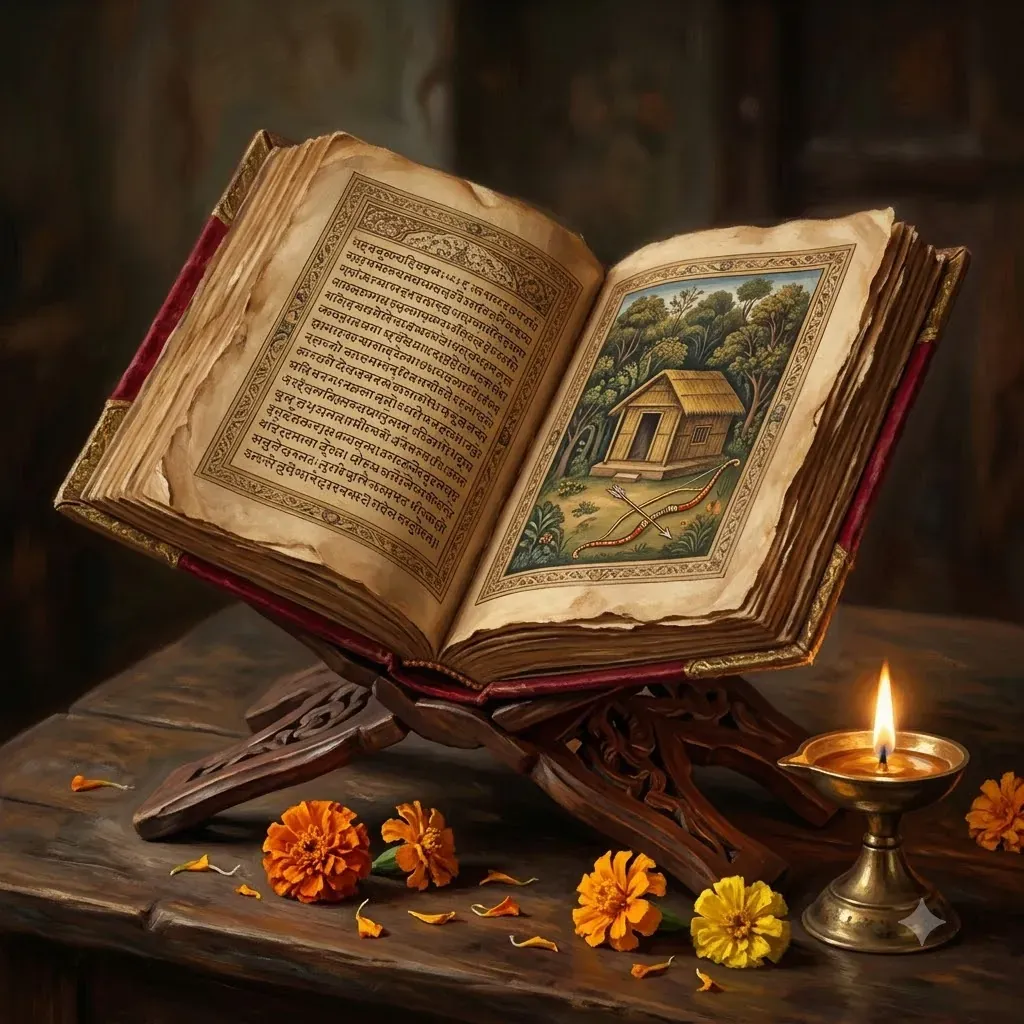
The Vivah Panchami katha is the wedding of Rama and Sita. Vishvamitra took Rama and Lakshmana to King Janaka’s Mithila; there Rama broke the bow of Shiva that no king had even been able to lift, and Janaka gave Sita to Rama in marriage. In the same pavilion Lakshmana married Urmila, Bharata married Mandavi and Shatrughna married Shrutakirti.
Each morning the tithi, Rahu Kaal and coming festivals, in one short WhatsApp message.Follow the channel
Vivah Panchami falls on Margashirsha (Aghan) Shukla Panchami. By tradition Rama and Sita were married on this day at Janakpur, so temples in Mithila, at Janakpur Dham in Nepal and in Ayodhya hold the wedding festival of Rama and Sita (Drik Panchang, Nepal Tourism Board). The Panchami times for your city are on the Vivah Panchami page.
The story is told mainly in the Bala Kanda of the Valmiki Ramayana (sargas 66–77) and in the Bala Kand of Goswami Tulsidas’s Ramcharitmanas (dohas 206–361); we read and checked both in the original. Neither gives a tithi. Valmiki names the nakshatra of the wedding, Uttara Phalguni, and the Manas names the month: “him ritu agahanu maasu suhaava”, the pleasant month of Aghan in the cool season. The Shukla Panchami comes from tradition.
How the vrat and katha are kept
- By Drik Panchang, one bathes in the morning, takes the vow of the fast and worships an image or picture of Rama and Sita with incense, a lamp, food offerings, flowers, fruit and panchamrit.
- As the katha, the Sita Swayamvara and wedding episode is read or heard from the Valmiki Ramayana or the Ramcharitmanas (Drik Panchang). At the close of the Bala Kand the Manas itself says that those who sing and hear the wedding of Sita and Rama with love always have joy (doha 361).
- A common custom is to end the katha of the day at the wedding and not read on (Webdunia, DNA Hindi).
- In the evening temples hold a symbolic wedding of Rama and Sita, with tableaux, bhajan-kirtan and wedding songs (Drik Panchang).
The wedding of Rama and Sita in the Valmiki Ramayana
As told in the Valmiki Ramayana, Bala Kanda, sargas 31, 49–50 and 66–77 (Sanskrit text and Desiraju Hanumanta Rao’s translation, valmikiramayan.net; the key verses checked against Sanskrit Wikisource).
When Vishvamitra’s sacrifice had been completed under the guard of Rama and Lakshmana, the sages there told Rama that King Janaka of Mithila was holding a great sacrifice. There was a wondrous bow there that no god, asura or man had been able to string. Rama and Lakshmana set out for Mithila with Vishvamitra (sarga 31).
On the way, at the hermitage of the sage Gautama, Rama and Lakshmana touched Ahalya’s feet, and Ahalya, who had lived unseen under a curse, could be seen by all again (sarga 49). When they reached Mithila, King Janaka came with his priest Shatananda to welcome Vishvamitra and asked who the two radiant youths were (sarga 50).
The next morning Vishvamitra told Janaka that these sons of Dasharatha wished to see the bow. Janaka told its story: it was the bow of Shiva, which the gods had given into the keeping of King Devarata, sixth in descent from Nimi (sarga 66).
Then Janaka spoke of Sita. Once, as he ploughed the ground for a sacrifice, a girl rose from the furrow. Because she was found in the furrow (sita), she was named Sita. She was not born of any mother’s womb, but Janaka raised her as his own daughter (sarga 66.13–15).
Janaka had vowed that Sita was “viryashulka”: the only price for her hand was valour, and she would marry whoever could string this bow. Many kings came, but none could even lift it. In their anger they besieged Mithila for a year; then Janaka won an army from the gods by his austerity, and the kings fled. Janaka said that if Rama strung the bow, he would give Sita to him (sarga 66.15–26).
The bow lay in an eight-wheeled iron chest that five thousand men hauled in with great effort. At Vishvamitra’s word Rama opened the chest, took the bow by the middle, lifted it with ease and strung it. As he drew it back to his ear, the bow broke in the middle. There was a sound like a thunderbolt and the earth shook; everyone fainted except Vishvamitra, Janaka and the two brothers (sarga 67.3–19).
Janaka said his vow was fulfilled and that Sita, as Rama’s wife, would bring glory to the house of Janaka. With Vishvamitra’s consent he sent his ministers to Ayodhya. After three nights on the road the envoys gave King Dasharatha the news. Dasharatha took counsel with Vasishtha and others and set out the very next day; in four days he reached Mithila, where Janaka welcomed him and Rama touched his father’s feet (sargas 67–69).
Janaka sent for his younger brother Kushadhvaja from the city of Sankashya. Vasishtha recited Rama’s Ikshvaku line and Janaka his own line from Nimi. Then Janaka said he gave Sita to Rama and his second daughter Urmila to Lakshmana. He said: today the moon is in Magha; on the third day, under Uttara Phalguni, hold the wedding (sargas 70–71; 71.24).
Then Vishvamitra, with Vasishtha’s agreement, proposed that Kushadhvaja’s two daughters marry Bharata and Shatrughna, so that the two houses would be bound still closer. Janaka gladly agreed and said that all four weddings should be on one day. Dasharatha gave many cows to Brahmins on behalf of each of his sons (sarga 72).
On the wedding day Vasishtha built an altar in the middle of the pavilion and set up the sacred fire with mantras. Janaka brought Sita, adorned with every ornament, set her before Rama in front of the fire and said: “iyam sita mama suta”, this is my daughter Sita, your companion in dharma; take her hand in yours. She will always be with you like your shadow. With that he poured water sanctified by mantras into Rama’s hands, and flowers fell from the sky (sarga 73.19–29).
Then Janaka asked Lakshmana to take Urmila’s hand, Bharata Mandavi’s and Shatrughna Shrutakirti’s. Amid Vasishtha’s mantras the four brothers went with their wives round the fire, the altar, King Janaka and the sages, and walked three times round the fire. Drums sounded in the sky, the gandharvas sang and the apsaras danced (sarga 73.30–39).
The next morning Vishvamitra left for the Himalaya. Janaka sent his daughters off with great wealth, garments and an escort, and Dasharatha set out for Ayodhya. By Valmiki it was on this way back that Parashurama met them on the road: he challenged Rama to string the bow of Vishnu; Rama strung it, and Parashurama went back to Mount Mahendra (sargas 74–76).
In Ayodhya all were welcomed through decorated streets, and the queens received Sita, Urmila, Mandavi and Shrutakirti with honour. Valmiki says that the love of Rama and Sita grew day by day through each other’s virtues (sarga 77).
The wedding of Sita and Rama in the Ramcharitmanas
As told in Goswami Tulsidas’s Ramcharitmanas, Bala Kand, dohas 206–361 (Gita Press text and numbering, compared on mnsgranth.com and swargarohan.org).
In the Manas Vishvamitra comes to Ayodhya and asks King Dasharatha for Rama and Lakshmana. Dasharatha is grieved at first, but when Vasishtha reasons with him he hands over both sons. Rama kills Tadaka and guards the sacrifice. Then, hearing of the bow-sacrifice, the brothers set out with the sage; on the way Ahalya, who had been turned to stone, is set free by the touch of Rama’s feet (dohas 207–211).
When they reach Janakpur, King Janaka comes to meet Vishvamitra. Seeing the two brothers he forgets himself and asks whether the Brahman the Vedas sing of has come in two forms. Vishvamitra tells him they are Rama and Lakshmana, sons of King Dasharatha (dohas 214–216).
The next morning the brothers go to the king’s flower garden (Pushpavatika) to gather flowers for their guru’s worship. At that very time Sita comes there with her friends, bathes in the garden lake and goes to worship at the temple of Girija (Parvati). One friend sees the two princes, and Sita goes to see them (dohas 226–229).
Hearing the sound of bangles and anklets, Rama looks that way, sees Sita and tells Lakshmana that this is Janaka’s daughter for whom the bow-sacrifice is held. Sita too sees Rama from behind the creepers and keeps him in her heart (dohas 230–234).
Back at the temple Sita praises Gauri. Gauri’s image smiles, the garland slips and falls, and Gauri blesses her: the dark, handsome groom her heart has chosen will be hers. Rama, for his part, tells his guru everything truthfully, and Vishvamitra blesses them (dohas 235–237). This garden episode is not in the Valmiki Ramayana.
The Manas calls it “Siya Swayambar”, Sita’s swayamvara. Kings from many lands sit in the arena, and Sita is brought in with her friends. The bards proclaim Janaka’s vow: whoever breaks this hard bow of Shiva will win Sita. Warriors like Ravana and Banasura had looked at the bow and quietly left; the other kings could not lift it, strain as they might (dohas 240–251).
Grieved, Janaka says it seems the earth has been left without heroes. Hearing this Lakshmana rises in anger, but grows calm at a sign from Rama. Then Vishvamitra says: rise, Rama, break Shiva’s bow and end Janaka’s sorrow (dohas 252–254).
Sita’s mother (in the Manas her name is Sunayana) worries how this tender prince will lift so hard a bow, and Sita prays to the gods in her heart. Rama bows to his guru in his mind, lifts the bow with great ease and in an instant breaks it in the middle; no one even saw when he lifted, strung and drew it (dohas 255–261).
Cheers ring out on every side. At her friends’ prompting Sita places the victory garland (jaymala) round Rama’s neck, and the gods shower flowers (dohas 262–264).
By the Manas, Parashurama hears that the bow is broken and comes to that very assembly. He is furious; Lakshmana answers him sharply, and Rama calms him with humility. At last Parashurama asks Rama to draw the bow of Vishnu; the bow passes to Rama of its own accord, and Parashurama, knowing who Rama is, praises him and goes to the forest for austerity (dohas 268–285).
Vishvamitra tells Janaka that the marriage hung on the bow and was settled the moment it broke; now hold the wedding by family custom and send messengers to Ayodhya. Reading Janaka’s letter, Dasharatha, Bharata and all of Avadh are filled with joy, and a great wedding procession reaches Janakpur (dohas 286–309).
The day of the lagna comes: the cool hemant season and the pleasant month of Aghan (Margashirsha). Brahma works out the auspicious moment and sends it by Narada, and Janaka’s astrologers had reckoned the same. The wedding begins at Godhuli, the hour of dusk (doha 312).
Singing wedding songs, the women go out to welcome the groom Rama with the parchhan rite, and Sita’s mother joyfully waves the aarti lamp before him; then the friends bring Sita to the pavilion. Janaka and Sunayana wash Rama’s feet, and Janaka gives Sita to Rama. Both family priests recite the lineages, the hands are joined (panigrahan), after the fire offering the knot is tied and the rounds are walked. Then Rama puts sindoor in the parting of Sita’s hair, and at Vasishtha’s word bride and groom sit together on one seat (dohas 317–325).
Then, at Vasishtha’s bidding, Janaka sends for Urmila, Mandavi and Shrutakirti. Mandavi, elder daughter of his brother Kusaketu, is married to Bharata, Urmila, Sita’s younger sister, to Lakshmana, and Shrutakirti to Shatrughna, by the same rites. Seeing the four couples in one pavilion, Dasharatha is overjoyed (doha 325). After many days of hospitality the procession returns and Ayodhya celebrates (dohas 326–361).
Other tellings
- Where Parashurama appears: in the Manas, in the assembly at Janakpur as soon as the bow breaks, with his exchange with Lakshmana (dohas 268–285); in the Valmiki Ramayana, on the road back to Ayodhya after the wedding, with no exchange with Lakshmana (sargas 74–76).
- The first sight of Rama and Sita in the flower garden (Pushpavatika) and Sita’s worship of Gauri are only in the Ramcharitmanas (dohas 226–237), not in the Valmiki Ramayana.
- Swayamvara or a vow of valour: in Valmiki, Sita is “viryashulka”, to be won only by valour; Rama breaks the bow before Vishvamitra, Janaka and thousands of people, with no gathering of kings that day, the kings having failed earlier and besieged Mithila for a year (sargas 66–67). The Manas calls it “Siya Swayambar”: the bow breaks before an assembly of kings and Sita gives the victory garland (dohas 240–264).
- Ahalya: in Valmiki she lived in the hermitage unseen by all under a curse, and Rama and Lakshmana touch her feet (sarga 49); in the Manas she was a stone, freed by the touch of Rama’s feet (dohas 210–211).
- Janaka’s younger brother is Kushadhvaja (king of Sankashya) in Valmiki and Kusaketu in the Manas; in both, Mandavi and Shrutakirti are his daughters. Sita’s mother is named (Sunayana) in the Manas, not in these sargas of Valmiki.
- The wedding day: Valmiki names the nakshatra Uttara Phalguni (sargas 71.24, 72.13), the Manas the month of Aghan and the hour of Godhuli (doha 312); neither gives the Shukla Panchami, which comes from tradition.
After the katha
After the katha come the worship of Rama and Sita, bhajan-kirtan and wedding songs, and in the evening the wedding festival of Rama and Sita in temples (Drik Panchang). The Panchami times for your city are on the Vivah Panchami page.
Shri Ram Stuti: Shri Ramchandra Kripalu Bhaju ManFrequently asked questions
What is the Vivah Panchami katha?
It is the story of the wedding of Rama and Sita. Vishvamitra took Rama and Lakshmana to Mithila, where King Janaka had vowed that Sita would marry whoever could string the bow of Shiva. Rama lifted the bow and broke it, King Dasharatha came from Ayodhya with the wedding party, and all four brothers were married on one day: Rama and Sita, Lakshmana and Urmila, Bharata and Mandavi, Shatrughna and Shrutakirti (Valmiki Ramayana, Bala Kanda 66–73; Ramcharitmanas, Bala Kand).
Does the Ramayana say the wedding was on a Panchami?
No, it gives no tithi. In the Valmiki Ramayana Janaka chooses the day of the Uttara Phalguni nakshatra for the wedding (Bala Kanda 71.24). The Ramcharitmanas gives the month: Aghan in the cool season, with the wedding at Godhuli (Bala Kand, doha 312). Keeping Margashirsha Shukla Panchami as the wedding day is tradition, as sources such as Drik Panchang and the Nepal Tourism Board describe.
Was there a swayamvara for Sita?
The Ramcharitmanas calls it “Siya Swayambar”: Rama breaks the bow in an assembly of kings and Sita places the victory garland on him (dohas 240–264). In the Valmiki Ramayana Sita is “viryashulka”, to be won by a vow of valour; there Rama breaks the bow before Vishvamitra and Janaka, and no garland is mentioned (Bala Kanda 66–67).
Are weddings avoided on Vivah Panchami?
It is a folk belief, not a rule of scripture. According to ETV Bharat (Darbhanga, 2020) and DNA Hindi (2022), many families in Mithila do not marry their daughters on this day, because Sita’s life after her wedding was full of hardship; Webdunia says the same of Nepal. The Nepal Tourism Board, on the other hand, calls the day auspicious for marriage. Ask your own purohit about your family’s custom.
Where did Parashurama meet Rama?
In the Ramcharitmanas Parashurama hears that the bow is broken and comes to the assembly at Janakpur, has a sharp exchange with Lakshmana, and when the bow of Vishnu passes to Rama he knows who Rama is and leaves for the forest (Bala Kand, dohas 268–285). In the Valmiki Ramayana he meets the wedding party on its way back to Ayodhya, and when Rama strings the bow of Vishnu he returns to Mount Mahendra (Bala Kanda 74–76).
Sources
- Valmiki Ramayana, Bala Kanda, sargas 31, 49–50, 66–77 (Sanskrit text and Desiraju Hanumanta Rao’s translation, valmikiramayan.net; Sanskrit Wikisource)
- Goswami Tulsidas, Ramcharitmanas, Bala Kand, dohas 206–361 (Gita Press text, mnsgranth.com and swargarohan.org)
- Drik Panchang: Vivah Panchami 2026; Vivah Panchami vrat katha
- Nepal Tourism Board (ntb.gov.np): Vivah Panchami
- The Rising Nepal (2022) and The Himalayan Times (2017): Vivah Panchami at Janakpur Dham; Amar Ujala (2024): the Ram baraat from Ayodhya to Janakpur
- ETV Bharat, Darbhanga (2020), DNA Hindi (2022) and Webdunia: the Mithila belief against weddings on Vivah Panchami
- English Wikipedia: Vivaha Panchami
Something wrong? Report a mistake
