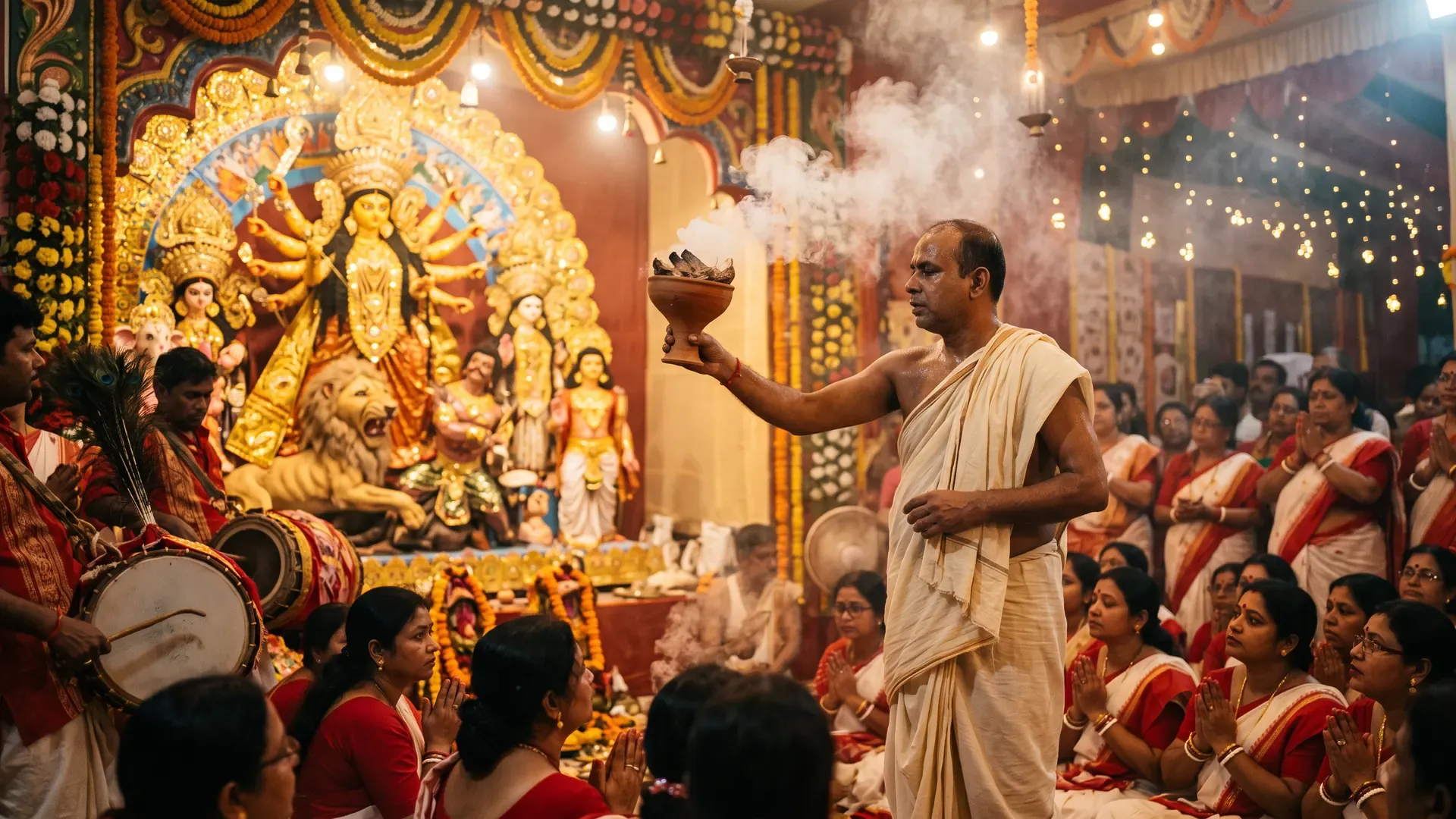
अम्बे तू है जगदम्बे काली, जय दुर्गे खप्पर वाली।
तेरे ही गुण गावें भारती, ओ मैया हम सब उतारें तेरी आरती॥
Ambe too hai jagdambe kali, jay durge khappar vali.
Tere hi gun gaven bharti, o maiya ham sab utaren teri aarti ||
O Ambe, you are Jagdamba, Mother of the world, and you are Kali; victory to you, Durga, who holds the khappar (skull-bowl). Bharati (speech itself) sings your praise alone; O Mother, all of us wave the aarti lamp before you.
Verse 2
तेरे भक्त जनों पर माता, भीर पड़ी है भारी।
दानव दल पर टूट पड़ो माँ, करके सिंह सवारी॥
सौ-सौ सिंहों से बलशाली, है अष्ट भुजाओं वाली,
दुष्टों को पल में संहारती।
ओ मैया हम सब उतारें तेरी आरती॥
Tere bhakta janon par mata, bhir padi hai bhari.
Danav dal par toot pado man, karke sinh savari || sau-sau sinhon se balshali, hai ashta bhujaon vali,
Dushton ko pal mein sanharti.
O maiya ham sab utaren teri aarti ||
O Mother, a heavy trouble has fallen on your devotees; ride out on your lion and fall upon the hosts of demons. Stronger than hundreds of lions, eight-armed, you destroy the wicked in a moment.
Verse 3
माँ-बेटे का है इस जग में, बड़ा ही निर्मल नाता।
पूत-कपूत सुने हैं पर ना, माता सुनी कुमाता॥
सब पे करुणा दरसाने वाली, अमृत बरसाने वाली,
दुखियों के दुखड़े निवारती।
ओ मैया हम सब उतारें तेरी आरती॥
Man-bete ka hai is jag mein, bada hi nirmal nata.
Poot-kapoot sune hain par na, mata suni kumata || sab pe karuna darsane vali, amrit barsane vali,
Dukhiyon ke dukhde nivarti.
O maiya ham sab utaren teri aarti ||
In this world the bond of mother and child is the purest of all. We have heard of sons who turn out bad, but never of a mother who is a bad mother. You show compassion to all, you shower nectar, and you end the sorrows of the suffering.
Verse 4
नहीं माँगते धन और दौलत, न चाँदी न सोना।
हम तो माँगें माँ तेरे मन में, एक छोटा सा कोना॥
सबकी बिगड़ी बनाने वाली, लाज बचाने वाली,
सतियों के सत को सँवारती।
ओ मैया हम सब उतारें तेरी आरती॥
Nahin mangate dhan aur daulat, na chandi na sona.
Ham to mangen man tere man mein, ek chhota sa kona || sabki bigdi banane vali, laj bachane vali,
Satiyon ke sat ko sanvarti.
O maiya ham sab utaren teri aarti ||
We do not ask for money or riches, for silver or gold; we ask only for a small corner in your heart. You set right what has gone wrong for everyone, you protect our honour, and you uphold the virtue of the faithful.
Verse 5
चरण शरण में खड़े तुम्हारी, ले पूजा की थाली।
वरद हस्त सर पर रख दो माँ, संकट हरने वाली॥
माँ भर दो भक्ति रस प्याली, अष्ट भुजाओं वाली,
भक्तों के कारज तू ही सारती।
ओ मैया हम सब उतारें तेरी आरती॥
Charan sharan mein khade tumhari, le pooja ki thali.
Varad hasta sar par rakh do man, sankat harne vali || man bhar do bhakti ras pyali, ashta bhujaon vali,
Bhakton ke karaj too hi sarti.
O maiya ham sab utaren teri aarti ||
We stand in the shelter of your feet holding the plate of worship; O Mother who removes troubles, place your boon-giving hand on our heads. Eight-armed Mother, fill our cup with the joy of devotion; you alone bring your devotees’ work to completion.
“Ambe Tu Hai Jagdambe Kali” is one of the most popular aartis of Goddess Durga. It calls her Ambe, Jagdamba, Kali and Durga who holds the khappar (skull-bowl). Its language is simple modern Hindi, and the name of its author is not known. It is sung especially during the nine days of Navratri, on Durga Ashtami, at Mata ki Chowki and jagrans, and in Friday worship.
Two common versions of this aarti exist. Some collections (such as Drik Panchang) read verse 2 as ‘dushton ko tu hi lalkarti’ and verse 4 as ‘hum to maangein tere charnon mein chhota sa kona’; many others have ‘dushton ko pal mein sanharti’ and ‘maa tere man mein ek chhota sa kona’. You will also see ‘bheed’ for ‘bheer’, ‘gaayein’ for ‘gaavein’ and ‘darshane’ for ‘darsane’. The fifth verse (‘Charan sharan mein khade tumhari’) is missing from some collections. When sung, the first two lines (the refrain) are repeated after every verse.
Each morning the tithi, Rahu Kaal and coming festivals, in one short WhatsApp message.Follow the channel
Frequently asked questions
How is this aarti different from “Jai Ambe Gauri”?
Both are aartis of Goddess Durga, but they are separate compositions. “Jai Ambe Gauri” is in an older style, describes the Goddess’s adornments and her defeat of the demons, and names Shivanand Swami in its last verse. “Ambe Tu Hai Jagdambe Kali” is in simple modern Hindi, and its central feeling is the bond between a mother and her child.
Who wrote this aarti?
The author is not known, and no verse carries a poet’s name. It became popular through recordings by many singers, including Anuradha Paudwal.
Where does the line “Poot-kapoot sune hain par na, mata suni kumata” come from?
The same idea is found in the famous line of the Devyaparadha Kshamapana Stotra, ‘kuputro jayeta kvachid api kumata na bhavati’ (a son may turn out bad, but a mother is never a bad mother). Tradition attributes this stotra to Adi Shankaracharya.
When is this aarti sung?
During the nine days of Sharad and Chaitra Navratri, on Durga Ashtami, at Mata ki Chowki and jagrans, in Friday worship of the Goddess, and at Kali Puja.
How many verses does this aarti have?
Besides the opening refrain, three verses are found in every collection. Many collections add one more, ‘Charan sharan mein khade tumhari’, which is given here as verse 5.
Sources
Traditional aarti text
The idea of “kumata na bhavati”: Devyaparadha Kshamapana Stotra (attributed to Shankaracharya by tradition)
Add SanatanBodh to your phone as an appToday’s panchang and choghadiya in one tap. Free, no app store needed.Tap the Share button below, then “Add to Home Screen”. How?