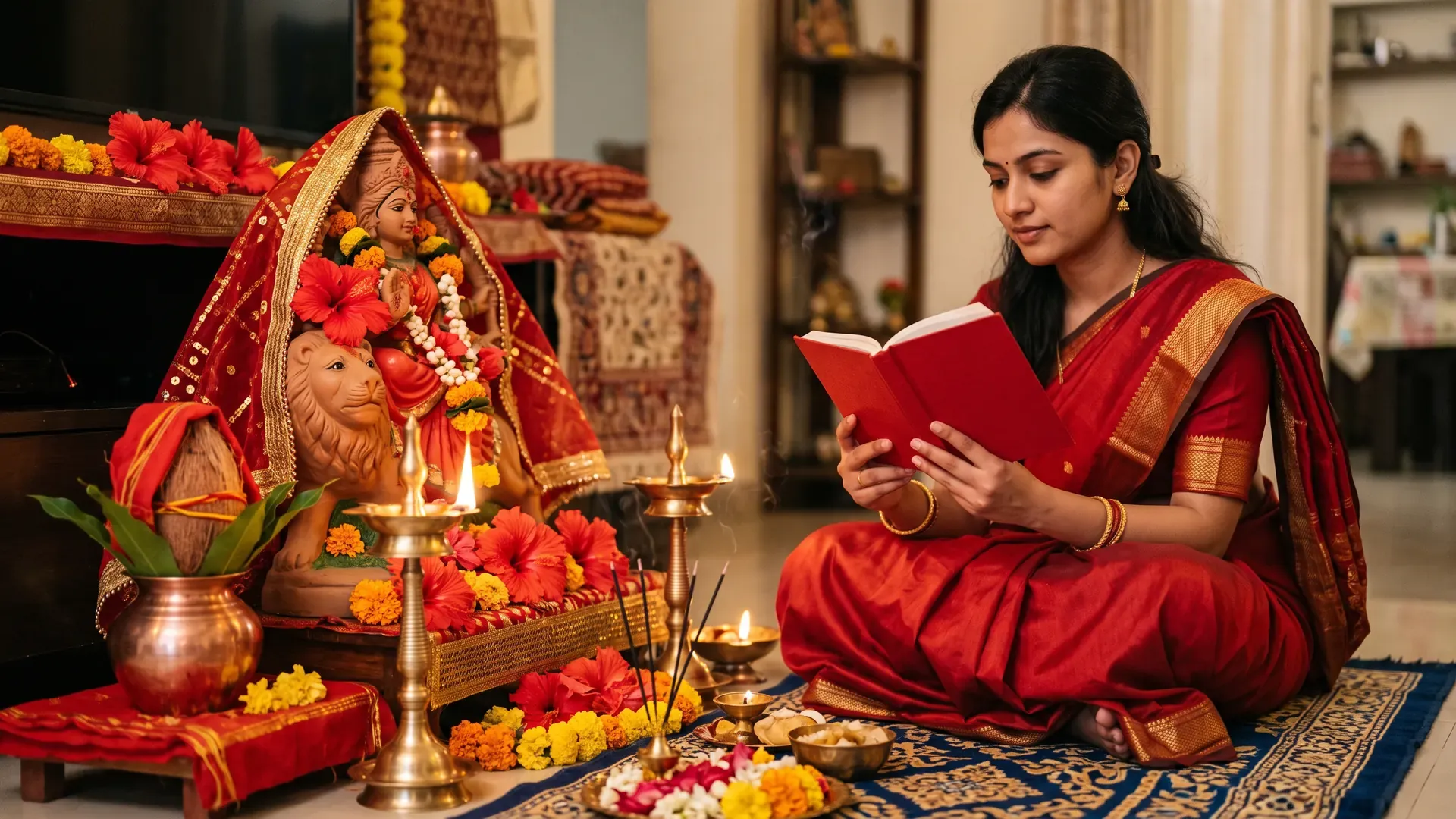
- Verse 1
अयि गिरिनन्दिनि नन्दितमेदिनि विश्वविनोदिनि नन्दनुते
गिरिवरविन्ध्यशिरोऽधिनिवासिनि विष्णुविलासिनि जिष्णुनुते।
भगवति हे शितिकण्ठकुटुम्बिनि भूरिकुटुम्बिनि भूरिकृते
जय जय हे महिषासुरमर्दिनि रम्यकपर्दिनि शैलसुते॥१॥
Ayi Girinandini Nanditamedini Vishvavinodini Nandanute
Girivaravindhyashirodhinivasini Vishnuvilasini Jishnunute |
Bhagavati He Shitikanthakutumbini Bhurikutumbini Bhurikrite
Jaya Jaya He Mahishasuramardini Ramyakapardini Shailasute || 1 ||
O daughter of the king of mountains! You delight the earth and gladden the whole world, and Nanda (in one reading Nandi) sings your praise. You dwell on the peak of the great Vindhya mountain, you delight Vishnu, and Indra (Jishnu) praises you. O Bhagavati, wife of the blue-throated Shiva, mother of a large family, who does and gives so much! Victory, victory to you, slayer of Mahishasura, with lovely matted hair, daughter of the mountain!
- Verse 2
सुरवरवर्षिणि दुर्धरधर्षिणि दुर्मुखमर्षिणि हर्षरते
त्रिभुवनपोषिणि शङ्करतोषिणि कल्मषमोषिणि घोषरते।
दनुजनिरोषिणि दितिसुतरोषिणि दुर्मदशोषिणि सिन्धुसुते
जय जय हे महिषासुरमर्दिनि रम्यकपर्दिनि शैलसुते॥२॥
Suravaravarshini Durdharadharshini Durmukhamarshini Harsharate
Tribhuvanaposhini Shankaratoshini Kalmashamoshini Ghosharate |
Danujaniroshini Ditisutaroshini Durmadashoshini Sindhusute
Jaya Jaya He Mahishasuramardini Ramyakapardini Shailasute || 2 ||
You shower boons on the best of the gods, you crush and do not spare the demons Durdhara and Durmukha, and you are ever joyful. You sustain the three worlds, you please Shankara, you take away sins and you delight in the war cry. You are angry with the danavas and the sons of Diti (the daityas), you dry up the pride of the arrogant, and you are also the daughter of the ocean (Lakshmi). Victory, victory to you, slayer of Mahishasura, with lovely matted hair, daughter of the mountain!
- Verse 3
अयि जगदम्ब मदम्ब कदम्बवनप्रियवासिनि हासरते
शिखरिशिरोमणितुङ्गहिमालयशृङ्गनिजालयमध्यगते।
मधुमधुरे मधुकैटभगञ्जिनि कैटभभञ्जिनि रासरते
जय जय हे महिषासुरमर्दिनि रम्यकपर्दिनि शैलसुते॥३॥
Ayi Jagadamba Madamba Kadambavanapriyavasini Hasarate
Shikharishiromanitungahimalayashringanijalayamadhyagate |
Madhumadhure Madhukaitabhaganjini Kaitabhabhanjini Rasarate
Jaya Jaya He Mahishasuramardini Ramyakapardini Shailasute || 3 ||
O mother of the world, my mother! You love the kadamba forest and dwell there, delighting in laughter. You live in your own home on the peak of the lofty Himalaya, crown jewel of mountains. Sweeter than honey, you humbled Madhu and Kaitabha and destroyed Kaitabha, and you delight in the rasa dance. Victory, victory to you, slayer of Mahishasura, with lovely matted hair, daughter of the mountain!
- Verse 4
अयि शतखण्डविखण्डितरुण्डवितुण्डितशुण्डगजाधिपते
रिपुगजगण्डविदारणचण्डपराक्रमशौण्डमृगाधिपते।
निजभुजदण्डनिपातितचण्डविपाटितमुण्डभटाधिपते
जय जय हे महिषासुरमर्दिनि रम्यकपर्दिनि शैलसुते॥४॥
Ayi Shatakhandavikhanditarundavitunditashundagajadhipate
Ripugajagandavidaranachandaparakramashaundamrigadhipate |
Nijabhujadandanipatitachandavipatitamundabhatadhipate
Jaya Jaya He Mahishasuramardini Ramyakapardini Shailasute || 4 ||
You cut off the trunks of the enemy’s lordly elephants and hacked their bodies into a hundred pieces. Your lion is fierce and skilled at tearing open the temples of the enemy’s elephants. With your own arms you struck down Chanda and tore apart Munda, leaders of warriors. Victory, victory to you, slayer of Mahishasura, with lovely matted hair, daughter of the mountain!
- Verse 5
अयि रणदुर्मदशत्रुवधोदितदुर्धरनिर्जरशक्तिभृते
चतुरविचारधुरीणमहाशयदूतकृतप्रमथाधिपते।
दुरितदुरीहदुराशयदुर्मतिदानवदूतकृतान्तमते
जय जय हे महिषासुरमर्दिनि रम्यकपर्दिनि शैलसुते॥५॥
Ayi Ranadurmadashatruvadhoditadurdharanirjarashaktibhrite
Chaturavicharadhurinamahashayadutakritapramathadhipate |
Duritadurihadurashayadurmatidanavadutakritantamate
Jaya Jaya He Mahishasuramardini Ramyakapardini Shailasute || 5 ||
To kill enemies drunk with battle you took up the unconquerable power that arose from the gods. You made Shiva, lord of the pramathas, foremost in clever counsel and great of heart, your messenger (in the Devi Mahatmya the Goddess sends Shiva as her envoy to Shumbha). For the envoy of the sinful, ill-willed, ill-intentioned, foolish demon your resolve was like death itself. Victory, victory to you, slayer of Mahishasura, with lovely matted hair, daughter of the mountain!
- Verse 6
अयि शरणागतवैरिवधूवरवीरवराभयदायिकरे
त्रिभुवनमस्तकशूलविरोधिशिरोधिकृतामलशूलकरे।
दुमिदुमितामरदुन्दुभिनादमहोमुखरीकृतदिङ्निकरे
जय जय हे महिषासुरमर्दिनि रम्यकपर्दिनि शैलसुते॥६॥
Ayi Sharanagatavairivadhuvaraviravarabhayadayikare
Tribhuvanamastakashulavirodhishirodhikritamalashulakare |
Dumidumitamaradundubhinadamahomukharikritadinnikare
Jaya Jaya He Mahishasuramardini Ramyakapardini Shailasute || 6 ||
Your hand grants freedom from fear to the brave husbands of enemy women who come to you for refuge. You set your spotless trident on the heads of the enemies who had become a pain in the head of the three worlds. You make all the directions ring with the “dumi dumi” of the gods’ kettledrums. Victory, victory to you, slayer of Mahishasura, with lovely matted hair, daughter of the mountain!
- Verse 7
अयि निजहुंकृतिमात्रनिराकृतधूम्रविलोचनधूम्रशते
समरविशोषितशोणितबीजसमुद्भवशोणितबीजलते।
शिवशिवशुम्भनिशुम्भमहाहवतर्पितभूतपिशाचरते
जय जय हे महिषासुरमर्दिनि रम्यकपर्दिनि शैलसुते॥७॥
Ayi Nijahunkritimatranirakritadhumravilochanadhumrashate
Samaravishoshitashonitabijasamudbhavashonitabijalate |
Shivashivashumbhanishumbhamahahavatarpitabhutapishacharate
Jaya Jaya He Mahishasuramardini Ramyakapardini Shailasute || 7 ||
With your mere roar of “hum” you destroyed Dhumralochana and hundreds of smoky demons. In battle you dried up the creeper of Raktabija and of the Raktabijas born from the drops of his blood. You delight among Shiva’s bhutas and pishachas, sated by the great war with Shumbha and Nishumbha. Victory, victory to you, slayer of Mahishasura, with lovely matted hair, daughter of the mountain!
- Verse 8
धनुरनुषङ्गरणक्षणसङ्गपरिस्फुरदङ्गनटत्कटके
कनकपिशङ्गपृषत्कनिषङ्गरसद्भटशृङ्गहतावटुके।
कृतचतुरङ्गबलक्षितिरङ्गघटद्बहुरङ्गरटद्बटुके
जय जय हे महिषासुरमर्दिनि रम्यकपर्दिनि शैलसुते॥८॥
Dhanuranushangaranakshanasangaparisphuradanganatatkatake
Kanakapishangaprishatkanishangarasadbhatashringahatavatuke |
Kritachaturangabalakshitirangaghatadbahurangaratadbatuke
Jaya Jaya He Mahishasuramardini Ramyakapardini Shailasute || 8 ||
In the moments of battle the bracelets dance on your shining arms as they move with the bow. The heads of warriors, roaring with their golden-yellow arrows and quivers, fall to your arrows. Destroying the fourfold army of elephants, horses, chariots and foot soldiers, you turned the battlefield into a stage where your many-coloured attendants (batukas) shout. (Commentators explain several words of this verse differently; this gives the simple sense.)
- Verse 9
सुरललनाततथेयितथेयितथाभिनयोत्तरनृत्यरते
कृतकुकुथः कुकुथो गडदादिकतालकुतूहलगानरते।
धुधुकुटधुक्कुटधिन्धिमितध्वनिधीरमृदङ्गनिनादरते
जय जय हे महिषासुरमर्दिनि रम्यकपर्दिनि शैलसुते॥९॥
Suralalanatatatheyitatheyitathabhinayottaranrityarate
Kritakukuthah Kukutho Gadadadikatalakutuhalaganarate |
Dhudhukutadhukkutadhindhimitadhvanidhiramridanganinadarate
Jaya Jaya He Mahishasuramardini Ramyakapardini Shailasute || 9 ||
You delight in the expressive dance of the heavenly women to the syllables “ta-ta-theyi-theyi”. You enjoy the singing set to talas with syllables like “kukutha” and “gadada”. You delight in the deep sound of the mridanga, “dhudhukuta, dhukkuta, dhindhimi”. Victory, victory to you, slayer of Mahishasura, with lovely matted hair, daughter of the mountain!
- Verse 10
जय जय जप्यजये जयशब्दपरस्तुतितत्परविश्वनुते
झणझणझिञ्झिमिझिङ्कृतनूपुरशिञ्जितमोहितभूतपते।
नटितनटार्धनटीनटनायकनाटकनाटितनाट्यरते
जय जय हे महिषासुरमर्दिनि रम्यकपर्दिनि शैलसुते॥१०॥
Jaya Jaya Japyajaye Jayashabdaparastutitatparavishvanute
Jhanajhanajhinjhimijhinkritanupurashinjitamohitabhutapate |
Natitanatardhanatinatanayakanatakanatitanatyarate
Jaya Jaya He Mahishasuramardini Ramyakapardini Shailasute || 10 ||
Victory, victory to you, the victory to be invoked in japa! The whole world, intent on praising you with cries of “victory”, bows to you. With the jingle of your anklets, “jhana jhana jhinjhimi”, you enchant Shiva, lord of the bhutas. You delight in the drama staged by the leader of dancers whose half is a woman dancer (Shiva as Ardhanarishvara). Victory, victory to you, slayer of Mahishasura, with lovely matted hair, daughter of the mountain!
- Verse 11
अयि सुमनःसुमनःसुमनःसुमनःसुमनोहरकान्तियुते
श्रितरजनीरजनीरजनीरजनीरजनीकरवक्त्रवृते।
सुनयनविभ्रमरभ्रमरभ्रमरभ्रमरभ्रमराधिपते
जय जय हे महिषासुरमर्दिनि रम्यकपर्दिनि शैलसुते॥११॥
Ayi Sumanahsumanahsumanahsumanahsumanoharakantiyute
Shritarajanirajanirajanirajanirajanikaravaktravrite |
Sunayanavibhramarabhramarabhramarabhramarabhramaradhipate
Jaya Jaya He Mahishasuramardini Ramyakapardini Shailasute || 11 ||
This verse is a play on words: the same word comes again and again with a different sense. The simple meaning: your lovely radiance grows brighter with the beautiful flowers offered by gods of glad mind. Your face is like a lotus that blooms at night and like the moon. The play of your beautiful eyes is like that of bees, and bees, enchanted, hover all around you. Victory, victory to you, slayer of Mahishasura, with lovely matted hair, daughter of the mountain!
- Verse 12
महितमहाहवमल्लमतल्लिकमल्लितरल्लकमल्लरते
विरचितवल्लिकपल्लिकमल्लिकझिल्लिकभिल्लिकवर्गवृते।
सितकृतफुल्लसमुल्लसितारुणतल्लजपल्लवसल्ललिते
जय जय हे महिषासुरमर्दिनि रम्यकपर्दिनि शैलसुते॥१२॥
Mahitamahahavamallamatallikamallitarallakamallarate
Virachitavallikapallikamallikajhillikabhillikavargavrite |
Sitakritaphullasamullasitarunatallajapallavasallalite
Jaya Jaya He Mahishasuramardini Ramyakapardini Shailasute || 12 ||
You delight in watching the moves of the finest wrestlers and warriors in the great battle. You are surrounded by bands of Bhil women who live in huts of creepers and play cymbals. You are beautifully adorned with bright blossoms and soft, choice red leaves. (This verse too is a play on words, and commentaries explain it differently.) Victory, victory to you, slayer of Mahishasura, with lovely matted hair, daughter of the mountain!
- Verse 13
अविरलगण्डगलन्मदमेदुरमत्तमतङ्गजराजपते
त्रिभुवनभूषणभूतकलानिधिरूपपयोनिधिराजसुते।
अयि सुदतीजनलालसमानसमोहनमन्मथराजसुते
जय जय हे महिषासुरमर्दिनि रम्यकपर्दिनि शैलसुते॥१३॥
Aviralagandagalanmadameduramattamatangajarajapate
Tribhuvanabhushanabhutakalanidhirupapayonidhirajasute |
Ayi Sudatijanalalasamanasamohanamanmatharajasute
Jaya Jaya He Mahishasuramardini Ramyakapardini Shailasute || 13 ||
Your majesty is like that of a maddened royal elephant, its temples ever streaming with musth. You are the daughter of the king of the ocean, lovely as the moon, the ornament of the three worlds. You enchant even Kama, who stirs longing in the hearts of women with lovely teeth. Victory, victory to you, slayer of Mahishasura, with lovely matted hair, daughter of the mountain!
- Verse 14
कमलदलामलकोमलकान्तिकलाकलितामलभालतले
सकलविलासकलानिलयक्रमकेलिचलत्कलहंसकुले।
अलिकुलसङ्कुलकुवलयमण्डलमौलिमिलद्बकुलालिकुले
जय जय हे महिषासुरमर्दिनि रम्यकपर्दिनि शैलसुते॥१४॥
Kamaladalamalakomalakantikalakalitamalabhalatale
Sakalavilasakalanilayakramakelichalatkalahansakule |
Alikulasankulakuvalayamandalamaulimiladbakulalikule
Jaya Jaya He Mahishasuramardini Ramyakapardini Shailasute || 14 ||
Your spotless forehead is adorned with a crescent of soft radiance, pure as a lotus petal. You are the home of every graceful art, and your gait is like that of a flock of swans. Your hair is like a mass of blue lotuses crowded with bees, and bees swarm over the bakula flowers in the knot on your head. Victory, victory to you, slayer of Mahishasura, with lovely matted hair, daughter of the mountain!
- Verse 15
करमुरलीरववीजितकूजितलज्जितकोकिलमञ्जुमते
मिलितमिलिन्दमनोहरगुञ्जितरञ्जितशैलनिकुञ्जगते।
निजगुणभूतमहाशबरीगणसद्गुणसम्भृतकेलितले
जय जय हे महिषासुरमर्दिनि रम्यकपर्दिनि शैलसुते॥१५॥
Karamuraliravavijitakujitalajjitakokilamanjumate
Militamilindamanoharagunjitaranjitashailanikunjagate |
Nijagunabhutamahashabariganasadgunasambhritakelitale
Jaya Jaya He Mahishasuramardini Ramyakapardini Shailasute || 15 ||
Before the sweet sound of the flute in your hand even the call of the koel falls silent in shame, and yet you love the koel’s sweet voice. You roam the mountain groves that ring with the lovely hum of gathered bees. You play in fine pleasure grounds with your band of Shabari forest women, who are like your own virtues. Victory, victory to you, slayer of Mahishasura, with lovely matted hair, daughter of the mountain!
- Verse 16
कटितटपीतदुकूलविचित्रमयूखतिरस्कृतचन्द्ररुचे
प्रणतसुरासुरमौलिमणिस्फुरदंशुलसन्नखचन्द्ररुचे।
जितकनकाचलमौलिमदोर्जितनिर्जरकुञ्जरकुम्भकुचे
जय जय हे महिषासुरमर्दिनि रम्यकपर्दिनि शैलसुते॥१६॥
Katitatapitadukulavichitramayukhatiraskritachandraruche
Pranatasurasuramaulimanisphuradanshulasannakhachandraruche |
Jitakanakachalamaulimadorjitanirjarakunjarakumbhakuche
Jaya Jaya He Mahishasuramardini Ramyakapardini Shailasute || 16 ||
The many-coloured sheen of the yellow silk at your waist outshines the radiance of the moon. Your moon-like toenails glow with the rays of the gems on the crowns of the gods and demons who bow to you. Your bosom, like the temples of proud celestial elephants, rises higher than the peak of the golden Meru. Victory, victory to you, slayer of Mahishasura, with lovely matted hair, daughter of the mountain!
- Verse 17
विजितसहस्रकरैकसहस्रकरैकसहस्रकरैकनुते
कृतसुरतारकसङ्गरतारकसङ्गरतारकसूनुसुते।
सुरथसमाधिसमानसमाधिसमाधिसमाधिसुजातरते
जय जय हे महिषासुरमर्दिनि रम्यकपर्दिनि शैलसुते॥१७॥
Vijitasahasrakaraikasahasrakaraikasahasrakaraikanute
Kritasuratarakasangaratarakasangaratarakasunusute |
Surathasamadhisamanasamadhisamadhisamadhisujatarate
Jaya Jaya He Mahishasuramardini Ramyakapardini Shailasute || 17 ||
This verse too is a play on words. The simple meaning: radiant beings who outshine even the thousand-rayed sun bow to you. Karttikeya, who fought the demon Taraka to save the gods, is your son. You are pleased by deep meditation and fine japa like the meditation of King Suratha and the merchant Samadhi (the two figures of the Durga Saptashati story). Victory, victory to you, slayer of Mahishasura, with lovely matted hair, daughter of the mountain!
- Verse 18
पदकमलं करुणानिलये वरिवस्यति योऽनुदिनं सुशिवे
अयि कमले कमलानिलये कमलानिलयः स कथं न भवेत्।
तव पदमेव परम्पदमित्यनुशीलयतो मम किं न शिवे
जय जय हे महिषासुरमर्दिनि रम्यकपर्दिनि शैलसुते॥१८॥
Padakamalam Karunanilaye Varivasyati Yonudinam Sushive
Ayi Kamale Kamalanilaye Kamalanilayah Sa Katham Na Bhavet |
Tava Padameva Parampadamityanushilayato Mama Kim Na Shive
Jaya Jaya He Mahishasuramardini Ramyakapardini Shailasute || 18 ||
O home of compassion, most auspicious Shiva! Whoever serves your lotus feet every day, O Kamala who dwells in the lotus, how could he not become a home of Lakshmi himself? What would I not gain, O Shiva, as I dwell on the thought that your feet alone are the highest goal? Victory, victory to you, slayer of Mahishasura, with lovely matted hair, daughter of the mountain!
- Verse 19
कनकलसत्कलसिन्धुजलैरनुषिञ्चति ते गुणरङ्गभुवं
भजति स किं न शचीकुचकुम्भतटीपरिरम्भसुखानुभवम्।
तव चरणं शरणं करवाणि नतामरवाणिनिवासि शिवं
जय जय हे महिषासुरमर्दिनि रम्यकपर्दिनि शैलसुते॥१९॥
Kanakalasatkalasindhujalairanushinchati Te Gunarangabhuvam
Bhajati Sa Kim Na Shachikuchakumbhatatiparirambhasukhanubhavam |
Tava Charanam Sharanam Karavani Natamaravaninivasi Shivam
Jaya Jaya He Mahishasuramardini Ramyakapardini Shailasute || 19 ||
Whoever sprinkles the stage of your virtues (your courtyard) with the water of a murmuring river that gleams like gold, does he not win the joys of heaven? (The poet likens them to the joy of the embrace of Shachi, Indra’s queen.) Let me take refuge in your auspicious feet, where the bowing gods and Vani (Saraswati) dwell. Victory, victory to you, slayer of Mahishasura, with lovely matted hair, daughter of the mountain!
- Verse 20
तव विमलेन्दुकलं वदनेन्दुमलं सकलं ननु कूलयते
किमु पुरुहूतपुरीन्दुमुखीसुमुखीभिरसौ विमुखीक्रियते।
मम तु मतं शिवनामधने भवतीकृपया किमुत क्रियते
जय जय हे महिषासुरमर्दिनि रम्यकपर्दिनि शैलसुते॥२०॥
Tava Vimalendukalam Vadanendumalam Sakalam Nanu Kulayate
Kimu Puruhutapurindumukhisumukhibhirasau Vimukhikriyate |
Mama Tu Matam Shivanamadhane Bhavatikripaya Kimuta Kriyate
Jaya Jaya He Mahishasuramardini Ramyakapardini Shailasute || 20 ||
Whoever contemplates the whole of your spotless, moon-like face, could the moon-faced beauties of Indra’s city ever turn away from him? (That is, he wins the joys of heaven.) O goddess whose wealth is the name of Shiva! My own belief is this: what is there that your grace cannot do? Victory, victory to you, slayer of Mahishasura, with lovely matted hair, daughter of the mountain!
- Verse 21
अयि मयि दीनदयालुतया कृपयैव त्वया भवितव्यमुमे
अयि जगतो जननी कृपयासि यथासि तथाऽनुमितासि रमे।
यदुचितमत्र भवत्युररीकुरुतादुरुतापमपाकुरु मे
जय जय हे महिषासुरमर्दिनि रम्यकपर्दिनि शैलसुते॥२१॥
Ayi Mayi Dinadayalutaya Kripayaiva Tvaya Bhavitavyamume
Ayi Jagato Janani Kripayasi Yathasi Tathanumitasi Rame |
Yaduchitamatra Bhavatyurarikurutadurutapamapakuru Me
Jaya Jaya He Mahishasuramardini Ramyakapardini Shailasute || 21 ||
O Uma! Since you are kind to the helpless, you must surely be gracious to me. O Rama, just as by your grace you are the mother of the whole world, so I too have taken you as my mother. Accept here whatever is fitting, and take away my great suffering. Victory, victory to you, slayer of Mahishasura, with lovely matted hair, daughter of the mountain!
Meaning, sources and more prayers: sanatanbodh.in/en/prayers/mahishasura-mardini-stotram/
On the author: the hymn is usually printed and sung under the name of Adi Shankaracharya, but this is a traditional attribution and it is disputed. The Gita Press ‘Devi Stotra Ratnakar’ gives it as ‘Shri Sankata Stutih [compiled]’ and names no author. According to sanskritdocuments.org these 21 verses are verses 7 to 27 of the 30-verse ‘Bhagavati Padya Pushpanjali’ hymn of Ramakrishna Kavi, a part of it is also found in the Shiva Rahasya, and since it is not among Shankaracharya’s collected works it is wrongly attributed to him; we have not checked this in those books ourselves. On the text: it was compared word by word in sanskritdocuments.org (A. Hudli, G. Ramkumar; proofread by Sunder Hattangadi), the book with Swami Kashikanandagiri’s commentary (Bharati Samskrta Vidya Niketanam, Mumbai, 1991) and the pages of the Gita Press book. Where they differ, we give the reading two of them share. The order of the verses is that of sanskritdocuments, the one usually sung; Kashikanandagiri’s book has ‘ayi nijahunkriti’ sixth and ‘ayi sharanagata’ eighth, and Gita Press has the order 1, 2, 3, 7, 4, 8, 5, 6 and then 9 onwards (in our numbering). Main variants: verse 1 ‘nandinute’ and ‘bhutikrite’ (Gita Press); 2 ‘kilbishamoshini’ (sanskritdocuments); 4 ‘nipatitakhandavipatita’ (sanskritdocuments) and ‘nipatita’ with a retroflex t (Kashikanandagiri); 5 ‘mahashivaduta’ (sanskritdocuments); 7 ‘bhutapishachapate’ (Kashikanandagiri); in verse 9 Gita Press has a different second line, ‘kritakukuthakukuthodidadadika…’, and sanskritdocuments a different main line (‘hasavilasahulasamayi pranatartajane’mitapremabhare’); the drum syllables of the third line of verse 9 differ in every book (‘dhudhukutadhudhuta… ghora’, ‘dhimikitadhikkatadhikatadhimi…’); 10 ‘natananatita’ (Gita Press) and ‘natitanatyasuganarate’ (sanskritdocuments); 11 ‘vaktrayute’ (Kashikanandagiri) and ‘vaktrabhrite’ (Gita Press); the third line of 15 in Gita Press is ‘nijaganabhutamahashabariganaranganasambhritakelirate’; the third line of 19 in Gita Press is ‘tava charanam sharanam karavani suvani patham mama dehi shivam’; 21 ‘karunaparaya’ (Kashikanandagiri). Some books add a phalashruti verse at the end (‘stutimimam stimitah susamadhina…’); its wording differs between the books, so we leave it out. Verses 8, 11, 12 and 17 are plays on words and commentaries explain them differently; we give the simple sense.