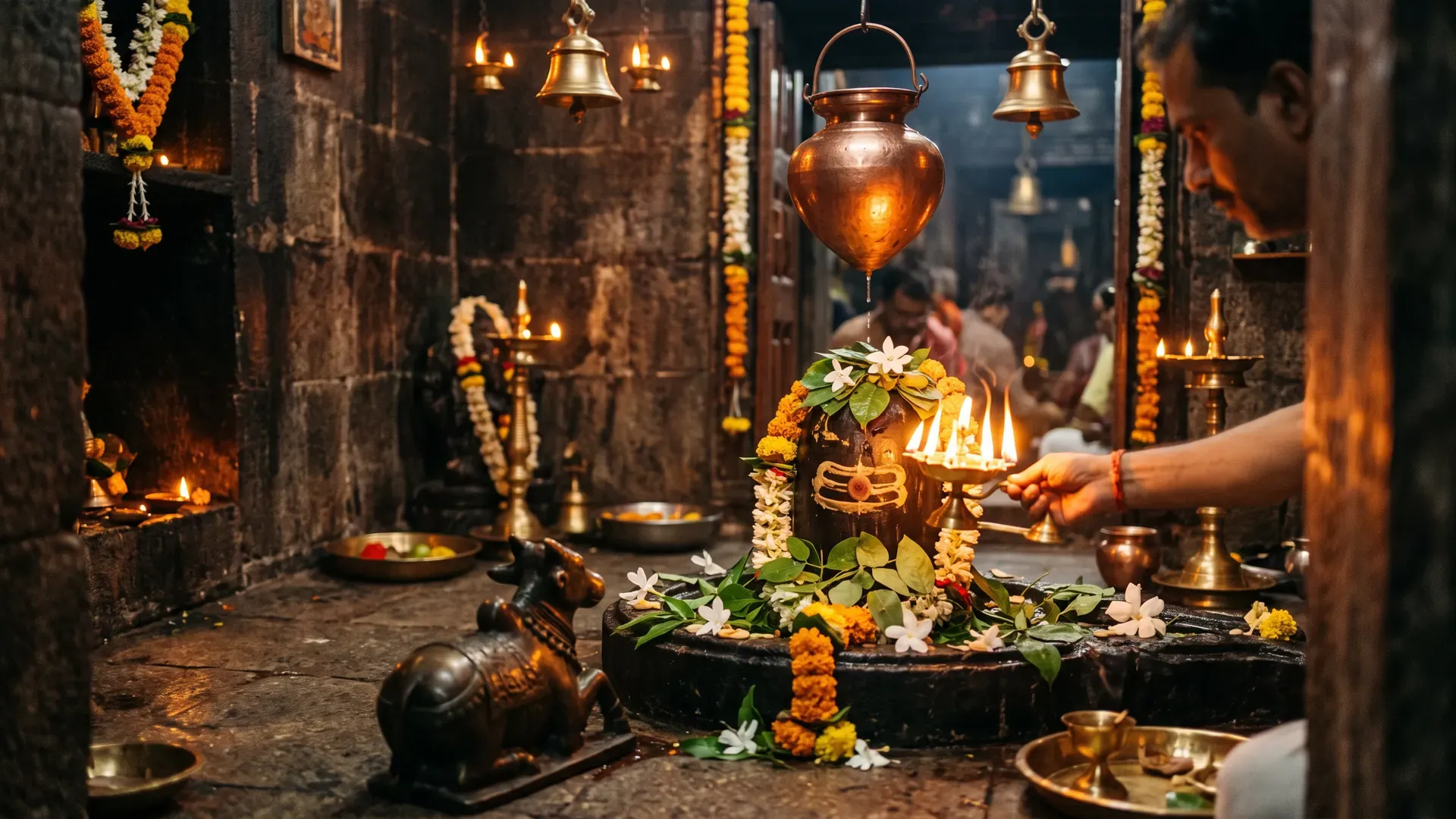
The original katha of the Pradosh vrat is in the Skanda Purana: Dharmagupta, an orphaned prince of Vidarbha, grows up in a poor brahmin widow’s home with her son Shuchivrata. On sage Shandilya’s advice the two boys worship Shiva at Pradosh time; Shuchivrata finds a pot full of treasure, and Dharmagupta marries the Gandharva maiden Anshumati and wins back his lost kingdom. Besides this, a separate katha is read for the Pradosh of each weekday (Som, Bhaum, Guru, Shani and the rest); those seven kathas have pages of their own.
Hindi in Roman letters: a reading aid, made by a program. The Devanagari text is the original.
The other language could not be loaded. Keep reading here, or try again.
Each morning the tithi, Rahu Kaal and coming festivals, in one short WhatsApp message.Follow the channel
The next Pradosh Vrat dates
- Friday, 6 November 2026Shukra Pradosh · Kartika Krishna TrayodashiPuja time 5:33–8:10 PM (New Delhi) · your city’s timeShukra Pradosh vrat katha →
- Sunday, 22 November 2026Ravi Pradosh · Kartika Shukla TrayodashiPuja time 5:25–8:06 PM (New Delhi) · your city’s timeRavi Pradosh vrat katha →
- Sunday, 6 December 2026Ravi Pradosh · Margashirsha Krishna TrayodashiPuja time 5:24–8:07 PM (New Delhi) · your city’s timeRavi Pradosh vrat katha →
- Monday, 21 December 2026Som Pradosh · Margashirsha Shukla TrayodashiPuja time 5:37–8:13 PM (New Delhi) · your city’s timeSom Pradosh vrat katha →
The Pradosh vrat is kept every month on the Trayodashi of both fortnights, and the puja is done in Pradosh kaal after sunset. By the Skanda Purana, at Pradosh time Shiva dances on Kailasa and all the gods attend on him there, so at that time Shiva alone is to be worshipped. The katha is heard after the puja.
The katha below is from the Brahmottara Khanda of the Brahma Khanda of the Skanda Purana (chapters 6–7 in G. V. Tagare’s English translation, chapter 7 in Gita Press’s abridged Skanda Puranank), where Suta tells it to the sages. We checked it event by event against the translation and a Hindi text based on Gita Press, and told it in our own words. In the printed Pradosh booklets the same story appears in short form as the katha of Som Pradosh and of Shani Pradosh; the differences are under "Other tellings" below.
The weekday kathas: by the Pradosh booklets, the katha of the weekday on which the Trayodashi falls is read and heard that day. These are kathas told by tradition; only the core episode of the Guru Pradosh katha is also found in the Skanda Purana (Kedara Khanda). All seven are under "The katha for each weekday" below.
How the vrat and katha are kept
- The day: by sage Shandilya in the Skanda Purana, fast all day on the Trayodashi of either fortnight, bathe three ghatis (about an hour and a quarter) before sunset, wear white, finish the evening rites and then begin the Shiva puja.
- The time: the puja is done in Pradosh kaal after sunset, while the Trayodashi tithi also runs (Drik Panchang). The time of the next Pradosh vrats (New Delhi) is above; every city’s time is on the month pages of the Pradosh list.
- The puja: Shiva is worshipped together with Parvati; bathing with water and panchamrit, sandal paste, bel leaves and flowers, incense, a lamp and food offering. The Purana says that one without much means should worship with what one can; Shiva accepts even a single flower offered with devotion.
- The prayer: at the end of the puja one prays to Shiva to remove debt, sin, misfortune and poverty (Skanda Purana). Then the katha is heard.
- The meal: by Gita Press’s "Vrat Parichay", after the puja, and after feeding brahmins and giving dakshina, one eats at night.
- The closing rite (udyapan): the booklets give it after 11 Trayodashis or the 26 of a year; "Vrat Parichay" gives the full term of the vrat as 21 years, and if that is not possible the vrat is closed with an udyapan. Settle the number and the udyapan with your family’s custom and your purohit.
Hindi in Roman letters: a reading aid, made by a program. The Devanagari text is the original.
The other language could not be loaded. Keep reading here, or try again.
The orphaned prince and sage Shandilya
After the Skanda Purana, Brahmottara Khanda; Suta tells it to the sages.
Suta said to the sages: a righteous king ruled the land of Vidarbha. Once enemy kings laid siege to his city. The king was killed in battle and his kingdom fell to the enemies. His little son was left an orphan; his mother too did not live.
In those days a poor brahmin woman whose husband had died lived by begging, with her little son. She came upon the orphaned prince. Out of pity she took him home and raised him along with her own son. The two boys grew up together, and the household still lived on alms.
One day the brahmin woman brought the two boys to sage Shandilya. She bowed to him and asked whose son the prince was and how the boys’ poverty could end. The sage told her that this was the son of the king of Vidarbha, whose father had been killed in battle. Of her own son he said that in his past life he had been a fine brahmin but had spent his whole life only accepting gifts, without performing sacrifices or other good rites; that was why poverty had come to him in this life, and the remedy was to take refuge in Lord Shankara.
Sage Shandilya said that those who do not worship Shiva at Pradosh time stay poor, while those who worship Shiva’s feet at Pradosh with a single mind see their wealth, grain, family and good fortune grow in this very world. Then he taught the rite: to fast on the Trayodashi of both fortnights, to bathe before sunset and wear white, and to worship Shiva together with Parvati at Pradosh time.
Shuchivrata finds a pot of treasure
Following the sage’s word, the two boys began to worship Shiva on every Pradosh. (In the katha the brahmin woman’s son is named Shuchivrata and the prince Dharmagupta.) Four months passed this way. One day Shuchivrata went to bathe in the river without the prince and wandered along the bank for a long while. There, in ground cut away by the flowing water, he saw a large buried pot gleaming, full of treasure. He brought it to his mother and said it was Shiva’s grace.
The mother called the prince too and said, "Sons, share this treasure equally." But Dharmagupta refused a share. He said, "This is the fruit of my brother’s merit. Lord Shankara has been gracious to him, and he will be gracious to me too." And he went on with the Shiva puja as before.
The Gandharva maiden Anshumati and Dharmagupta’s kingdom
A year passed in Shiva worship. One day the two brothers went walking in the forest. Some way in, they saw hundreds of Gandharva maidens at play. Shuchivrata said it was not right to go further where women were at play, and turned back and waited at a distance. Dharmagupta went on alone, without fear.
One of the maidens, seeing him come, began to think. She sent her friends to the nearby forest to bring champa and ashoka flowers and stayed behind. She offered Dharmagupta a seat and asked who he was and whose son. Dharmagupta said he was the son of the king of Vidarbha, that his parents were dead and enemies had taken his kingdom. The maiden said she was Anshumati, daughter of a Gandharva king, and took off her pearl necklace and gave it to Dharmagupta.
Dharmagupta said he had no kingdom and no wealth. Anshumati asked him to come to the same place after two days. He went home and told Shuchivrata and his mother everything.
When Dharmagupta reached the place on the appointed day, the Gandharva king was there with his daughter. He said, "I went to Kailasa. There Mahadeva called me and said that on earth there is a prince named Dharmagupta, whose kingdom enemies have seized and who always worships me; by his merit his ancestors have reached my world. Help him." At this command of Shiva the Gandharva king gave Anshumati to Dharmagupta and said he would defeat the enemies and win him back his kingdom.
The wedding took place there in the forest. As dowry the Gandharva king gave great wealth, weapons, chariots, elephants and horses, and an army of Gandharvas. Dharmagupta went to his city with the army, defeated the enemies, won back his kingdom and became king. The brahmin woman who had raised him remained his mother, Shuchivrata his brother, and Anshumati became queen.
Suta said that just as Dharmagupta won his kingdom by worshipping Shiva at Pradosh, so others too gain what they long for by worshipping Shiva on Pradosh. The Purana says that whoever hears or reads this greatness of Pradosh on that day after the Shiva puja is not poor for a hundred births.
Other tellings
- How the brahmin woman found the prince: in the English translation of the Purana (chapter 6) she finds him as a newborn by a lake where his mother had died; in the booklets’ Som Pradosh katha she meets him in a bad way on the road while returning from begging (wounded, in one booklet).
- The prince’s father: killed in battle in the Purana; in Drik Panchang and the Randhir Prakashan booklet a neighbouring king seized his kingdom; in the Manav Vikas Foundation booklet enemies took him captive.
- The treasure: in the Purana a pot buried in ground cut away by the river; in the booklets’ Shani Pradosh katha a golden pot found while going to bathe at a pond; in Aaj Tak’s telling near an old well of the village; in Swami Sivananda’s book a pot of nectar, which Shuchivrata drinks.
- The Gandharva king’s name: "Dravika" in the English translation, "Vidravik" or "Bidravik" in the booklets and Drik Panchang; the Hindi text based on Gita Press gives no name.
- The marriage: in the Purana Shiva gives the Gandharva king the command on Kailasa and the king comes after two days (on the third day, in the Shani Pradosh booklets); in the Som Pradosh katha Shiva gives Anshumati’s parents the command in a dream.
- Shuchivrata: in the Purana he is called the king’s brother; in the Som Pradosh katha the prince makes him his chief minister.
After the katha
After the katha the Shiva aarti is done; the Pradosh booklets give "Jai Shiv Omkara" for it. The katha of the weekday on which the Pradosh falls is on the pages below.
Pradosh Vrat 2026-27: full listFrequently asked questions
Which Purana has the Pradosh vrat katha?
The story of sage Shandilya, the brahmin woman and prince Dharmagupta is in the Brahmottara Khanda of the Brahma Khanda of the Skanda Purana (chapters 6–7 in G. V. Tagare’s English translation, chapter 7 in Gita Press’s abridged Skanda Puranank). The kathas of Ravi, Som, Bhaum, Budh and Shukra Pradosh are told by tradition and found in the printed Pradosh booklets and on Drik Panchang. The core episode of the Guru Pradosh katha is in the Kedara Khanda of the Skanda Purana (chapter 17), but there the day of the vrat is a Saturday Trayodashi.
Which katha is read on a Pradosh?
By the Pradosh booklets, the katha of the weekday on which the Trayodashi falls is read and heard that day: the Guru Pradosh katha on a Thursday, the Shani Pradosh katha on a Saturday, and so on. By the Skanda Purana, the story of the greatness of Pradosh on this page is heard or read on the Pradosh day after the Shiva puja.
At what time are the Pradosh puja and katha done?
After sunset, in Pradosh kaal, while the Trayodashi tithi also runs (Drik Panchang). The puja time of the next Pradosh vrats (New Delhi) is at the top of this page, and every city’s time is on the month pages of the Pradosh list. The katha is heard after the puja.
Sources
- Skanda Purana, Brahma Khanda, Brahmottara Khanda, chapter 6 "The Importance of Pradosha" and 7 "The Procedure of Shiva’s Worship", English translation by G. V. Tagare (Motilal Banarsidass), on wisdomlib.org (read 10 October 2026)
- The article "Pradoshavrat ki vidhi evam mahima" (in the book "Ishanah Sarvadevanam", pp. 314–329), based, it says, on Gita Press’s "Vrat Parichay" (Pt. Hanuman Sharma) and Kalyan’s "Sankshipt Skanda Puranank" (Brahma Khanda, Brahmottara Khanda, ch. 7; Maheshvara Khanda, Kedara Khanda, ch. 17): archive.org/details/20240806_20240806_0143
- "Pradoshapuja Piyush", Samarthashri Tryambakeshwar Chaitanya, Shri Dharmasamrat Prakashanam, 2019, pp. 77–78: Hindi rendering of Shandilya’s words in the Skanda Purana, Brahmottara Khanda (verses 71–80) (archive.org/details/pradosh-book-fainal-pdf-1)
- Swami Sivananda, "Hindu Fasts and Festivals", chapter "Pradosha Vrata" (dlshq.org)
- Drik Panchang, Soma Pradosha Vrat Katha (drikpanchang.com/vrat-katha/pradosha/soma-pradosha/soma-pradosha-vrat-katha.html), read 10 October 2026
- Drik Panchang, Shani Pradosha Vrat Katha (drikpanchang.com/vrat-katha/pradosha/shani-pradosha/shani-pradosha-vrat-katha.html), read 10 October 2026
- "Pradosh (Trayodashi) Vrat Katha, with the separate kathas of all seven days", told by Pt. Jwala Prasad Chaturvedi, Randhir Prakashan, Haridwar (archive.org/details/PradoshVratKathaRandhirPrakashan)
- "Pradosh (Trayodashi) Vrat Katha, Puja Vidhi, Udyapan Vidhi", Manav Vikas Foundation, Mumbai (Acharya Akhilesh Dwivedi), 2021 (archive.org/details/mvf_20240803_20240803_1531)
- Aaj Tak, "Shani Pradosh Vrat Katha" (aajtak.in/religion/vrat-katha/shani-pradosh-vrat-katha-2588072), read 10 October 2026
- Skanda Purana, Maheshvara Khanda, Kedara Khanda, chapter 17 "Vritra Killed", English translation by G. V. Tagare, on wisdomlib.org (read 10 October 2026)
- Drik Panchang, Pradosh list, puja times and the names by weekday (drikpanchang.com/vrats/pradoshdates.html)
Something wrong? Report a mistake