In the Padma Purana (Uttara Khanda) the sage Vasishtha tells King Mandhata the Amalaki Ekadashi katha: after the great dissolution the amla tree arose from a drop that fell from the mouth of the Supreme Self, all the gods dwell in it, and the Lord himself taught the sages the vow of a vigil beneath the amla and the worship of Parashurama on Phalguna Shukla Ekadashi. A popular tale is also told on this day, of a hunter who stayed awake and hungry all night watching this Ekadashi’s vigil in the city of Vaidisha and was reborn as King Vasuratha; that tale is not in the Padma Purana.
Each morning the tithi, Rahu Kaal and coming festivals, in one short WhatsApp message.Follow the channel
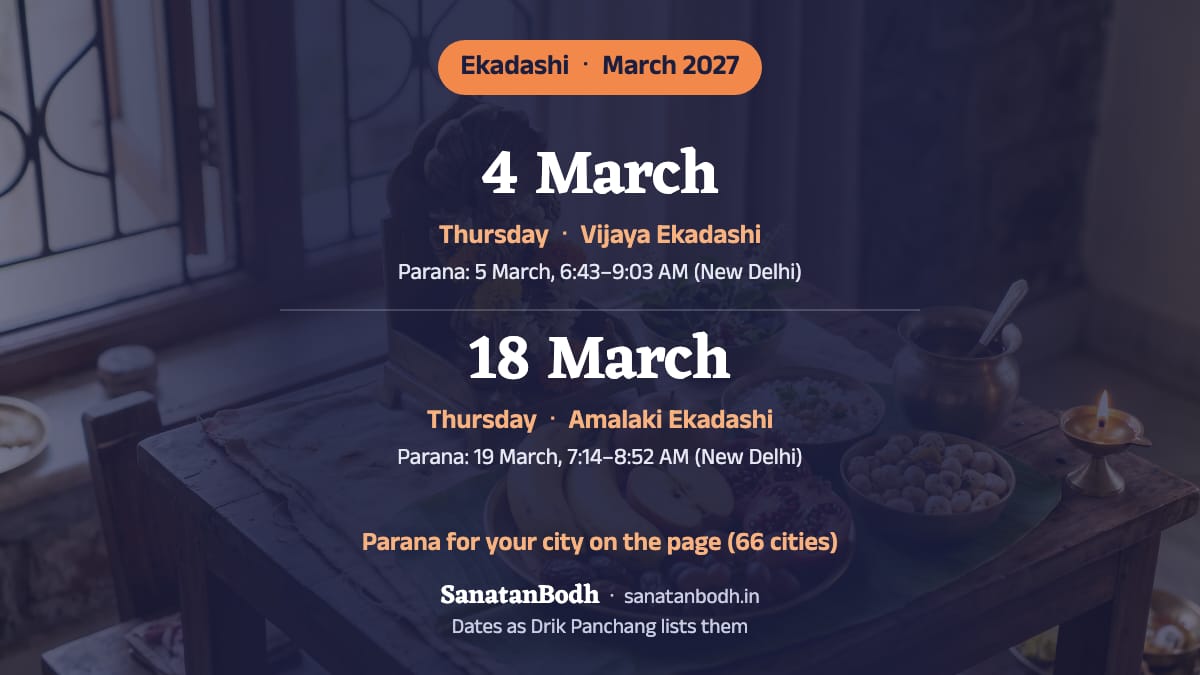
Amalaki Ekadashi falls on Phalguna Shukla Ekadashi, a few days before Holi. Amalaki is the Sanskrit name of the amla (Indian gooseberry): on this day Lord Vishnu is worshipped at an amla tree, a fast is kept and a vigil held at night. The katha is read or heard after the puja.
The Amalaki chapter of the Padma Purana’s Uttara Khanda tells no story of mortals: it gives the origin of the amla, its glory and the full rite of the vow. Drik Panchang, vrat-katha websites and the ISKCON book tell on this day the tale of a hunter and King Vasuratha. So this page first gives the Padma Purana’s account in our own words, and then that popular tale, kept apart.
How the vrat and katha are kept
- By the Padma Purana, on Ekadashi morning one cleans the teeth and takes this vow: “O lotus-eyed Achyuta, I will stay without food on Ekadashi and eat on the next day; be my refuge.” That day one does not talk with the fallen, thieves, hypocrites and the wicked.
- In the afternoon, a bath in a river, pond, well or at home, first rubbing the body with earth. Then a small golden image of Parashurama, as one can afford, and worship and homa at home.
- Then take everything to an amla tree, clean the ground all round, and set up a pot full of water there: five gems and fragrance in it, a garland at its neck, white sandal paste, an umbrella and sandals beside it, incense and rows of lamps all round. On the pot place a vessel filled with puffed rice (laja) and on it the image of Parashurama; worship its limbs with the Lord’s names and offer arghya with a fruit.
- A vigil all night with devotion: songs, music, sacred stories and hymns. Going round the amla tree 108 or 28 times while saying the names of Lord Vishnu.
- On Dwadashi morning, aarti to Shri Hari; a brahmin is honoured and given Parashurama’s pot, a pair of clothes and sandals; then one touches the amla and goes round it, bathes, feeds brahmins, and after that eats with one’s family.
- Where no amla tree is at hand, families choose the form of worship by their own custom; the ISKCON book suggests worshipping tulsi in that case.
Padma Purana: how the amla arose, and the Amalaki vow
As given in the Padma Purana, Uttara Khanda, chapter 45 (47 in the Gita Press edition), checked against the Sanskrit, Deshpande’s English translation and the Gita Press Hindi. The chapter tells no story of mortals.
Yudhishthira said, “Krishna, I have heard the glory of Vijaya Ekadashi, which bears great fruit. Now tell me the name of the Ekadashi of the bright half of Phalguna.” Krishna said, “Son of Dharma, listen. I will tell you what the great Vasishtha said when King Mandhata asked him.”
Vasishtha said, “The Ekadashi of Phalguna Shukla is named Amalaki. Its holy vow leads to Lord Vishnu’s world. To go beneath an amla tree on this day and keep vigil there at night brings the fruit of a gift of a thousand cows.” Mandhata asked, “Best of the twice-born, when did this amalaki come to be? Why is it holy, and why does it destroy sin? I am eager to know.”
Vasishtha said, “Fortunate one, hear how the amla came to the earth. Long ago, when all was sunk in a single ocean and everything moving and unmoving, gods, asuras, serpents and rakshasas alike, had perished, the eternal Supreme Self rested in his imperishable state. From his mouth a drop shining like the moon came forth and fell to the earth. From that drop arose the great amla tree, many-branched and bowed with the weight of its fruit. It is called the first of all trees.”
“Then came creation, and gods, danavas, gandharvas, yakshas, rakshasas, serpents and the pure-minded great sages were born. The gods and sages came to where this amla, dear to the Lord, stood, and were amazed at the sight: this tree they did not know. Then a voice spoke from the sky: ‘This is the amalaki, the best of trees, dear to Lord Vishnu. To remember it brings the fruit of the gift of a cow, to touch it twice that, and to wear it thrice. So serve it always; it takes away all sin.’”
“‘In its root dwells Vishnu, above it Brahma, in its trunk Lord Rudra, in its branches all the sages, in its twigs the gods, in its leaves gods too, in its flowers the Maruts, and in its fruit all the Prajapatis. This dhatri is full of all the gods, and so it is most worthy of worship for Vishnu’s devotees.’ The sages asked, ‘Who are you? A god, or some other?’ The voice said, ‘I am he who made all beings and all worlds: I am the eternal Vishnu.’”
“Hearing this, those sages, the sons of Brahma, praised the Lord without beginning or end. Pleased, the Lord asked, ‘What boon shall I give you?’ The sages said, ‘Lord, for our good, tell us of a vow that gives heaven and liberation, wealth and grain, much fruit for little toil, and by which one is honoured in Vishnu’s world.’”
“Lord Vishnu said, ‘In the bright half of Phalguna, if the Dwadashi falls under the Pushya nakshatra, it gives great merit and destroys great sins. On Amalaki Ekadashi go to an amla tree and keep vigil there at night; by this one is freed of all sins and gains the fruit of a gift of a thousand cows.’ When the sages asked, the Lord gave its full rite, set out above: the vow, the bath after rubbing on earth, the image of Parashurama, the worship of the pot beneath the amla, the vigil and the rounds of the tree, and the gifts and meal on Dwadashi.”
“The Lord said that whoever keeps the vow by this rite gains the merit of every tirtha and every gift, and more fruit than every sacrifice. With that he vanished then and there, and all those sages kept the vow in full.” Vasishtha said, “Lord of kings, you too should keep this vow.” At the end Krishna tells Yudhishthira that this demanding vow frees one from all sins.
The hunter and King Vasuratha: a popular tale
This tale is not in the Amalaki chapter of the Padma Purana. It is found in Drik Panchang, Bhakti Bharat and the ISKCON Ekadasi book, in which Vasishtha tells it to Mandhata. The ISKCON book places it in the Brahmanda Purana; we have not checked it there, so we give it as a popular tale.
As the popular tale goes, there was a city named Vaidisha where people of all four varnas lived in happiness and the recitation of the Veda was always heard. No one there was wicked or faithless. It was ruled by Chaitraratha, a king of the lunar line, learned and righteous. In his kingdom no one was poor or miserly, and young and old alike were devotees of Lord Vishnu and kept every Ekadashi.
Amalaki Ekadashi came, in the bright half of Phalguna. The king and all his people kept the fast gladly. They went to the temple, set up a sacred pot, and worshipped the amla with incense, lamps, food offerings and five gems. They prayed, “O dhatri, you destroy all sins; accept our offering.” At night they all kept vigil there.
That night a hunter came there. He fed his family by killing creatures and was a great sinner. Faint with hunger and thirst, he sat down in a corner of the temple, hoping for something to eat. Sitting there he listened to the story of Lord Vishnu and the glory of the Ekadashi, and like everyone else he stayed awake all night.
In the morning everyone went home, and the hunter too went home and ate. Some time later he died. For his killing of creatures he was bound for hell, but by the merit of that night’s fast and vigil he was born in the house of King Viduratha and named Vasuratha.
Grown up, Vasuratha became king. He was like the sun in splendour, the moon in beauty, Vishnu in valour and the earth in forbearance. He was righteous, truthful and devoted to Vishnu, cared for his people without favour, and gave in charity every day.
One day Vasuratha went hunting and lost his way in the forest. Tired, he fell asleep under a tree. Just then some armed men came who counted him their enemy, saying, “This is the king who killed our kin and drove us from the land; kill him today.” They began to strike at him with all kinds of weapons.
But their weapons broke the moment they touched the king’s body, and felt to him like flowers. Then their weapons turned back on them, and they began to fall senseless. At that moment a divine goddess came forth from the king’s body: very beautiful and adorned with jewels, but with brows knit and the fire of anger blazing from her eyes. In a moment she slew all those enemies.
When the king woke and saw his enemies lying dead all round, he was amazed: “Who has slain them? Who in this forest wishes me well?” Then a voice spoke from the sky: “O king, who but Lord Vishnu could protect you?” Hearing this, the king bowed to Lord Vishnu, returned to his city and ruled in peace.
At the end Vasishtha says that all this was the power of the Amalaki Ekadashi fast; whoever keeps it succeeds in every task and at last goes to the world of Vishnu.
Other tellings
- The Sanskrit Padma Purana and Gita Press have no tale of the hunter or Vasuratha in this chapter; it gives only the origin of the amla, its glory and the rite. The hunter’s tale is in Drik Panchang, Bhakti Bharat and the ISKCON book.
- The king is Chaitraratha in Drik Panchang, Chaitratha in Bhakti Bharat, and in the ISKCON book Pashabinduka, also called Chitraratha. The ISKCON book says Vasuratha ruled Jayanti; Drik Panchang and Bhakti Bharat say he ruled ten thousand villages.
- In the ISKCON book the hunter watches the festival from hiding, and the goddess slays the enemies with her blazing discus; there Parashurama is worshipped too. In Drik Panchang and Bhakti Bharat the enemies’ weapons turn back on them.
- The drop from which the amla arose fell, by Gita Press and Drik Panchang, from Lord Vishnu’s mouth; Deshpande’s translation reads it as a drop from Brahma’s mouth. The Sanskrit has “ब्रह्ममुखात्” here, which has been read both ways.
- The Padma Purana says gods dwell in the amla’s leaves; Gita Press names the Vasus here. The Sanskrit gives threefold merit for wearing the amla; Gita Press for eating its fruit. Gita Press also gives a mantra for the arghya to Parashurama that is not in the Sanskrit Wikisource text.
After the katha
After the katha the aarti of Lord Vishnu and the Ekadashi Mata aarti are sung, and at night a vigil is kept by the amla tree and rounds are made of it. The fast is broken the next day, Dwadashi, at the parana time; the parana time for your city is on the Amalaki Ekadashi page.
Ekadashi Aarti: Om Jai Ekadashi MataFrequently asked questions
Which Purana has the Amalaki Ekadashi katha?
The Uttara Khanda of the Padma Purana has the origin of the amla and the rite of the vow, told by the sage Vasishtha to King Mandhata (chapter 45 on Sanskrit Wikisource and in Deshpande, 47 in Gita Press). The tale of the hunter and King Vasuratha is not in it; the ISKCON book places that tale in the Brahmanda Purana, which we have not checked.
Why is the amla worshipped on Amalaki Ekadashi?
By the Padma Purana the amla arose from a drop that fell from the mouth of the Supreme Self, Vishnu dwells in its root, Brahma above it and Rudra in its trunk, and the Lord himself taught the vow of a vigil beneath the amla on this day.
Why is Parashurama worshipped on Amalaki Ekadashi?
The Padma Purana’s rite for this vow asks for a golden image of Parashurama (Jamadagnya) to be worshipped on a pot beneath the amla and given away the next day, with the prayer that Lord Keshava be pleased in Parashurama’s form.
When is the Amalaki Ekadashi katha read?
By tradition, on the Ekadashi after the worship of the amla and of Lord Vishnu, before the aarti, and during the night vigil.
Sources
- Padma Purana, Uttara Khanda, chapter 45, Sanskrit Wikisource (chapter numbers vary by edition; 47 in the Gita Press edition)
- Padma Purana, Uttara Khanda, chapter 45, N. A. Deshpande’s English translation (Motilal Banarsidass; wisdomlib.org)
- Gita Press, Gorakhpur: Ekadashi-vrat ka Mahatmya, compiled by Radheshyam Khemka, pp. 26–31 (based on the Padma Purana)
- ISKCON’s Ekadasi book text: Amalaki Ekadasi (iskcondesiretree.com)
- Drik Panchang: Amalaki Ekadashi Vrat Katha (Hindi and English), drikpanchang.com
- Bhakti Bharat: Amalaki Ekadashi Vrat Katha (bhaktibharat.com)
Something wrong? Report a mistake