The Jaya Ekadashi katha is in the Padma Purana (Uttara Khanda). Singing in Indra’s court, the Gandharvas Malyavan and Pushpavati are so taken with each other that they lose tune and rhythm, and Indra curses them to become pishachas. Suffering in the cold of the Himalaya, on Magha Shukla Ekadashi they sit beneath a peepal tree without food or water and stay awake all night. The next morning, on Dwadashi, by Lord Vishnu’s grace their pishacha form falls away and they return to heaven.
Each morning the tithi, Rahu Kaal and coming festivals, in one short WhatsApp message.Follow the channel
Jaya Ekadashi falls on Magha Shukla Ekadashi. The Padma Purana calls it the Ekadashi that takes away all sins and frees one from the state of a pishacha or a ghost. Lord Vishnu is worshipped and a fast is kept on the day, and the katha is read or heard after the puja. ISKCON’s calendar also calls it Bhaimi Ekadashi.
The katha is in the Uttara Khanda of the Padma Purana, where Krishna tells it to Yudhishthira at his request. We have written it in our own words from the Sanskrit, Deshpande’s English translation and the Gita Press Hindi translation, compared with Drik Panchang and the ISKCON book.
How the vrat and katha are kept
- The Padma Purana gives no separate detailed rite for this Ekadashi; the fast is kept like any Ekadashi, with the worship of Lord Vishnu, fasting and a night vigil.
- In the katha Malyavan and Pushpavati eat no food, drink no water, kill no creature and eat no fruit or leaf that day, and stay awake all night; the text counts this as their fast and vigil.
The story of Malyavan and Pushpavati
As told in the Padma Purana, Uttara Khanda, chapter 43 (the Gita Press edition numbers its chapters two higher), checked against the Sanskrit, Deshpande’s English translation and the Gita Press Hindi.
Yudhishthira said, “Krishna, you are the first of the gods; you create, sustain and dissolve all beings. You have told me of Shattila Ekadashi in the dark half of Magha. Now, of your kindness, tell me which Ekadashi comes in the bright half, what its rite is and which deity is worshipped that day.”
Krishna said, “Lord of kings, the Ekadashi of the bright half of Magha is known as Jaya. It takes away all sins, purifies, fulfils wishes and grants liberation. It removes even the sin of killing a brahmin and ends the state of a pishacha; one who keeps its fast never becomes a ghost. So it should be kept with care. Now hear its ancient, auspicious story.”
Once Indra was ruling in heaven. The gods lived there in ease, drank nectar and were waited on by the apsaras. One day, in the Nandana garden full of parijata trees, Indra in good spirits called for dance and song. The Gandharvas Pushpadanta and Chitrasena were singing there.
Chitrasena’s wife Malini had a daughter, Pushpavati. The Gandharva Pushpadanta had a son, Malyavan. Malyavan was captivated by Pushpavati’s beauty, and Pushpavati too had won his heart with her glances. That day both had come to sing for Indra’s pleasure.
As they sang, they had eyes only for each other. With their minds astray they could not sing true: now the rhythm broke, now the song stopped. Indra saw where their hearts were, and taking it as an insult to himself he grew angry.
Indra cursed them: “Shame on you both, you fools! You have broken my command. Go to the mortal world as pishachas, husband and wife, and reap the fruit of your deed.”
Grieved by the curse, the two came to the Himalaya and became pishachas. They forgot that they had ever been Gandharvas. At night they found neither sleep nor rest. Talking of their misery to each other, they wandered the mountain caves. In the cold of the snow their teeth chattered and their hair stood on end.
One day the pishacha said to his wife, “What dreadful sin did we commit, that our own wrongdoing has brought us to this pishacha life? Hell is terrible, and to be a pishacha is just as painful. So one must keep from sin with all one’s strength.” In this sorrow they were wasting away.
As fate would have it, the Ekadashi of the bright half of Magha came, the one known as Jaya. That day, in their misery, the two neither ate nor drank. They killed no creature and ate no leaf or fruit. All day they sat in sorrow beside a peepal tree.
The sun set, and a dreadful, deadly cold night came on. Trembling, they lay on the ground clinging to each other, but neither sleep nor any comfort came. So, tormented by Indra’s curse, they passed that night, and the sun rose on Dwadashi.
Krishna says, “I had resolved in my heart to free them, for they had kept the Jaya fast and the night’s vigil.” On Dwadashi, by Lord Vishnu’s power, their pishacha form fell away. Pushpavati and Malyavan were themselves again, with their old love and their old ornaments, and they rode a celestial chariot back to heaven.
They went and joyfully bowed to Indra. Astonished to see them so, Indra said, “Tell me, by what merit did your pishacha form leave you? You were bound by my curse; which god set you free?” Malyavan said, “Lord, it was the grace of Lord Vasudeva and the fast of Jaya Ekadashi that freed us.”
Indra said, “Then you are both made pure and are worthy of honour even from me. Mortals who keep the fast of Hari’s day and live in the Lord’s refuge are worthy of worship even by us gods. Now live happily in heaven with Pushpavati.”
At the end Krishna says, “So, O king, the Ekadashi fast should be kept. Jaya takes away even the sin of killing a brahmin. One who has kept the Jaya fast has, as it were, given every gift and performed every sacrifice.” According to the katha, the one who fasts rejoices in Vaikuntha for an age beyond counting, and reading and hearing this katha bring the fruit of an Agnishtoma sacrifice.
Other tellings
- Pushpavati is “Pushpadanti” in the Sanskrit Padma Purana, “Pushpavanti” in Gita Press, and “Pushpavati” in Drik Panchang and the ISKCON book; we use the common name.
- In the Sanskrit and Gita Press, Malyavan is the son of the Gandharva Pushpadanta and Pushpavati the daughter of Chitrasena and Malini. In the ISKCON book Malyavan is the son of Chitrasena and Malini and Pushpavati an apsara; Drik Panchang calls Pushpavati a Gandharva maiden.
- In the Sanskrit, Gita Press and the ISKCON book the two do not eat even fruit that day; in Drik Panchang they live on fruit and flowers alone.
- In Drik Panchang and the ISKCON book Indra says that devotees of both Lord Vishnu and Lord Shiva are worthy of honour even from the gods; the Sanskrit speaks here only of Hari’s devotees. In Gita Press Indra bids them drink nectar.
- The fruit of the fast is joy in Vaikuntha for crores of kalpas in the Sanskrit; a thousand years in heaven in Drik Panchang. In Drik Panchang’s telling Krishna tells the katha to Arjuna. The ISKCON book places it in the Bhavishyottara Purana, yet in it too Krishna says he has told this episode in the Padma Purana, as the Sanskrit also has him say.
After the katha
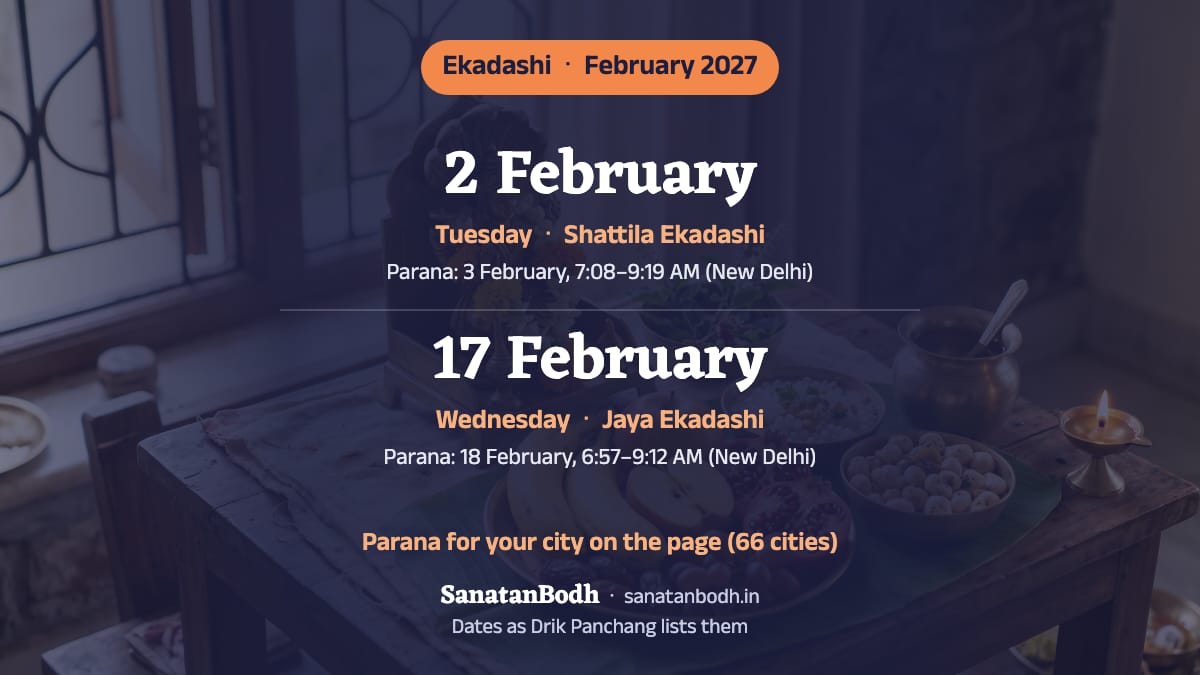
After the katha the aarti of Lord Vishnu and the Ekadashi Mata aarti are sung, and a vigil is kept at night. The fast is broken the next day, Dwadashi, at the parana time; the parana time for your city is on the Jaya Ekadashi page.
Ekadashi Aarti: Om Jai Ekadashi MataFrequently asked questions
Which Purana has the Jaya Ekadashi katha?
The Uttara Khanda of the Padma Purana, where Krishna tells it to Yudhishthira. It is chapter 43 on Sanskrit Wikisource and in Deshpande’s English translation; the Gita Press edition numbers its chapters two higher.
Why is the Jaya Ekadashi fast kept?
By the Padma Purana it takes away all sins and frees one from the state of a pishacha or a ghost; in the katha this very fast frees Malyavan and Pushpavati from Indra’s curse.
Why is Jaya Ekadashi also called Bhaimi Ekadashi?
ISKCON’s calendar and its Ekadasi book also call Magha Shukla Ekadashi Bhaimi Ekadashi. This chapter of the Padma Purana gives no reason for the name, so we add none.
When is the Jaya Ekadashi katha read?
By tradition, on the Ekadashi after the worship of Lord Vishnu and before the aarti. By the Padma Purana, reading and hearing it bring the fruit of an Agnishtoma sacrifice.
Sources
- Padma Purana, Uttara Khanda, chapter 43, Sanskrit Wikisource (chapter numbers vary by edition)
- Padma Purana, Uttara Khanda, chapter 43, N. A. Deshpande’s English translation (Motilal Banarsidass; wisdomlib.org)
- Gita Press, Gorakhpur: Ekadashi-vrat ka Mahatmya, compiled by Radheshyam Khemka, pp. 21–23 (based on the Padma Purana)
- ISKCON’s Ekadasi book text: Bhaimi (Jaya) Ekadasi (iskcondesiretree.com)
- Drik Panchang: Jaya Ekadashi Vrat Katha (Hindi and English), drikpanchang.com
Something wrong? Report a mistake