The Pausha Putrada Ekadashi katha is in the Padma Purana (Uttara Khanda). King Suketuman of Bhadravati and his queen grieved that they had no son; his forefathers too worried about who would offer them water after him. In his sorrow the king rode alone into the forest, where by a lake he met the sages called the Vishvedevas. They told him that the day was Putrada Ekadashi. On their word the king kept the fast and broke it on Dwadashi, and in time a radiant son was born to him.
Each morning the tithi, Rahu Kaal and coming festivals, in one short WhatsApp message.Follow the channel
Pausha Putrada Ekadashi falls on Pausha Shukla Ekadashi. “Putrada” means “giver of a son”. The Ekadashi of Shravana Shukla is also named Putrada, so the panchangs call this one Pausha Putrada. Lord Narayana is worshipped and a fast is kept on the day, and by tradition couples who wish for a son or a child keep it in particular. The katha is read or heard after the puja.
The katha is in the Uttara Khanda of the Padma Purana, where Krishna tells it to Yudhishthira at his request. We have written it in our own words from the Sanskrit, Deshpande’s English translation and the Gita Press Hindi translation, compared with Drik Panchang and the ISKCON book.
How the vrat and katha are kept
- By the Padma Purana this fast is kept with care by the same Ekadashi rite already described. The presiding deity of this Ekadashi is Lord Narayana.
- In the katha the king fasts that very day on the sages’ word and breaks the fast on the next day, Dwadashi.
- If you have worries about having a child, take your doctor’s advice along with the fast, and choose the form of the fast to suit your health.
The story of King Suketuman
As told in the Padma Purana, Uttara Khanda, chapter 41 (the Gita Press edition numbers its chapters two higher), checked against the Sanskrit, Deshpande’s English translation and the Gita Press Hindi.
Yudhishthira said, “Krishna, you have told me the glory of Saphala Ekadashi. Now, of your kindness, tell me of the Ekadashi of the bright half of Pausha. What is its name, what is its rite, and which deity is worshipped on that day?”
Krishna said, “O king, for the good of the world I will tell you. This fast too should be kept with care by the rite already described. Its name is Putrada; it is an excellent tithi that takes away all sins. Lord Narayana, who fulfils wishes and grants success, is its presiding deity, and in the three worlds there is no tithi greater. Now hear its story, which takes away sin.”
Long ago King Suketuman ruled the city of Bhadravati. His queen was named Champaka. Much of the king’s life went by, but no son was born to carry on his line. He kept thinking, “What shall I do, where shall I go, how shall I have a son?” He found no joy in his kingdom or his city; with his devoted queen he was sad every day.
His forefathers grieved too. The water the king offered them they drank warmed by their sighs, thinking, “After the king we see no one who will offer us water.” Kin, friends, ministers, elephants, horses and soldiers: nothing pleased the king any more.
Despair settled in the king’s heart. He thought, “Without a son life bears no fruit; a sonless man’s house is empty and his heart always sad. Without a son there is no release from the debts owed to the forefathers, the gods and men. Sons and fortune come only from merit and devotion to Vishnu.” Sunk in this worry day and night, the king once thought of ending his own life, but held back, reflecting that taking one’s own life leads to a bad end.
Seeking some way to his own good, the king mounted his horse and rode alone into the deep forest; not even his priest knew. In the forest he saw banyan, peepal, bel, date palm, jackfruit and many other trees; he saw jackals, hares, wildcats, buffaloes and snakes half out of their anthills; he saw elephants in rut moving among the cow elephants and their calves, and the sight brought his own elephants to mind. Here jackals howled, there owls hooted.
Midday came. Faint with hunger and thirst, the king wandered this way and that, his throat parched. He thought, “What have I done to earn such sorrow? I have pleased the gods with sacrifice and worship and the brahmins with gifts and good food, and I have always cared for my people as my own sons. Why then this great grief?”
Going on in this worry, by the power of his own merit he came upon a lovely lake with lotuses in bloom, swans, chakravaka birds and fish. Near it were many hermitages of sages. Just then came good omens: the king’s right eye and right hand began to throb. On the shore the sages were reciting the Veda.
The king was overjoyed. Getting down from his horse, he folded his hands and bowed full length again and again to each sage in turn. The sages said, “O king, we are pleased with you.” The king asked, “Who are you, what are your names, and why have you gathered here? Tell me truly.”
The sages said, “O king, we are the Vishvedevas, and we have come here to bathe. The month of Magha is near, five days from today. Today is the Ekadashi named Putrada; Lord Vishnu gives a son to those who keep its fast.”
The king said, “Having no son is my greatest care. If you are pleased with me, grant me the boon of a son.” The sages said, “O king, this very day is Putrada Ekadashi. Keep its excellent fast today. By the grace of Lord Keshava and our blessing you will surely have a son.”
On the sages’ word the king kept the Putrada Ekadashi fast by the rite they taught. On Dwadashi he broke the fast, bowed to the sages again and again and returned home. Some time later the queen conceived, and when her time came a radiant son was born by the power of that merit. He pleased his father with his virtues and grew up to be a king who cared for his people.
At the end Krishna says, “So, O king, the excellent vow of Putrada should be kept. Those who keep it with a steady mind gain sons in this world and go to heaven after death.” According to the katha, reading and hearing it bring the fruit of an Agnishtoma sacrifice.
Other tellings
- The queen is Champaka in the Sanskrit Padma Purana and Deshpande, Champa in Gita Press, and Shaivya in Drik Panchang and the ISKCON book.
- In the Padma Purana, Gita Press and the ISKCON book, Krishna tells this katha to Yudhishthira; in Drik Panchang, to Arjuna.
- Drik Panchang calls the sages at the lake simply “rishis” and does not name them as the Vishvedevas. The ISKCON book also lists ten Vishvedevas by name, which the Sanskrit does not.
- The fruit of reading or hearing the katha equals an Agnishtoma sacrifice in the Sanskrit and Gita Press, and a horse sacrifice in the ISKCON book. The ISKCON book places the katha in the Bhavishya Purana; we have not checked it there.
After the katha
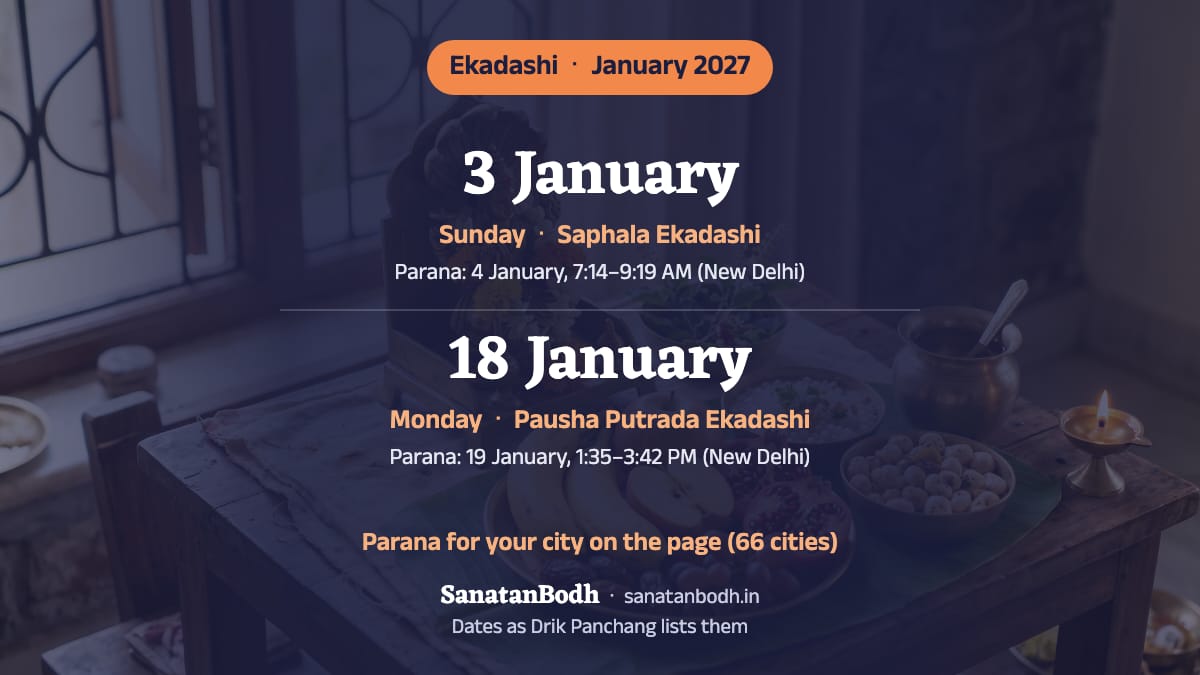
After the katha the aarti of Lord Vishnu and the Ekadashi Mata aarti are sung. The fast is broken the next day, Dwadashi, at the parana time; the parana time for your city is on the Pausha Putrada Ekadashi page.
Ekadashi Aarti: Om Jai Ekadashi MataFrequently asked questions
Which Purana has the Pausha Putrada Ekadashi katha?
The Uttara Khanda of the Padma Purana, where Krishna tells it to Yudhishthira. It is chapter 41 on Sanskrit Wikisource and in Deshpande’s English translation; the Gita Press edition numbers its chapters two higher.
How many times a year does Putrada Ekadashi come?
Twice: on Pausha Shukla Ekadashi (Pausha Putrada) and on Shravana Shukla Ekadashi (Shravana Putrada). This katha is the Pausha Putrada one.
Who is worshipped on Pausha Putrada Ekadashi?
Lord Narayana (Vishnu). In the Padma Purana Krishna names him the presiding deity of this tithi, and in the katha the sages tell the king a son will come by the grace of Lord Keshava.
When is the Pausha Putrada Ekadashi katha read?
By tradition, on the Ekadashi after the worship of Lord Vishnu and before the aarti. By the Padma Purana, reading and hearing it bring the fruit of an Agnishtoma sacrifice.
Sources
- Padma Purana, Uttara Khanda, chapter 41, Sanskrit Wikisource (chapter numbers vary by edition)
- Padma Purana, Uttara Khanda, chapter 41, N. A. Deshpande’s English translation (Motilal Banarsidass; wisdomlib.org)
- Gita Press, Gorakhpur: Ekadashi-vrat ka Mahatmya, compiled by Radheshyam Khemka, pp. 16–19 (based on the Padma Purana)
- ISKCON’s Ekadasi book text: Putrada Ekadasi (iskcondesiretree.com)
- Drik Panchang: Pausha Putrada Ekadashi Vrat Katha (Hindi and English), drikpanchang.com
Something wrong? Report a mistake
