The Saphala Ekadashi katha is in the Padma Purana (Uttara Khanda). King Mahishmata of Champavati drives his eldest son Lumpaka out of the kingdom for his sins. Living under an old peepal tree in the forest, Lumpaka lies numb with cold on the night of Pausha Krishna Dashami, goes hungry on the Ekadashi, lays the fruit he has gathered at the tree’s root as an offering to the Lord in the evening, and stays awake all night. The Lord counts this as his fast, worship and vigil; his form and his heart are changed, and he wins back his kingdom.
Each morning the tithi, Rahu Kaal and coming festivals, in one short WhatsApp message.Follow the channel
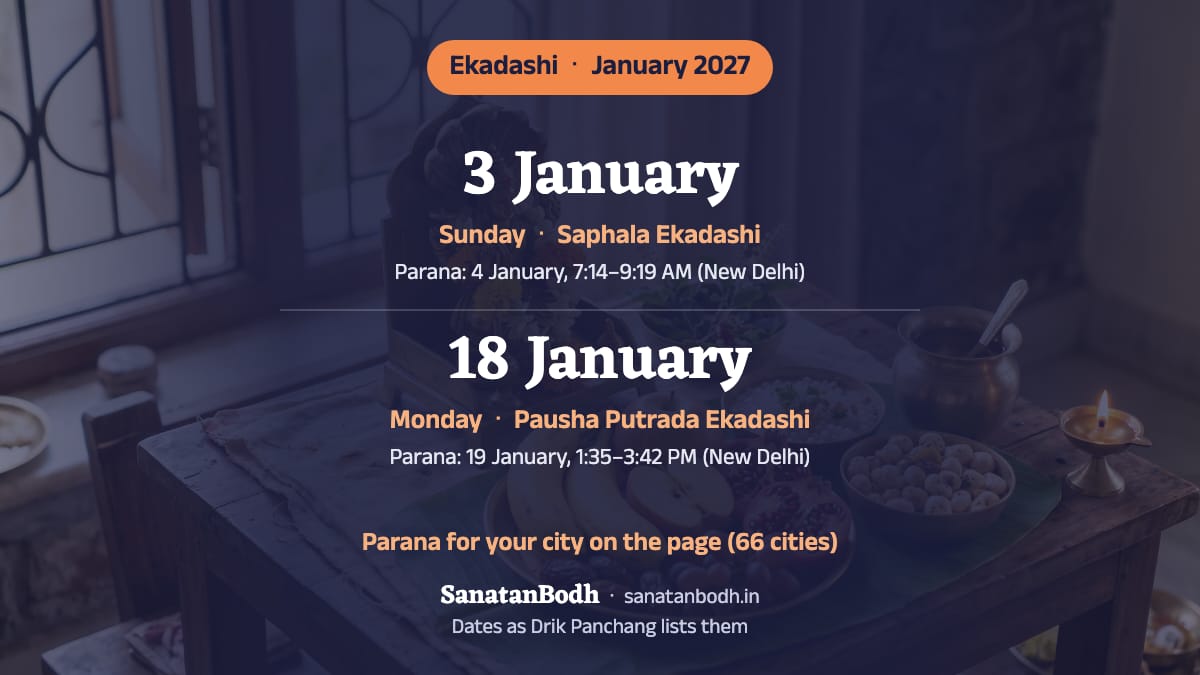
Saphala Ekadashi falls on Pausha Krishna Ekadashi (Purnimanta calendar; Margashirsha Krishna in the Amanta calendar). “Saphala” means fruitful, the one that brings success; the rite of the day is to worship Lord Narayana with fruits, and this katha is read or heard after the puja.
The katha is in the Uttara Khanda of the Padma Purana, where Krishna tells Yudhishthira, at his request, the glory of each Ekadashi. We have written it in our own words from the Sanskrit, N. A. Deshpande’s English translation and the Gita Press Hindi translation, compared with the tellings of Drik Panchang and the ISKCON book. Where they differ, it is noted below.
How the vrat and katha are kept
- By the Padma Purana the fast is kept on this day by the Ekadashi rite already described, and Lord Narayana (Shri Hari) is worshipped while chanting his names.
- The worship is with fruits: the text names coconut, areca nut, citron and lemon, pomegranate, amla, cloves, jujube (ber) and above all mango. Offer with faith whatever fruits are at hand today.
- The worship is with incense and lamps, and on Saphala Ekadashi the gift of lamps is given special weight.
- A night vigil is kept with fellow devotees. The text says the fruit of this vigil kept with a steady mind is more than thousands of years of austerity can give.
The story of Prince Lumpaka
As told in the Padma Purana, Uttara Khanda, chapter 40 (the Gita Press edition numbers its chapters two higher), checked against the Sanskrit, Deshpande’s English translation and the Gita Press Hindi.
Yudhishthira asked Lord Krishna, “Master, which Ekadashi comes in the dark half of the month of Pausha? What is its name, what is its rite, and which deity is worshipped on that day? Tell me in full.”
Krishna said, “Lord of kings, out of my affection for you I will tell you. Even sacrifices rich in gifts do not please me as much as the Ekadashi fast; so one should keep this day of Hari with every effort. The Ekadashi of the dark half of Pausha is named Saphala. On that day worship Lord Narayana as prescribed. As Shesha is the best of serpents, Garuda of birds and Vishnu of the gods, so Ekadashi is the best of all vows.”
“On Saphala Ekadashi worship the Lord with fruits, honour him with incense and lamps, and above all give lamps on this day. At night keep vigil with other devotees. Now hear the auspicious story of Saphala.”
Champavati, a famous city, was the capital of the royal sage Mahishmata. He had five sons. The eldest was always busy with wrongdoing: he went after other men’s wives, kept company with courtesans and drank. He squandered his father’s wealth on his vices, and he was forever reviling brahmins, the Lord’s devotees and the gods.
Seeing his son so, the king came to call him Lumpaka (“the plunderer”) among the princes, and his father and brothers together drove him out of the kingdom. Abandoned by all, Lumpaka thought, “My father and my kin have cast me off. Now I will live in the deep forest, and from there I will plunder my father’s whole city.”
He went into the forest. There he killed animals and gave himself to theft and gambling, and he robbed the city again and again. One night the city watchmen caught him stealing, but when he said he was King Mahishmata’s son they let him go. He came back to the forest and lived on meat and the fruit of the trees.
His shelter was beside a very old peepal tree. In that forest the tree was held to be deeply sacred, and a shrine of Lord Vasudeva stood close by. There the sinful Lumpaka lived.
Much time passed. Then, through some merit stored up from long before, the Dashami of the dark half of Pausha came. That day Lumpaka ate the fruit of the trees. At night he had no clothes to cover himself, and he shivered in the bitter cold beside that sacred tree. Sleep did not come, nor any ease; with his teeth clenched he lay as if dead. Even when the sun rose he did not come to his senses.
All through Saphala Ekadashi he lay senseless, and at midday he came to. He looked about, got up and stumbled into the forest like a lame man. He was weak with hunger; that day he had no strength even to kill an animal. He only gathered some fruit, and by the time he was back at his shelter the sun had set.
“Alas, father, what will become of me!” he cried, and wept. Then he laid all the fruit at the root of the peepal and said, “May Lord Hari, husband of Lakshmi, be pleased with these fruits.” That night too he could not sleep.
Lord Vishnu took his sleepless night as the vigil of Saphala, and the fruit laid at the tree’s root as the Saphala worship with fruits. So, without knowing it, Lumpaka had kept the whole vow.
At daybreak a voice spoke from the sky: “By the grace of Saphala Ekadashi you will gain a kingdom and a son.” Lumpaka said, “So be it,” and in that moment his form became divine. His mind turned wholly to devotion to Lord Vishnu.
Adorned with divine ornaments, Lumpaka gained the kingdom without hindrance and ruled for fifteen years. By Krishna’s grace he was given a fair wife and a son. Then, letting go of the kingdom, he handed it to his son and went himself to Krishna’s abode, where no one grieves.
At the end Krishna says, “O king, whoever keeps the excellent vow of Saphala in this way finds happiness in this world and liberation after death. Those devoted to the Saphala vow are blessed, and their birth bears fruit.” According to the katha, reading it, hearing it and keeping the fast bring the fruit of a Rajasuya sacrifice.
Other tellings
- In the Padma Purana, Gita Press and the ISKCON book, Krishna tells this katha to Yudhishthira. In Drik Panchang’s Hindi and English tellings he tells it to Arjuna.
- The king has five sons in the Sanskrit Padma Purana, Deshpande and Gita Press; four in Drik Panchang and the ISKCON book. Gita Press spells the son’s name “Lumbhaka”, the others “Lumpaka”. Drik Panchang calls the king “Mahishmana”.
- Lumpaka’s tree is a peepal (ashvattha) in the Sanskrit, Gita Press and Drik Panchang; a banyan in the ISKCON book.
- The endings differ. In the Padma Purana and Gita Press, after the voice from the sky Lumpaka’s form becomes divine and he gains the kingdom. In Drik Panchang a celestial chariot arrives in the morning and Lumpaka goes and tells his father everything, who then hands over the kingdom and retires to the forest; in the ISKCON book a horse comes instead and Lumpaka rides it back to the city.
- Gita Press names Lumpaka’s son “Manojna”; the Sanskrit is unclear here (Deshpande reads “charming sons”), and the other sources give no name.
- The fruit of the vigil is “thousands of years of austerity” in the Sanskrit; “five thousand years” in Drik Panchang and the ISKCON book. The ISKCON book places the katha in the Bhavishyottara Purana; we have not checked it there.
After the katha
After the katha the aarti of Lord Vishnu and the Ekadashi Mata aarti are sung, lamps are offered, and a vigil is kept at night. The fast is broken the next day, Dwadashi, at the parana time; the parana time for your city is on the Saphala Ekadashi page.
Ekadashi Aarti: Om Jai Ekadashi MataFrequently asked questions
Which Purana has the Saphala Ekadashi katha?
The Uttara Khanda of the Padma Purana, where Krishna tells it to Yudhishthira. It is chapter 40 on Sanskrit Wikisource and in N. A. Deshpande’s English translation; the Gita Press edition numbers its chapters two higher.
What is offered in the Saphala Ekadashi puja?
By the Padma Purana, fruits: coconut, areca nut, citron, lemon, pomegranate, amla, cloves, ber and above all mango, with incense and lamps. Offering lamps carries special weight on this day. In the katha Lumpaka too offered only the fruit he had gathered.
Why is it called Saphala Ekadashi?
“Saphala” means fruitful. The worship of the day is with fruits, and at the end of the katha Krishna says that the birth of those devoted to this vow bears fruit.
When is the Saphala Ekadashi katha read?
By tradition, on the Ekadashi after the worship of Lord Vishnu and before the aarti. By the Padma Purana, reading or hearing this katha brings the fruit of a Rajasuya sacrifice.
Sources
- Padma Purana, Uttara Khanda, chapter 40, Sanskrit Wikisource (chapter numbers vary by edition)
- Padma Purana, Uttara Khanda, chapter 40, N. A. Deshpande’s English translation (Motilal Banarsidass; wisdomlib.org)
- Gita Press, Gorakhpur: Ekadashi-vrat ka Mahatmya (the stories of 26 Ekadashis), compiled by Radheshyam Khemka, pp. 14–16 (based on the Padma Purana)
- ISKCON’s Ekadasi book text: Saphala Ekadasi (iskcondesiretree.com)
- Drik Panchang: Saphala Ekadashi Vrat Katha (Hindi and English), drikpanchang.com
Something wrong? Report a mistake
