The Vijaya Ekadashi katha is in the Padma Purana (Uttara Khanda), where Brahma tells it to Narada. After the search for Sita, before the march on Lanka, Shri Rama stands on the seashore wondering how so deep a sea can be crossed. On Lakshmana’s advice he goes to the sage Bakadalbhya, who lives on an island nearby and tells him to keep the fast of Phalguna Krishna Ekadashi with the worship of a sacred pot. Shri Rama keeps it with the chiefs of his army, and by the katha that is how he wins Lanka.
Each morning the tithi, Rahu Kaal and coming festivals, in one short WhatsApp message.Follow the channel
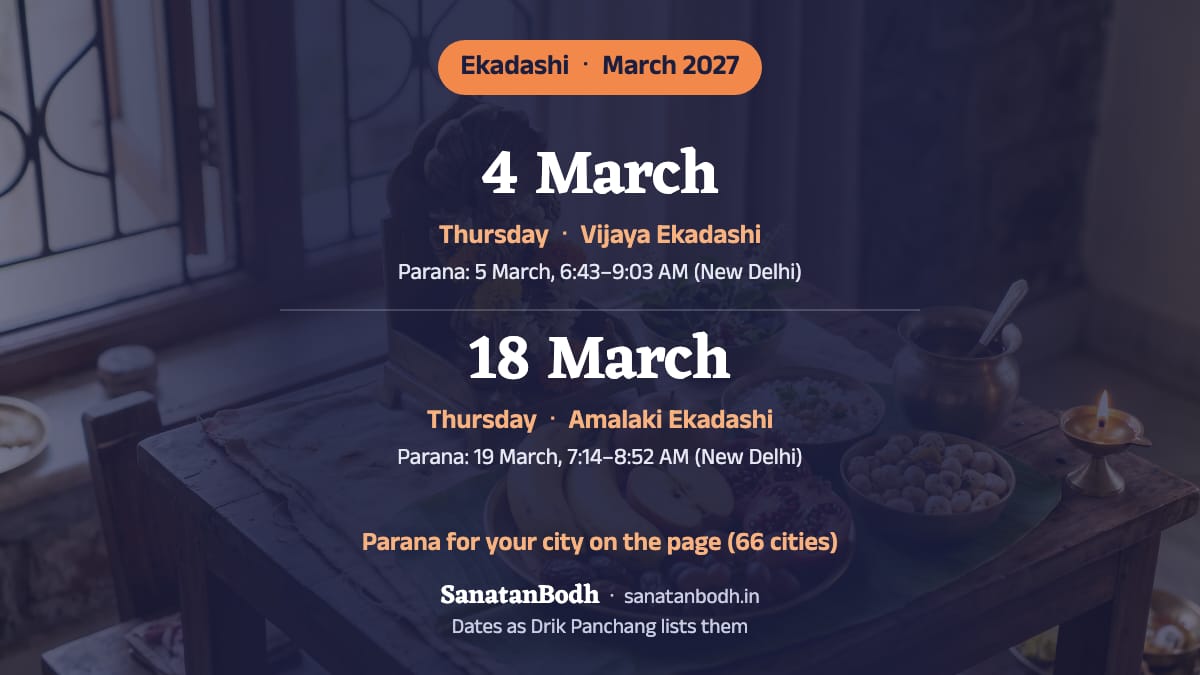
Vijaya Ekadashi falls on Phalguna Krishna Ekadashi (Purnimanta calendar; Magha Krishna in the Amanta calendar), a few days before Maha Shivratri. As the name says, the Padma Purana calls it the Ekadashi that gives victory. Lord Narayana is worshipped on a sacred pot, a fast is kept and a vigil held at night, and the katha is read or heard after the puja.
The katha is in the Uttara Khanda of the Padma Purana: when Yudhishthira asks, Krishna says that Narada once asked Brahma the same question, and Brahma told this story. We have written it in our own words from the Sanskrit, Deshpande’s English translation and the Gita Press Hindi translation, compared with Drik Panchang and the ISKCON book.
How the vrat and katha are kept
- Dashami: take a pot of gold, silver, copper or clay, fill it with water, set leaves (of mango and the like) in its mouth, and install it, decorated. Place seven grains beneath it and barley on top, and on that a golden image of Lord Narayana.
- Ekadashi: bathe in the morning, set the pot firmly in place and worship it with a garland, sandal paste, areca nuts, coconuts, fragrance, incense, lamps and many kinds of food offerings. Spend the day before the pot in good stories, keep vigil before it at night, and light a ghee lamp so the vow stays unbroken.
- Dwadashi: at sunrise take the pot to the bank of a river, a spring or a pond, set it there, worship it as prescribed, and give the pot with the image to a brahmin learned in the Veda. The text asks for other generous gifts along with the pot.
- The details of the pot worship vary by family and region; ask your own purohit.
Shri Rama and the sage Bakadalbhya
As told in the Padma Purana, Uttara Khanda, chapter 44 (the Gita Press edition numbers its chapters two higher), checked against the Sanskrit, Deshpande’s English translation and the Gita Press Hindi.
Yudhishthira asked, “Vasudeva, what is the name of the Ekadashi that comes in the dark half of Phalguna? Please tell me.” Krishna said, “Once the sage Narada asked Brahma, seated on his lotus, this very thing: what is the merit of Vijaya Ekadashi in the dark half of Phalguna?”
Brahma said, “Listen, Narada. I have never yet told anyone this excellent story that takes sin away. The vow of Vijaya is very old, holy and destroys sin. It gives victory to kings; of this there is no doubt.”
“Long ago Shri Rama went into the forest for fourteen years and lived at Panchavati with Sita and Lakshmana. There Ravana carried Sita away. Stricken with grief, Shri Rama wandered from forest to forest searching for her. He found Jatayu, whose life was at its end. Then he slew Kabandha in the forest, and he and Sugriva became friends.”
“Armies of vanaras gathered for Shri Rama. Hanuman saw Sita in a garden of Lanka, gave her Shri Rama’s token and came back to tell Shri Rama everything. Hearing it, Shri Rama, with Sugriva’s consent, resolved to march on Lanka.”
“Reaching the shore, Shri Rama said to Lakshmana, ‘Son of Sumitra, this sea is fathomless and full of fearsome creatures of the deep. By what merit can it be crossed? I see no way by which it could be crossed with ease.’”
“Lakshmana said, ‘You are the first of the gods, the ancient Supreme Person. On an island here lives a sage named Bakadalbhya; his hermitage is half a yojana from this place, and many other brahmins live there too. Joy of the Raghus, go to that ancient sage and ask him the way.’”
“Hearing Lakshmana, Shri Rama went to meet the sage Bakadalbhya and bowed his head before him. The sage knew him for the ancient Supreme Person, who for some purpose had taken a human body. Pleased, he asked, ‘Shri Rama, what brings you here?’”
“Shri Rama said, ‘O brahmin, by your grace I have come with my army to the seashore to conquer Lanka and its rakshasas. Tell me the way, with your favour, by which I may cross the sea; it is for this that I have come to see you.’”
“Pleased, the sage Bakadalbhya said, ‘Rama, keep a vow that is the best of vows, by which victory will soon be yours; you will conquer Lanka and the rakshasas and win spotless fame. In the dark half of Phalguna comes Vijaya Ekadashi. Keep its fast with a steady mind; by its power you will surely cross the sea with the vanaras.’ Then the sage taught its rite, given above: setting up the pot on Dashami, its worship and the vigil on Ekadashi, and on Dwadashi the worship by the water and the gift of the pot with the image.”
“The sage said, ‘Rama, keep this vow with care, by this rite, together with the leaders of your troops, and victory will be yours.’ Hearing this, Shri Rama kept the vow just so. By its power he was victorious: Ravana fell in battle, Lanka was won and Sita was restored to him.”
Brahma said, “My son, those who keep this fast by this rite win victory in this world, and their world beyond is unfailing. So the Vijaya fast should be kept.” According to the katha this glory of Vijaya destroys all sins, and reading and hearing it bring the fruit of a Vajapeya sacrifice.
Other tellings
- In the Padma Purana, Gita Press and the ISKCON book Krishna tells this to Yudhishthira; in Drik Panchang, to Arjuna. In every source the inner story is told by Brahma to Narada.
- In the Sanskrit, Gita Press and the ISKCON book Shri Rama slays Kabandha after meeting Jatayu; Drik Panchang leaves Kabandha out and speaks instead of slaying Bali after the friendship with Sugriva.
- The sage’s hermitage is on an island half a yojana away in the Sanskrit and Gita Press; Drik Panchang places it on “Kumari island”, and the ISKCON book four miles off. Drik Panchang and the ISKCON book add that the sage had seen many Brahmas come and go; that is not in the Sanskrit.
- In the ISKCON book the worship of the pot and the vigil begin already on the night of Dashami. The fruit of reading or hearing the katha equals a Vajapeya sacrifice in the Sanskrit, Gita Press and Drik Panchang, and a horse sacrifice in the ISKCON book. The ISKCON book places the katha in the Skanda Purana; we have not checked it there.
After the katha
After the katha the aarti of Lord Vishnu and the Ekadashi Mata aarti are sung, and a vigil is kept before the pot at night. The fast is broken the next day, Dwadashi, after the gift of the pot, at the parana time; the parana time for your city is on the Vijaya Ekadashi page.
Ekadashi Aarti: Om Jai Ekadashi MataFrequently asked questions
Which Purana has the Vijaya Ekadashi katha?
The Uttara Khanda of the Padma Purana, where Krishna tells Yudhishthira that Brahma told this story to Narada. It is chapter 44 on Sanskrit Wikisource and in Deshpande’s English translation; the Gita Press edition numbers its chapters two higher.
Did Shri Rama keep the Vijaya Ekadashi fast?
According to this katha of the Padma Purana, yes: on the seashore before Lanka, on the advice of the sage Bakadalbhya, Shri Rama kept this fast together with the chiefs of his army.
What is the pot rite of Vijaya Ekadashi?
On Dashami a pot of water is set on seven grains, with barley and an image of Lord Narayana on top; on Ekadashi it is worshipped and a vigil is kept at night; on Dwadashi it is worshipped by the water and given, with the image, to a brahmin. The full rite is given above.
When is the Vijaya Ekadashi katha read?
By tradition, on the Ekadashi after the worship of the pot and of Lord Vishnu, before the aarti. By the Padma Purana, reading and hearing it bring the fruit of a Vajapeya sacrifice.
Sources
- Padma Purana, Uttara Khanda, chapter 44, Sanskrit Wikisource (chapter numbers vary by edition)
- Padma Purana, Uttara Khanda, chapter 44, N. A. Deshpande’s English translation (Motilal Banarsidass; wisdomlib.org)
- Gita Press, Gorakhpur: Ekadashi-vrat ka Mahatmya, compiled by Radheshyam Khemka, pp. 23–26 (based on the Padma Purana)
- ISKCON’s Ekadasi book text: Vijaya Ekadasi (iskcondesiretree.com)
- Drik Panchang: Vijaya Ekadashi Vrat Katha (Hindi and English), drikpanchang.com
Something wrong? Report a mistake
