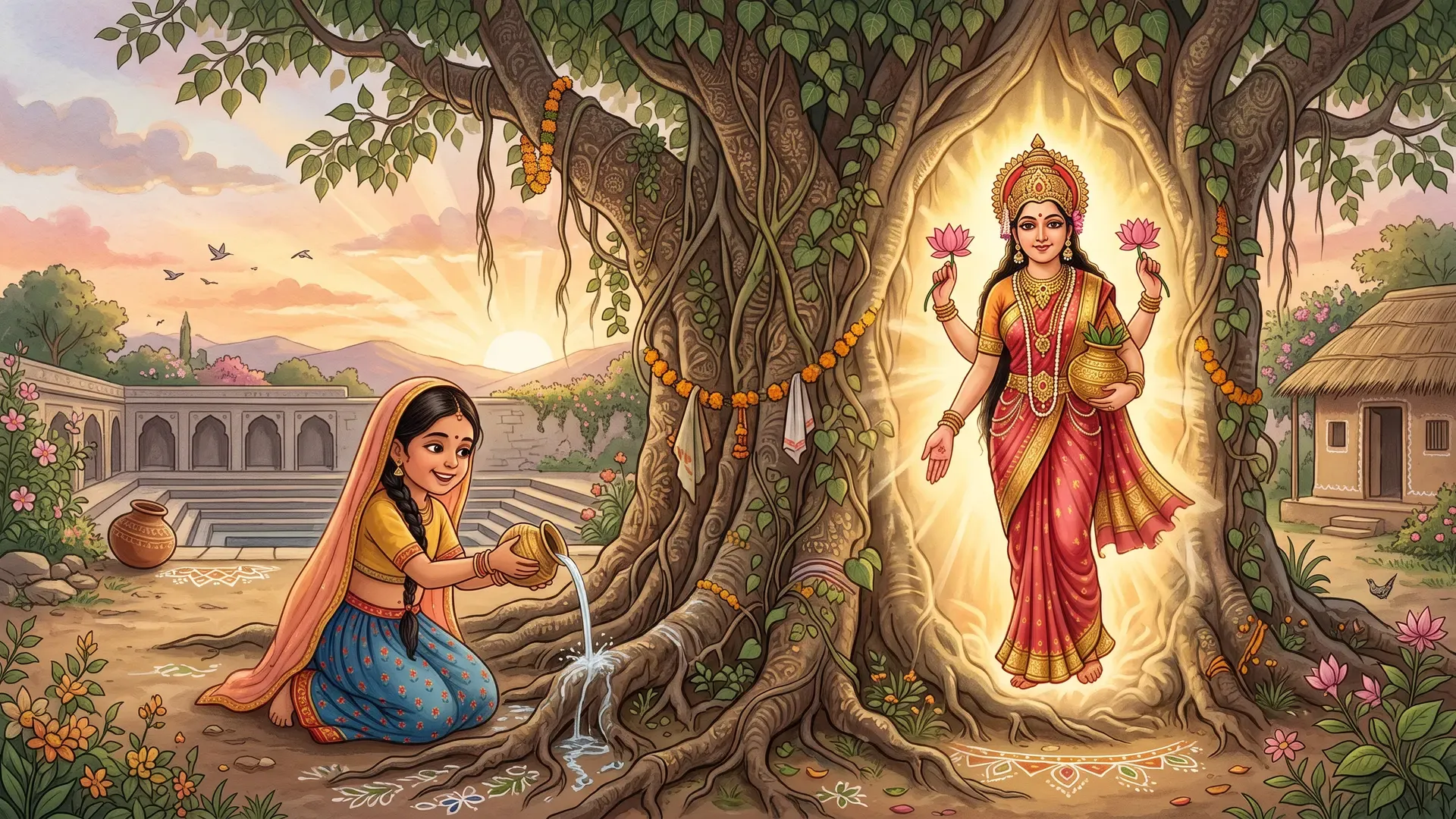
The story most often read on Diwali is the folk tale of the sahukar’s daughter: she waters a peepal tree every day, Lakshmi, who lives in the tree, makes her a friend, and when Lakshmi visits her home it fills with plenty. By the Skanda Purana, Lakshmi was freed from King Bali’s prison on this Amavasya, and by the boon given to Bali, Lakshmi is held to dwell in the homes of those who light lamps.
Each morning the tithi, Rahu Kaal and coming festivals, in one short WhatsApp message.Follow the channel
Diwali falls on Kartik Amavasya (Purnimanta count). On this night Lakshmi and Ganesha are worshipped, lamps are lit through the house and courtyard, and a katha of Lakshmi is read or heard. The one read most often is the story of the sahukar’s daughter and Lakshmi who lives in the peepal tree. It is a folk tale; we did not find it in any Purana.
What the texts say about Diwali night is found in the Skanda Purana (Vaishnava Khanda, Kartik Masa Mahatmya, chapter 9): King Bali’s boon that Lakshmi stay in the homes of those who light lamps, Lakshmi’s release from Bali’s prison on the Amavasya, and the driving out of Alakshmi after midnight. That account is the second story below. (Counting months Amanta, the Skanda Purana calls this the Amavasya of Ashwin; in the North Indian Purnimanta count it is Kartik Amavasya.)
Two other reasons are often given for Diwali. Popular belief holds that the people of Ayodhya lit lamps when Rama returned; but the Valmiki Ramayana (Yuddha Kanda, sargas 127–128) describes Ayodhya decorated with flags, flowers and music, not lamps, and does not tie the return to Kartik Amavasya. Likewise, Lakshmi’s rising from the churning of the ocean is told in the Bhagavata Purana (8.8) and the Vishnu Purana (1.9), but no text gives its date; popular tradition links it to Kartik Amavasya.
How the vrat and katha are kept
- On Diwali night Lakshmi is worshipped in Pradosh, while a fixed (sthir) lagna is rising (Drik Panchang); Ganesha is worshipped with her, and the katha is read or heard on this night.
- The father’s advice in the katha, to clean the house, draw a chauk and light a four-wick lamp, is what is done to prepare for Diwali.
- By the Skanda Purana, on the Amavasya morning one bathes, worships the devas and the forefathers and performs the parvana shraddha; at nightfall Lakshmi is worshipped in a decorated pavilion.
- In trading families the new account books (chopda) are worshipped on this night (Drik Panchang).
The sahukar’s daughter and Lakshmi in the peepal tree
A folk tale, not found in any scripture. This telling is printed by Times Now Navbharat, India TV, News24, Republic Bharat, Bharatkosh and several devotional sites; their wording is so close that they look like one tradition printed many times.
As the folk tale is told, a sahukar, a village merchant of modest means, lived in a village. Every morning his daughter poured water at the roots of a peepal tree. Lakshmi lived in that very tree.
One day Lakshmi appeared before her and said, “Will you be my friend?” The girl answered humbly, “I will ask my father and tell you.” At home she told her father everything, and he agreed. The next day she told Lakshmi that she would be her friend.
Some days later Lakshmi invited her friend home and welcomed her grandly. She seated her on a golden chauki, served her many dishes in vessels of gold and silver, and wrapped a fine shawl around her as she left.
As the girl was leaving, Lakshmi asked, “Friend, when will you invite me to your home?” The girl’s heart sank. At home she kept thinking: she welcomed me like that, so where in my plain house will I seat her, and what will I feed her?
Her father saw she was sad and asked why, and she told him. He said, “Don’t worry, child. Clean the house well, draw a chauk in the courtyard, light a four-wick lamp and remember Lakshmi with all your heart.”
She did just that. While she was cleaning, a kite flying overhead dropped a queen’s precious necklace into her courtyard. She sold the necklace and with it got a golden chauki, a golden plate, a fine shawl and all that was needed for a meal, and made everything ready to welcome her friend.
Then Lakshmi came to her friend’s house, with Lord Ganesha. The girl welcomed them both lovingly, seated them with honour and fed them with her own hands. In some tellings Lakshmi declines the golden chauki, saying she does not sit on a royal seat, and sits on the ground instead.
Seeing the girl’s true love, Lakshmi was delighted. By her grace the sahukar’s house filled with wealth and grain, and the family never faced poverty again.
The katha closes with the belief that Lakshmi dwells in the home of whoever reads or hears this story on Diwali night.
Diwali night in the Skanda Purana: Bali’s boon and Lakshmi set free
As told in the Skanda Purana, Vaishnava Khanda, Kartik Masa Mahatmya, chapter 9, verses 49–55 and 72–100 (checked in G. V. Tagare’s English translation).
By the Skanda Purana, the Lord as Vamana had taken the earth from King Bali in three steps. Pleased with Bali’s giving, the Lord said, “Blessings on you; ask for whatever boon is in your mind.” Bali said, “What should I ask for myself? I have given everything away. I will ask for the people.”
Bali asked that, as the Lord had taken the earth in three steps, the earth be counted his kingdom for three days, Chaturdashi, Amavasya and Pratipada, and that Lakshmi dwell for ever in the homes of those who light lamps in this kingdom of his. The Lord granted it. That, the text says, is why these three days are a festival of lamps.
Of the Amavasya, the Skanda Purana says that on this day the devas were set free from Bali’s prison, and Lakshmi was released too. Free at last, the devas went with Lakshmi to the ocean of milk and slept long and peacefully. Rid of the fear of the daityas, Lakshmi slept without a care inside a lotus.
So, the text says, Lakshmi is worshipped on Amavasya night in a decorated pavilion, and a soft bed is made ready for her rest; she does not leave the house of one who makes her a bed of lotuses. Laddus made of cow’s milk with nutmeg, cloves, cardamom, camphor and sugar are offered to her. Before Lord Vishnu wakes, women wake Lakshmi, and then, by the text, she does not leave that house all year.
In the text even the daityas praise the sleeping Lakshmi: the brightness in the sun, the moon, fire and the stars is you; goddess who dwells in the flame of the lamp, we bow to you. Lamps are lit in the first part of the night, and trees of lamps are set up at temples, crossroads, riverbanks, cowsheds and houses.
When midnight has passed and people are asleep, the women of the town drive Alakshmi, poverty and misfortune, out of their courtyards with winnowing baskets (soop) and small drums (dindima). The Padma Purana (Uttara Khanda, chapter 122) also speaks of waking Lakshmi, the same hymn, and driving out Alakshmi with instruments and drums.
Other tellings
- The father’s advice comes in two forms: clean the house, make a chauk or chauki and light a four-wick lamp while remembering Lakshmi (Times Now Navbharat 2022, Dharmyaatra, Astrobix, Sri Mandir); or a reminder that Lakshmi looks for devotion and love more than grandeur (Times Now Navbharat 2024, Republic Bharat, Bhaktvatsal).
- The bird that drops the necklace is a kite in most tellings; some say only “a bird”. The necklace is a “naulakha haar” (worth nine lakh) in some, “the queen’s necklace” in others.
- In most tellings the girl sells the necklace to buy the golden chauki, plate, shawl and food; in Bhaktvatsal’s telling she places the necklace on a plate and covers it with a cloth, and no sale is mentioned.
- In Times Now Navbharat, Dharmyaatra, Bhaktvatsal and Astrobix, Ganesha comes with Lakshmi; India TV, News24 and Republic Bharat do not mention Ganesha.
- In India TV, News24 and Republic Bharat, Lakshmi declines the golden chauki and sits on the ground; in the other tellings the girl simply seats her with honour and feeds her.
- In most tellings the sahukar is ordinary or poor; India TV and News24 call him wealthy.
- A printed “Vrat Katha” booklet on archive.org gives King Bali’s story as the Diwali katha, told by Krishna to Yudhishthira: granted a boon by Vamana, Bali asks that the earth be his kingdom from Kartik Krishna Trayodashi to Amavasya, that people light lamps and worship Lakshmi, and that Lakshmi dwell in their homes. In the Skanda Purana the three days run from Chaturdashi to Pratipada.
- Webdunia (“Deepavali: Mahalakshmi ki pauranik katha”) tells the freeing of Lakshmi and the devas from Bali’s prison as spoken by Sanatkumara, without naming a Purana; in this chapter of the Skanda Purana the words are the Valakhilya sages’.
- Webdunia also gives another folk tale: on the dark night of Kartik Amavasya, Lakshmi lost her way and found a lamp burning in only one house, where an old woman sat spinning; the woman gave her shelter, and in the morning her hut had become a palace. We found this story in this one source only.
After the katha
After the katha the aarti of Lakshmi is sung and lamps are lit through the house, the courtyard and at the door. The Lakshmi Puja muhurat for your city is on the Diwali page.
Lakshmi Aarti: Om Jai Lakshmi MataFrequently asked questions
Which katha is read on Diwali?
Most often, the folk tale of the sahukar’s daughter and Lakshmi who lives in the peepal tree. Some printed vrat-katha booklets give the story of King Bali and Vamana as the Diwali katha instead; it rests on Bali’s boon in the Skanda Purana.
Is the story of the sahukar’s daughter in a Purana?
No, it is a folk tale. Newspapers and devotional sites print it in nearly the same words, but none names a text. The scriptural account of Diwali night is in the Skanda Purana (Kartik Masa Mahatmya, chapter 9) and the Padma Purana (Uttara Khanda, chapter 122).
Does the Valmiki Ramayana describe lamps lit for Rama’s return?
No. In the Valmiki Ramayana (Yuddha Kanda, sargas 127–128), Bharata and Shatrughna have Ayodhya decorated with flags, flowers and music, but there is no illumination with lamps, and the return is not tied to Kartik Amavasya. Lamps lit to welcome Rama are popular belief.
On which day did Lakshmi rise from the churning of the ocean?
The Bhagavata Purana (8.8) and the Vishnu Purana (1.9) tell of Lakshmi rising from the churning, but give no date. Popular tradition links it to Kartik Amavasya; Drik Panchang places it on Dhanteras, and Lakshmi Jayanti, kept mainly in South India, falls on Phalguna Purnima.
Sources
- Skanda Purana, Vaishnava Khanda, Kartik Masa Mahatmya, chapter 9, verses 49–55 and 72–100 (G. V. Tagare’s translation, checked on wisdomlib.org)
- Padma Purana, Uttara Khanda, chapter 122 (N. A. Deshpande’s translation, wisdomlib.org)
- Bhagavata Purana 8.8 (vedabase.io); Vishnu Purana 1.9 (H. H. Wilson’s translation, wisdomlib.org)
- Valmiki Ramayana, Yuddha Kanda, sargas 124, 127 and 128 (valmikiramayan.net)
- Times Now Navbharat: Diwali vrat katha (24 October 2022; 1 November 2024)
- India TV Hindi (19 October 2025), News24 Hindi (20 October 2025) and Republic Bharat (18 October 2025): the Diwali katha
- Dharmyaatra (dharmyaatra.in), Bhaktvatsal (bhaktvatsal.com), Astrobix (astrobix.com) and Sri Mandir (srimandir.com): the story of the sahukar’s daughter
- Webdunia: Deepavali: Mahalakshmi ki pauranik katha; the Lakshmi katha told on Deepavali
- Bharatkosh (bharatdiscovery.org): Deepavali
- Drik Panchang: Diwali legends; Lakshmi Jayanti
- “Vrat Katha” booklet (archive.org, 20240806_20240806_0450): the story of King Bali
Something wrong? Report a mistake