Advertisement
Download the Parvati Aarti PDF
Advertisement
Meaning, sources and more prayers: sanatanbodh.in/en/prayers/parvati-aarti/
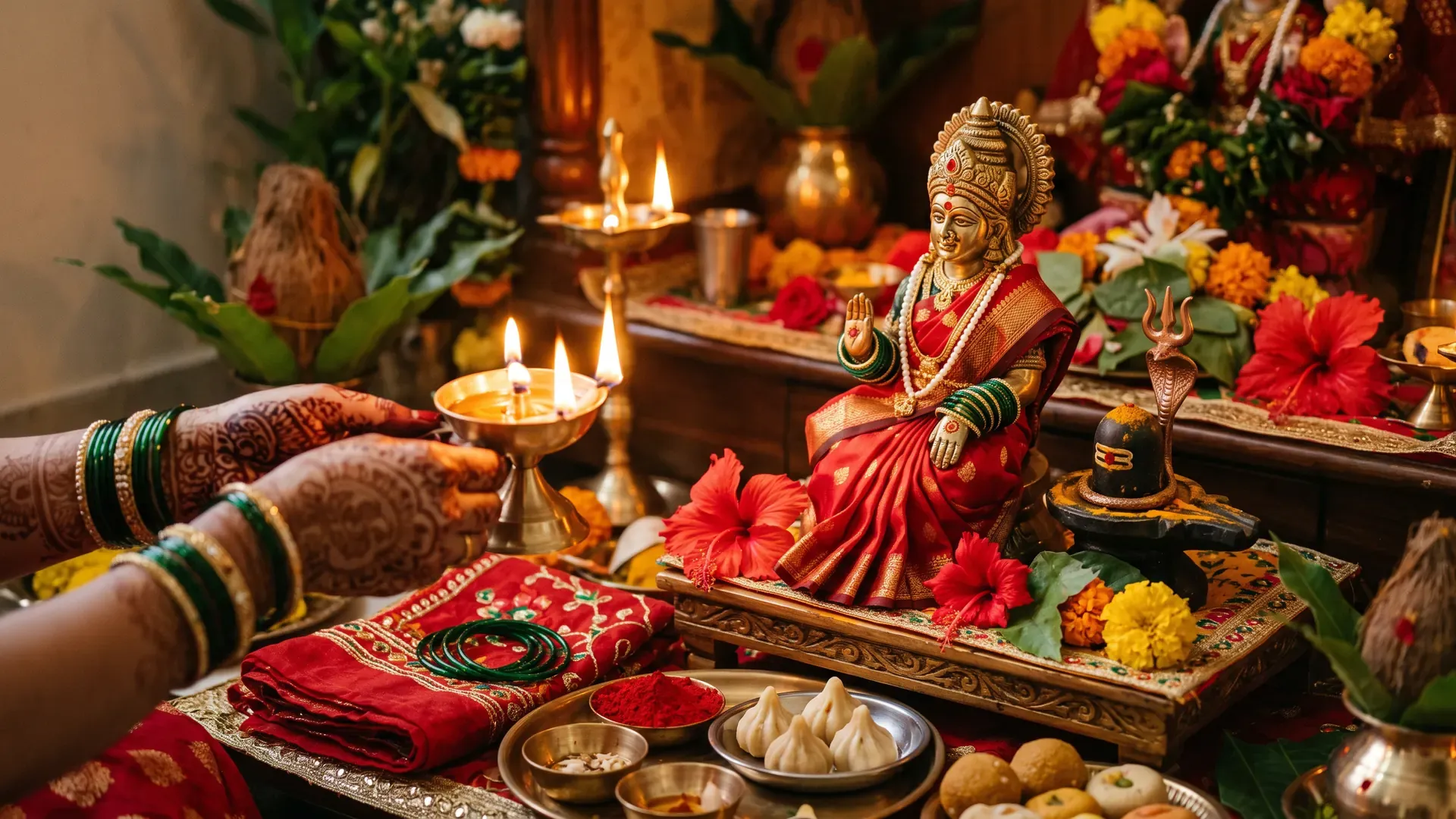
“Jai Parvati Mata” is the aarti of Goddess Parvati (Gauri), Shiva’s consort. It recalls her life as Sati, her birth in Himalaya’s house, her lion mount and her slaying of Shumbha and Nishumbha. It is sung at the Gauri puja of Karva Chauth, on Hartalika and Hariyali Teej, at Gangaur and in the Mangla Gauri vrat. By tradition, the Navadurga of Navratri are also forms of Parvati.
The wording of this aarti varies a good deal between collections. Some give verse 2 as ‘Arikul kantak naasani, nij sevak traata, jagjanani Jagdamba’, verse 3 with ‘Devbandhu’ for ‘Dev vadhu’, the last line of verse 6 as ‘Nandi Bhringi been lahi hai, haathan madmaata’, and verse 7 with ‘hum chit ko laata’ for ‘tav chit ko laata’. One popular collection has entirely different verses 7 and 8: ‘Devan araj karat hum, charan dhyan laata, teri kripa rahe to, man nahin bharmaata’ and ‘Maiya ji ki aarti, bhakti bhaav se jo nar gaata, nitya sukhi rah karke, sukh sampatti paata’. The words ‘Shri Pratap’ in the last verse can be read as ‘glorious’ or as a poet’s signature name; the author of the aarti is not known. When sung, the first line (the refrain) is repeated after every verse.
After the aarti, most homes recite: कर्पूरगौरं करुणावतारं संसारसारं भुजगेन्द्रहारम्।
Each morning the tithi, Rahu Kaal and coming festivals, in one short WhatsApp message.Follow the channel
Frequently asked questions
When is this Parvati aarti sung?
At the Gauri puja of Karva Chauth, on Hartalika Teej and Hariyali Teej, at Gangaur, during the Mangla Gauri vrat on the Tuesdays of Sawan, and in daily worship of Shiva and Parvati.
Why does the aarti mention Sati and the Himalaya?
According to the Shiva Purana (Rudra Samhita), Parvati in her previous birth was Sati, daughter of Daksha. After giving up her body at Daksha’s yajna, she was born as Parvati in the house of Himalaya (Himavan) and Mena. Verse 4 recalls this story.
How is Parvati connected with Shumbha and Nishumbha?
According to the Durga Saptashati (5.84 to 5.88), while the gods were praising the Goddess, Parvati came to bathe in the Ganga, and the Goddess Ambika emerged from the sheath of her body and was called Kaushiki; Parvati herself turned dark and dwelt on the Himalaya. This Ambika later slew Shumbha and Nishumbha. Verse 5 points to this.
How is it different from “Jai jai Giribarraj Kishori”?
“Jai jai Giribarraj Kishori” is Sita’s hymn to Gauri in the Ramcharitmanas (the chaupais before doha 235 of the Bal Kand), written by Tulsidas. “Jai Parvati Mata” is a popular folk aarti whose author is not known. Both are sung at Gauri puja.
How many verses does this aarti have?
The common text has eight verses, including the opening refrain.
Sources
- Traditional aarti text
- Sati and Parvati: Shiva Purana, Rudra Samhita
- Ambika (Kaushiki) emerging from Parvati’s body: Durga Saptashati 5.84 to 5.88
Something wrong? Report a mistake
Text checked against: drikpanchang.com, bhaktibharat.com, bhajandiary.com, bhajantimes.com, archive.org