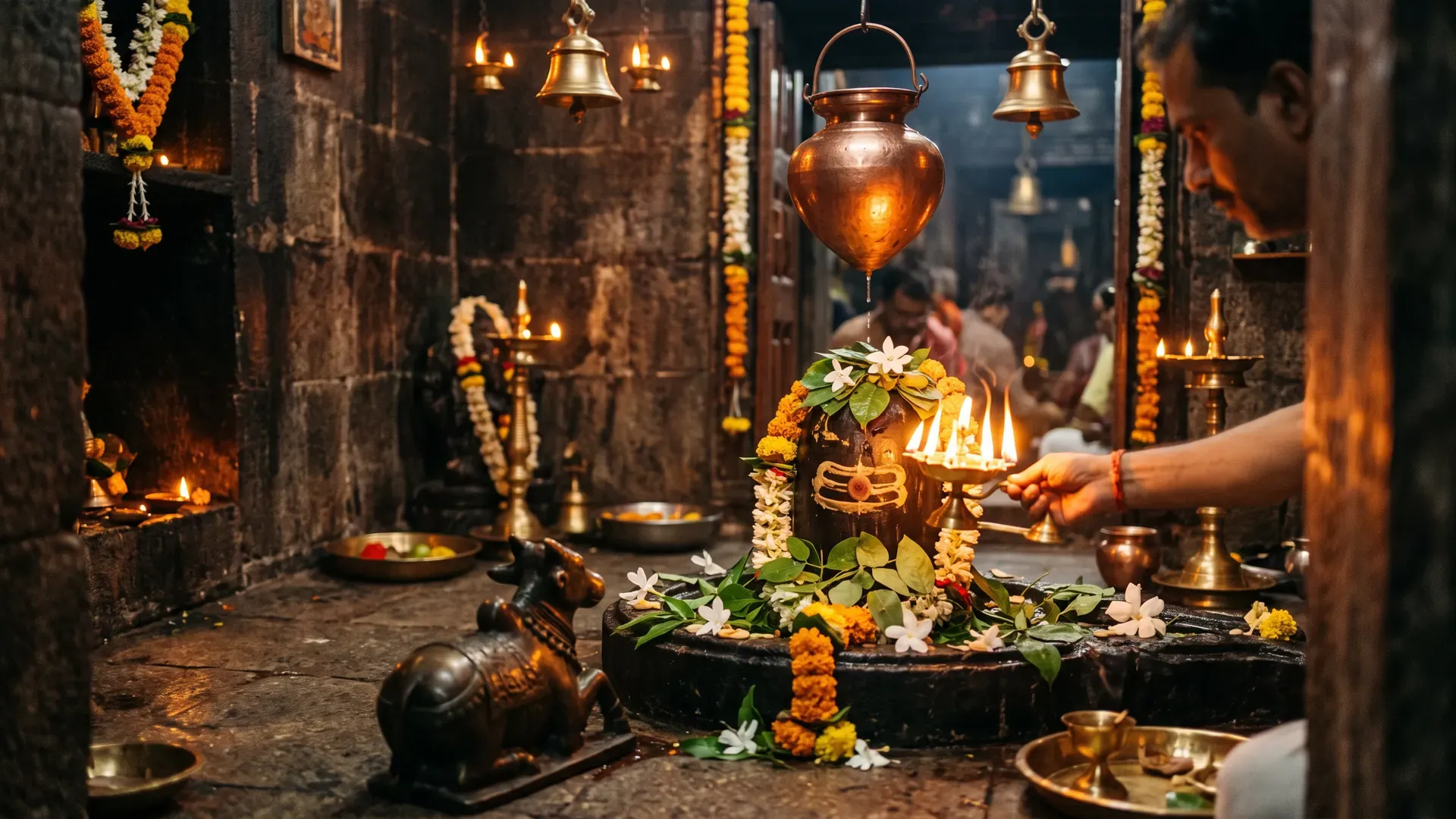
The linga worshipped by Brahma, Vishnu (Murari) and the gods, shining with a pure radiance, which destroys the sorrow that comes with birth: to that linga of Sadashiva I bow.
The linga worshipped by the best of gods and sages, which burnt Kama, which is a mine of compassion, which broke the pride of Ravana: to that linga of Sadashiva I bow.
The linga anointed well with every kind of fragrance, which makes understanding grow, which is honoured by siddhas, gods and asuras: to that linga of Sadashiva I bow.
The linga adorned with gold and great gems, beautiful with the king of serpents coiled around it, which destroyed the sacrifice of Daksha: to that linga of Sadashiva I bow.
The linga smeared with kumkum and sandalwood, beautiful with a garland of lotuses, which destroys the sins piled up (over many lives): to that linga of Sadashiva I bow.
Verse 6
देवगणार्चितसेवितलिङ्गं भावैर्भक्तिभिरेव च लिङ्गम्।
दिनकरकोटिप्रभाकरलिङ्गं तत्प्रणमामि सदाशिवलिङ्गम्॥६॥
The linga worshipped and served by the hosts of gods, (worshipped) with feeling and devotion alone, shining like millions of suns: to that linga of Sadashiva I bow.
The linga set upon and encircled by eight petals, the cause from which all things arise, which ends the eight kinds of poverty: to that linga of Sadashiva I bow.
The linga worshipped by the teacher of the gods (Brihaspati) and the best of the gods, ever worshipped with flowers from the gardens of the gods, higher than the highest, the supreme Self itself: to that linga of Sadashiva I bow.
The Lingashtakam is a Sanskrit hymn of eight verses to the Shivling. Each verse lists the glories of the linga and ends with the refrain “tat pranamami sadashivalingam”: to that linga of Sadashiva I bow. The ninth verse is the phalashruti. With its simple rhythm it is sung widely in Shiva temples and homes. Neither the Gita Press text nor the sanskritdocuments.org text names an author.
On the text: it was read word by word on the pages of the Gita Press, Gorakhpur ‘Shiv Stotra Ratnakar’ (no. 41, pp. 178–179) and compared with the sanskritdocuments.org text (Srinivas Sunder). Difference: in verse 7 Gita Press prints ‘ashtadaridravinashitalingam’ and sanskritdocuments ‘ashtadaridravinashanalingam’ (it also gives ‘vinashita’ as a variant); we follow Gita Press. sanskritdocuments also records the variant ‘nirmalabhashita’ in verse 1. Otherwise they differ only in writing words apart or joined (‘tat pranamami’, ‘ashtadalopariveshtita’). Neither text names an author, so we give none.
Each morning the tithi, Rahu Kaal and coming festivals, in one short WhatsApp message.Follow the channel
Frequently asked questions
Who wrote the Lingashtakam?
Neither the Gita Press Shiv Stotra Ratnakar nor the sanskritdocuments.org text names an author. We have not found its author named in any source we checked.
How many verses does the Lingashtakam have?
Eight verses, each ending with “tat pranamami sadashivalingam”, followed by a ninth verse, the phalashruti.
When and where is the Lingashtakam recited?
Its phalashruti speaks of reciting it in the presence of Shiva, that is, before a Shivling or in a Shiva temple. By tradition it is sung especially on Mondays, in Sawan and on Maha Shivratri.
Add SanatanBodh to your phone as an appToday’s panchang and choghadiya in one tap. Free, no app store needed.Tap the Share button below, then “Add to Home Screen”. How?