StutiShiva

Rudrashtakam (Namami Shamishan)

Composed by: Goswami Tulsidas (Ramcharitmanas, Uttar Kand)

Edited by the SanatanBodh editorial teamLast updated: 3 sourcesDrafted with AI, checked against sourcesReport a mistake
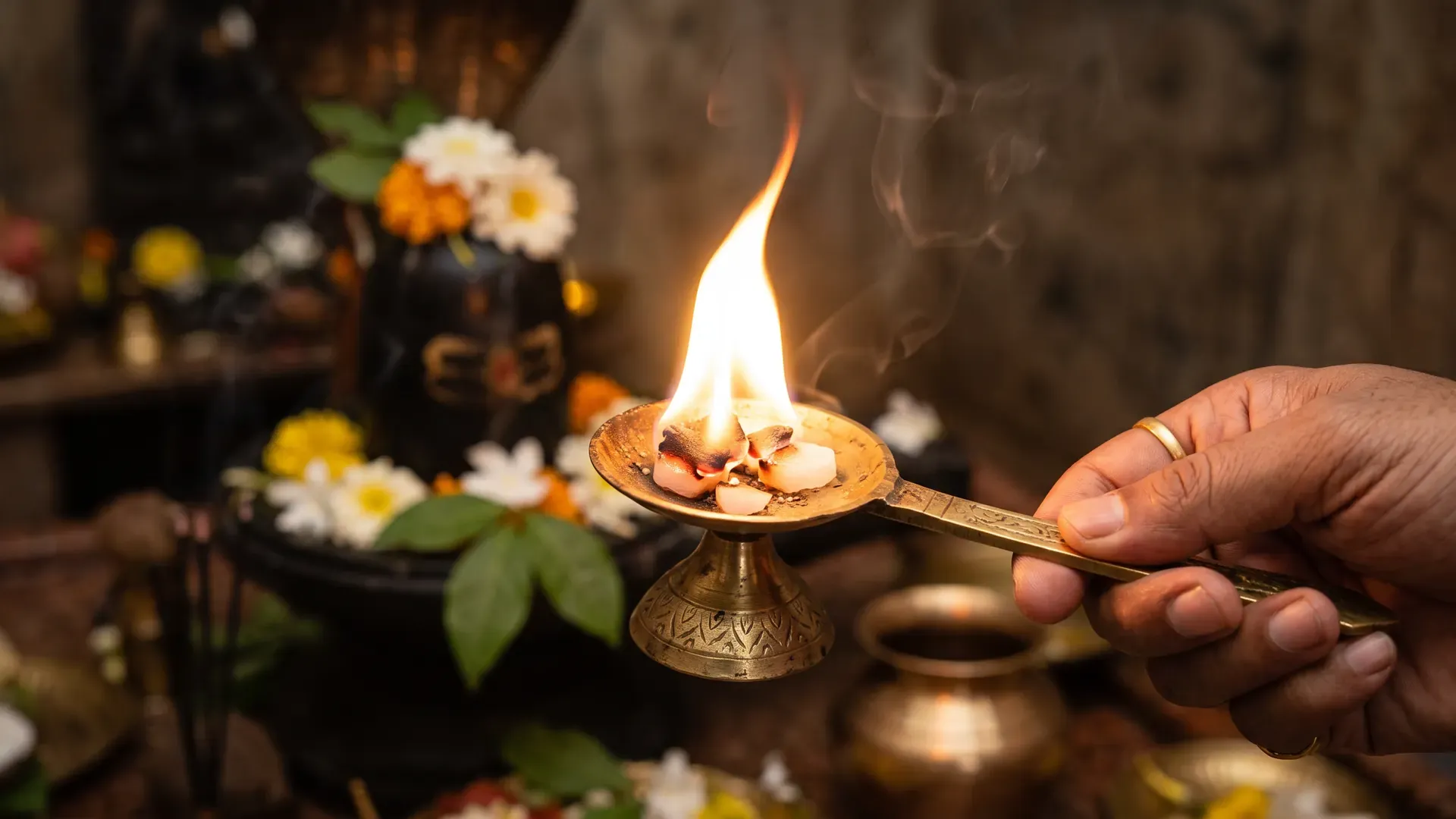
Camphor burning in a brass aarti holder before a Shivling
Image: made with AI

Large text, auto-scroll and a recitation counter; the screen stays on while you read.

  1. Stanza 1

    नमामीशमीशान निर्वाणरूपं विभुं व्यापकं ब्रह्म वेदस्वरूपं। निजं निर्गुणं निर्विकल्पं निरीहं चिदाकाशमाकाशवासं भजेऽहं॥१॥

    Namamishamishana Nirvanarupam Vibhum Vyapakam Brahma Vedasvarupam | Nijam Nirgunam Nirvikalpam Niriham Chidakashamakashavasam Bhajeham || 1 ||

    I bow to you, O Ishana, the Lord: you are liberation itself, all-powerful, all-pervading, Brahman, the Veda in form. I worship you, abiding in yourself, beyond the gunas, beyond all distinctions, free of desire, the sky of consciousness, clothed in the sky.

  2. Stanza 2

    निराकारमोंकारमूलं तुरीयं गिरा ग्यान गोतीतमीशं गिरीशं। करालं महाकाल कालं कृपालं गुणागार संसारपारं नतोऽहं॥२॥

    Nirakaramonkaramulam Turiyam Gira Gyana Gotitamisham Girisham | Karalam Mahakala Kalam Kripalam Gunagara Sansaraparam Natoham || 2 ||

    I bow to him who is formless, the root of Om, the fourth state (turiya, beyond waking, dream and deep sleep), beyond speech, knowledge and the senses; the Lord, lord of the mountain (Kailasa); fearsome, the death even of Mahakala, compassionate, the home of virtues, beyond the world.

  3. Stanza 3

    तुषाराद्रि संकाश गौरं गभीरं मनोभूत कोटि प्रभा श्री शरीरं। स्फुरन्मौलि कल्लोलिनी चारु गंगा लसद्भालबालेन्दु कंठे भुजंगा॥३॥

    Tusharadri Sankasha Gauram Gabhiram Manobhuta Koti Prabha Shri Shariram | Sphuranmauli Kallolini Charu Ganga Lasadbhalabalendu Kanthe Bhujanga || 3 ||

    He is fair like the snowy mountain and profound; his body has the radiance and beauty of millions of Kamas; on his head the lovely Ganga sparkles with her waves; on his forehead shines the young moon, and serpents are at his throat.

  4. Stanza 4

    चलत्कुंडलं भ्रू सुनेत्रं विशालं प्रसन्नाननं नीलकंठं दयालं। मृगाधीशचर्माम्बरं मुण्डमालं प्रियं शंकरं सर्वनाथं भजामि॥४॥

    Chalatkundalam Bhru Sunetram Vishalam Prasannananam Nilakantham Dayalam | Mrigadhishacharmambaram Mundamalam Priyam Shankaram Sarvanatham Bhajami || 4 ||

    His earrings swing, his brows are fine and his eyes large, his face is serene, his throat is blue and he is kind; he wears the skin of the king of beasts (literally the lion; tradition usually says the tiger) and a garland of skulls. I worship Shankara, dear to all, the lord of all.

  5. Stanza 5

    प्रचंडं प्रकृष्टं प्रगल्भं परेशं अखंडं अजं भानुकोटिप्रकाशं। त्रयः शूल निर्मूलनं शूलपाणिं भजेऽहं भवानीपतिं भावगम्यं॥५॥

    Prachandam Prakrishtam Pragalbham Paresham Akhandam Ajam Bhanukotiprakasham | Trayah Shula Nirmulanam Shulapanim Bhajeham Bhavanipatim Bhavagamyam || 5 ||

    I worship the lord of Bhavani: fierce, supreme, bold, the highest Lord, undivided, unborn, bright as millions of suns; who uproots the three kinds of pain (by the traditional reading, of the body, of fate and of the world), who holds the trident, and who is reached through loving devotion alone.

  6. Stanza 6

    कलातीत कल्याण कल्पान्तकारी सदा सज्जनानन्ददाता पुरारी। चिदानंद संदोह मोहापहारी प्रसीद प्रसीद प्रभो मन्मथारी॥६॥

    Kalatita Kalyana Kalpantakari Sada Sajjananandadata Purari | Chidananda Sandoha Mohapahari Prasida Prasida Prabho Manmathari || 6 ||

    O Lord, beyond all parts, goodness itself, who brings the aeon to its end, ever the giver of joy to the good, foe of Tripura, ocean of consciousness and bliss, remover of delusion, foe of Kama: be gracious, be gracious.

  7. Stanza 7

    न यावद् उमानाथ पादारविन्दं भजंतीह लोके परे वा नराणां। न तावत्सुखं शान्ति सन्तापनाशं प्रसीद प्रभो सर्वभूताधिवासं॥७॥

    Na Yavad Umanatha Padaravindam Bhajantiha Loke Pare Va Naranam | Na Tavatsukham Shanti Santapanasham Prasida Prabho Sarvabhutadhivasam || 7 ||

    O lord of Uma! As long as people do not worship your lotus feet, they find neither happiness nor peace, in this world or the next, nor an end to their suffering. O Lord who dwells in all beings, be gracious.

  8. Stanza 8

    न जानामि योगं जपं नैव पूजां नतोऽहं सदा सर्वदा शंभु तुभ्यं। जरा जन्म दुःखौघ तातप्यमानं प्रभो पाहि आपन्नमामीश शंभो॥८॥

    Na Janami Yogam Japam Naiva Pujam Natoham Sada Sarvada Shambhu Tubhyam | Jara Janma Duhkhaugha Tatapyamanam Prabho Pahi Apannamamisha Shambho || 8 ||

    I know neither yoga, nor japa, nor puja. O Shambhu, I bow to you always, at every moment. O Lord, O Ishvara, O Shambhu, protect me in my distress, burning in the flood of the sorrows of old age and birth.

  9. Shloka (phalashruti)

    रुद्राष्टकमिदं प्रोक्तं विप्रेण हरतोषये। ये पठन्ति नरा भक्त्या तेषां शम्भुः प्रसीदति॥९॥

    Rudrashtakamidam Proktam Viprena Haratoshaye | Ye Pathanti Nara Bhaktya Tesham Shambhuh Prasidati || 9 ||

    This Rudrashtakam was spoken by the brahmin to please Hara (Shiva). The Manas says: Shambhu is gracious to those who recite it with devotion.

Meaning, sources and more prayers: sanatanbodh.in/en/prayers/rudrashtakam/

In short

The Rudrashtakam is a Sanskrit hymn of eight stanzas to Shiva (Rudra), found in the Uttar Kand of Goswami Tulsidas’s Ramcharitmanas. In the Gita Press Manas it comes as a ‘chhand’ after doha 107 (kha), followed by a shloka and doha 108 (ka). In the story Kakbhushundi tells Garuda of a former life: when he failed to bow to his guru in a Shiva temple, Shiva cursed him, and his brahmin guru sang this hymn to win Shiva’s grace.

Location: in the Gita Press, Gorakhpur ‘Shri Ramcharitmanas (original text)’, Uttar Kand, after doha 107 (ka, kha), marked ‘chhan.’ (pp. 650–651), then ‘shloka: rudrashtakamidam proktam…’ and then doha 108 (ka). In the Manas the eight stanzas are printed together without numbers; the numbers here follow the Gita Press ‘Stotraratnavali’ (Shiva hymns, no. 15). On the text: it was read word by word on the pages of the Manas and compared with the Stotraratnavali and sanskritdocuments.org (Girish Beeharry). We keep the Manas spelling (‘gira gyana’, ‘bhajantiha’, words written apart); sanskritdocuments writes it in Sanskrit spelling with the words joined (‘girajnanagotitamisham girisham’, ‘bhajantiha’, ‘naranam’), with the same words. The Stotraratnavali prints ‘prachanda prakrishtam’ in stanza 5, where the Manas and sanskritdocuments have ‘prachandam’. sanskritdocuments also notes that some forms (‘shambhu’ as a vocative, ‘balendu’, ‘bhujanga’, ‘haratoshaye’, ‘purari’, ‘manmathari’) depart from strict grammar and are taken to be kept for rhythm and rhyme.

Frequently asked questions

Who wrote the Rudrashtakam?

Goswami Tulsidas. It comes in the Uttar Kand of his Ramcharitmanas, where in the story the guru of Kakbhushundi, a brahmin, sings it to please Shiva.

Where is the Rudrashtakam in the Ramcharitmanas?

In the Gita Press Manas, in the Uttar Kand, as a ‘chhand’ after doha 107 (kha), followed by the phalashruti shloka ‘rudrashtakamidam proktam…’ and then doha 108 (ka).

Is the Rudrashtakam in Sanskrit or in Awadhi?

It is in Sanskrit, although the Ramcharitmanas is in Awadhi. Tulsidas gives several hymns in the Manas in Sanskrit. Some word forms are taken to depart from grammar for the sake of rhythm and rhyme.

When is the Rudrashtakam recited?

Its last shloka says that Shambhu is gracious to those who recite it with devotion; it names no special time. By tradition it is recited especially on Mondays, in Sawan and on Maha Shivratri.

Sources

  1. Shri Ramcharitmanas (original text), Gita Press, Gorakhpur: Uttar Kand, the chhand and shloka after doha 107 (kha)
  2. Stotraratnavali, Gita Press, Gorakhpur: ‘Shri Rudrashtakam (of Goswami Shri Tulsidas)’, no. 15
  3. sanskritdocuments.org: Shri Rudrashtakam by Tulsidas (Girish Beeharry)

Something wrong? Report a mistake

Text checked against: archive.org, archive.org, sanskritdocuments.org