AartiHanuman

Hanuman Aarti: Aarti Kije Hanuman Lala Ki

By custom sung on: Tuesday

Edited by the SanatanBodh editorial teamLast updated: 2 sourcesDrafted with AI, checked against sourcesReport a mistake
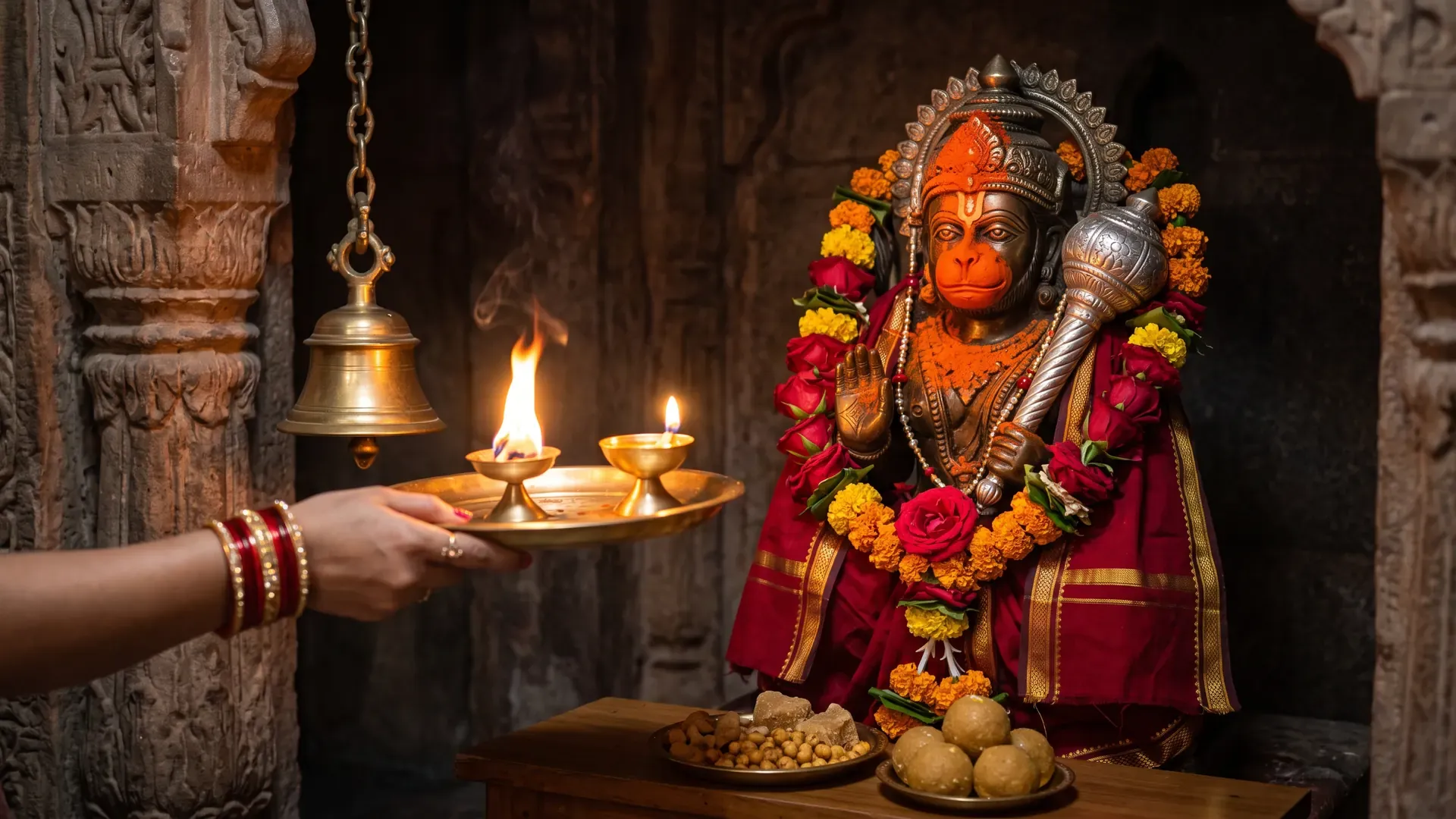
An aarti plate with camphor and a ghee lamp before a sindoor-covered Hanuman murti, with a bell nearby
Image: made with AI
Download PDF

Advertisement

  1. Verse 1

    आरती कीजै हनुमान लला की। दुष्ट दलन रघुनाथ कला की॥

    Aarti kijai Hanuman lala ki. Dushta dalan raghunath kala ki ||

    Perform the aarti of dear Hanuman, who crushes the wicked and is a portion of Raghunath’s own power.

  2. Verse 2

    जाके बल से गिरिवर काँपे। रोग दोष जाके निकट न झाँके॥ अंजनि पुत्र महा बलदाई। संतन के प्रभु सदा सहाई॥

    Jake bal se girivar kanpe. Rog dosh jake nikat na jhanke || anjani putra maha baldaee. Santan ke prabhu sada sahaee ||

    By his strength great mountains tremble, and the aarti says that disease and faults dare not even peep near him. Anjani’s son is the giver of great strength and the constant helper of the saints.

  3. Verse 3

    दे बीरा रघुनाथ पठाए। लंका जारि सिया सुधि लाए॥ लंका सो कोट समुद्र-सी खाई। जात पवनसुत बार न लाई॥

    De bira raghunath pathae. Lanka jari siya sudhi lae || lanka so kot samudra-si khaee. Jat pavansut bar na laee ||

    Raghunath handed you the bida (entrusting you with the mission) and sent you forth; you burned Lanka and brought back news of Sita. Lanka was a fortress with the ocean for its moat, yet the son of the Wind took no time to get there.

  4. Verse 4

    लंका जारि असुर संहारे। सियारामजी के काज सँवारे॥ लक्ष्मण मूर्छित पड़े सकारे। आनि संजीवन प्राण उबारे॥

    Lanka jari asur sanhare. Siyaramji ke kaj sanvare || lakshman moorchhit pade sakare. Aani sanjivan pran ubare ||

    You burned Lanka, slew the demons and accomplished the work of Sita and Ram. When Lakshman lay unconscious, you brought the Sanjivani herb by daybreak and saved his life.

  5. Verse 5

    पैठि पाताल तोरि जमकारे। अहिरावण की भुजा उखारे॥ बाएँ भुजा असुर दल मारे। दाहिने भुजा संतजन तारे॥

    Paithi patal tori jamkare. Ahiravan ki bhuja ukhare || baen bhuja asur dal mare. Dahine bhuja santajan tare ||

    Entering the netherworld, you broke bonds as dreadful as Yama’s prison and tore off Ahiravana’s arms. With your left arm you struck down the demon hosts, and with your right you carried the saints to safety.

  6. Verse 6

    सुर नर मुनि जन आरती उतारें। जय जय जय हनुमान उचारें॥ कंचन थार कपूर लौ छाई। आरती करत अंजना माई॥

    Sur nar muni jan aarti utaren. Jay jay jay Hanuman ucharen || kanchan thar kapoor lau chhaee. Aarti karat anjana maee ||

    Gods, humans and sages wave the aarti lamp before you and call out, “Victory, victory, victory to Hanuman!” The camphor flame glows in a golden plate as Mother Anjana herself performs your aarti.

  7. Verse 7

    जो हनुमानजी की आरती गावे। बसि बैकुंठ परम पद पावे॥ लंक विध्वंस किये रघुराई। तुलसीदास स्वामी कीर्ति गाई॥

    Jo hanumanji ki aarti gave. Basi baikunth param pad pave || lank vidhvans kiye raghuraee. Tulsidas svami kirti gaee ||

    The aarti says that whoever sings this aarti of Hanuman dwells in Vaikuntha and attains the supreme state. Raghurai (Shri Ram) destroyed Lanka, and Tulsidas has sung the glory of his Lord.

Download the Hanuman Aarti PDF

Advertisement

Meaning, sources and more prayers: sanatanbodh.in/en/prayers/hanuman-aarti/

In short

“Aarti Kije Hanuman Lala Ki” is the most widely sung aarti of Hanuman. It briefly recalls the search for Sita, the burning of Lanka, bringing the Sanjivani herb to save Lakshman, and the slaying of Ahiravana. It is sung on Tuesdays, Saturdays and Hanuman Jayanti, after reciting the Hanuman Chalisa or the Sundar Kand, and at Ramayan recitations around Dussehra.

Some collections (such as Drik Panchang) do not have the last two lines, ‘Lank vidhvans kiye Raghurai. Tulsidas swami kirti gai’; others give them as ‘Lankvidhvans keenh Raghurai. Tulsidas prabhu kirati gai’ and place them before ‘Jo Hanumanji ki aarti gave’. Other differences: ‘de veera’ for ‘de beera’, ‘laaye sanjivan’ for ‘aani sanjivan’, ‘girvar’ for ‘girivar’ and ‘basahin Baikunth’ for ‘basi Baikunth’. Because Tulsidas is named in the last line, many people regard the aarti as his work, but this is not established. When sung, the first two lines (the refrain) are repeated after every verse.

After the aarti, most homes recite: कर्पूरगौरं करुणावतारं संसारसारं भुजगेन्द्रहारम्।

Frequently asked questions

When is this aarti sung?

On Tuesdays and Saturdays, on Hanuman Jayanti, after reciting the Hanuman Chalisa, Bajrang Baan or Sundar Kand, and at the close of Ramayan recitations.

Did Tulsidas write this aarti?

Because of the last line, ‘Tulsidas swami kirti gai’, many people regard it as Tulsidas’s work, but this is not established, and some collections do not have that line at all. No reliable history of its composition is known.

What does “De beera Raghunath pathaye” mean?

A beera (bida) is a rolled betel leaf. In earlier times, when a difficult task was entrusted to someone, a bida was offered, and whoever took it up pledged to complete the task (the Hindi idiom ‘beeda uthana’ comes from this). The line means that Shri Ram entrusted Hanuman with the search for Sita and sent him forth.

Where does the Ahiravana episode come from?

The story of Ahiravana (Mahiravana) carrying Ram and Lakshman to the netherworld and Hanuman rescuing them is not in the Valmiki Ramayana. It is found in later Ram-katha traditions and folk tales. The burning of Lanka and the Sanjivani episode are in the Sundara Kanda and Yuddha Kanda of the Valmiki Ramayana.

Sources

  1. Traditional aarti text
  2. Burning of Lanka and the Sanjivani: Valmiki Ramayana, Sundara Kanda and Yuddha Kanda

Something wrong? Report a mistake

Text checked against: drikpanchang.com, bhaktibharat.com, hindi.webdunia.com, vedadhara.com