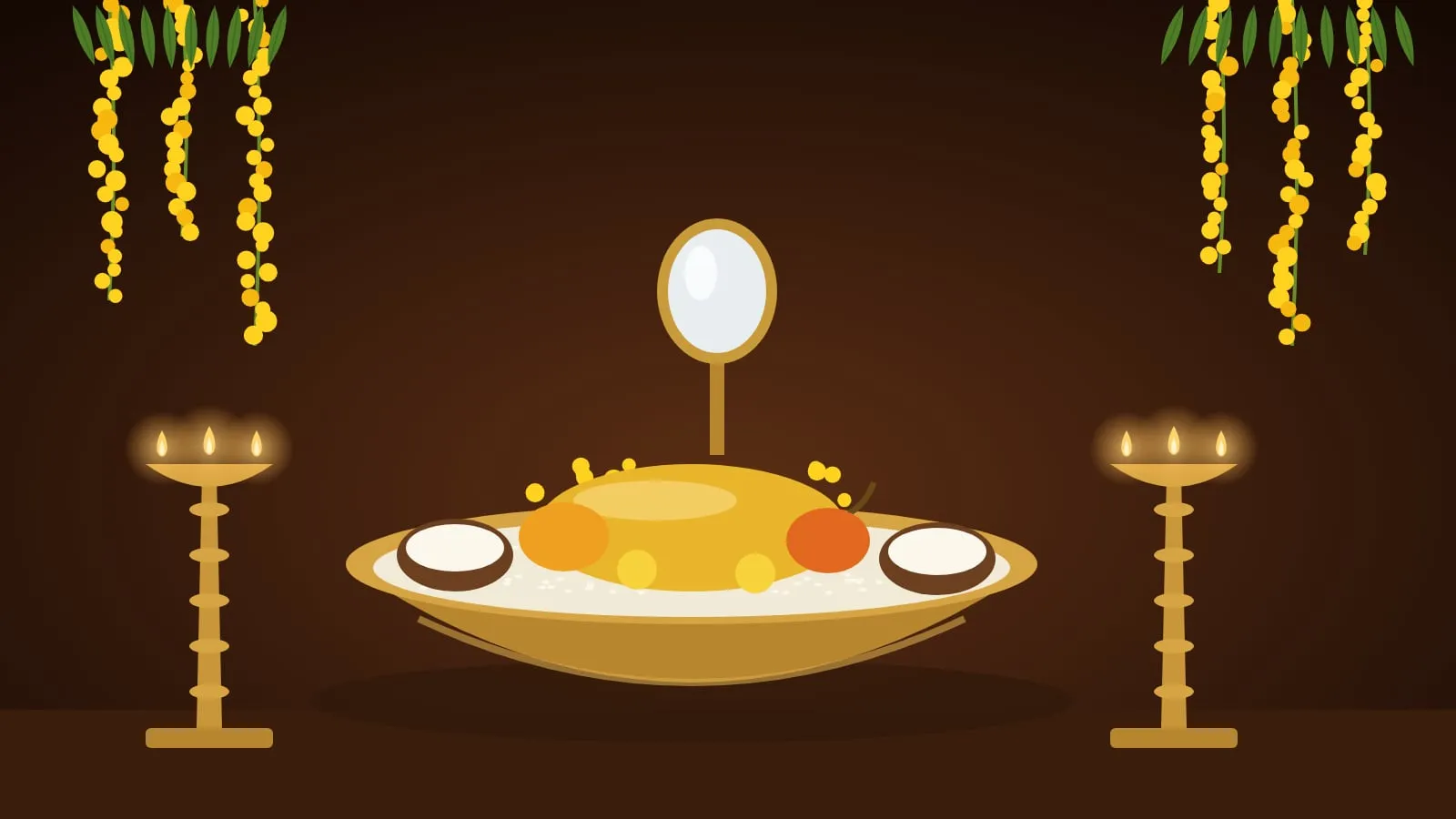
Vishu 2027 is on Thursday, 15 April. The Sun enters Mesha (Aries) at 3:33 PM on Wednesday, 14 April 2027 (Drik Panchang; our calculation 3:34). In Kerala’s Malayalam calendar a month whose Sankranti falls after the first three-fifths of the day begins the next day; in Thiruvananthapuram that limit is 1:37 PM on 14 April, so Medam 1 and Vishu are on 15 April. Drik Panchang’s Malayalam calendar for Thiruvananthapuram and Prokerala also give Vishu on 15 April 2027. The Vishukkani, the first sight of auspicious things, is seen at dawn on 15 April; the sun rises in Thiruvananthapuram at 6:13 AM.
Each morning the tithi, Rahu Kaal and coming festivals, in one short WhatsApp message.Follow the channel
City-wise times
The Mesha Sankranti is the same moment in every city; the sunrise of the Vishukkani dawn changes with the city. For another city, pick it in the box above.
| City | Vishukkani |
|---|---|
| Thiruvananthapuram | 6:13 AM |
| Kochi | 6:15 AM |
| Bengaluru | 6:07 AM |
| Chennai | 5:57 AM |
| New Delhi | 5:56 AM |
At a glance
- Date
- Thursday, 15 April 2027
- Malayalam date
- Medam 1, Kollavarsham 1202
- Mesha Sankranti
- 14 April, 3:34 PM (Drik Panchang: 3:33 PM)
- Vishukkani
- Dawn on 15 April; sunrise in Thiruvananthapuram 6:13 AM
- Where
- Kerala and Mahe; Malayalis in India and abroad
- Main customs
- Vishukkani, Vishukkaineetam, Vishu sadya, firecrackers (tradition)
- Flower
- Kani konna (Indian laburnum, Cassia fistula)
- Around the same time
- Puthandu (Tamil, 14 April), Baisakhi (14 April), Pohela Boishakh (Bengal, 15 April)
- Same day
- Ram Navami (15 April 2027)
Why Vishu is on 15 April, not 14
The Malayalam calendar is solar: each month begins with the Sankranti when the Sun enters the next sign, and Medam (Mesha) with the Mesha Sankranti. Matching it with Drik Panchang’s calendar for Thiruvananthapuram, we found Kerala’s rule to be this: if the Sankranti falls between sunrise and three-fifths of the daytime, the month begins that day; if later, the next day. All 25 month starts of 2026-27 agree with Drik by this rule. In 2027 the Mesha Sankranti is at 3:33 PM on 14 April (Drik), while the limit in Thiruvananthapuram that day is 1:37 PM, so Medam 1 is 15 April. The Vishukkani is seen on the first dawn after the Sankranti, which is also 15 April. In 2026 the Sankranti was at 9:39 AM on 14 April, after sunrise; Kerala’s holiday list still had Vishu on 15 April (Onmanorama). In both years Vishu is the day of the first sunrise after the Sankranti.
Vishukkani: the first sight of the year
Vishukkani means “that which is seen first”. According to Kerala Tourism it is an arrangement of auspicious things, rice, fruits, vegetables, golden cucumber (kanivellari), betel leaves, flowers, coins and a mirror, placed before an image of Lord Krishna, and seeing it first thing in the morning is believed to bring a good year. According to Wikipedia the elders of the home, usually the women, arrange it the night before in a bell-metal uruli: rice, golden lemon and cucumber, coconut, jackfruit, betel leaves and arecanut, a mirror (Aranmula kannadi), konna flowers and a nilavilakku lamp. At dawn the lamp is lit and the elders bring the others, in many homes with their eyes closed, before the kani. This is a custom, and the things vary a little from home to home.
Uruli and rice
A wide brass or bell-metal vessel filled with rice or paddy.
Wikipedia “Vishu”Golden cucumber
Kanivellari, a ripe golden cucumber, the kani’s main fruit.
Kerala Tourism; WikipediaKani konna
The yellow flowers of the Indian laburnum (Cassia fistula), in bloom at Vishu.
WikipediaMirror and lamp
A mirror and a lit nilavilakku; the lamp is lit first at dawn.
Kerala Tourism; WikipediaCoins, betel, fruit
Coins or notes, betel and arecanut, coconut, mango, jackfruit and more.
Kerala Tourism; WikipediaKaineettam, sadya and firecrackers
According to Kerala Tourism the elders give the younger ones Vishukkaineetam, a gift of money, firecrackers are burst and a Vishu sadya (feast) is made. According to Wikipedia the amount of the kaineettam often ends in 1 (11, 21, 51, 101), linked with a new beginning, and the feast has dishes such as Vishu kanji, Vishu katta, thoran, veppampoo rasam (rasam of neem flowers) and mampazha pulissery (ripe mango curry), with sweet, sour and bitter tastes together.
One Sankranti, different New Years
The Mesha Sankranti is the solar new year of several regions, but each calendar has its own rule for the day, so in 2027 they fall on two different days. In the Tamil calendar a month begins the same day if the Sankranti is before sunset: Puthandu (Chithirai 1) is on 14 April. Punjab’s Baisakhi is also on 14 April. In Kerala the limit is three-fifths of the day, so Vishu is on 15 April; in Bengal the month is counted from the day after the Sankranti, so Pohela Boishakh (Bangabda 1434) is also on 15 April. All these dates were checked against Drik Panchang’s calendars for Chennai, Thiruvananthapuram and Kolkata. The Malayalam year number (Kollavarsham) changes not at Vishu but on Chingam 1: on 18 August in 2027, when 1203 begins.
Sabarimala and the temples
According to Kerala Tourism, the Sabarimala temple opens for darshan on Vishu as well as for the first five days of every Malayalam month. Kerala’s temples hold a Vishukkani darshan at dawn on Vishu; each temple’s timing is announced by its Devaswom board.
Checked against Drik Panchang
Drik Panchang’s 2027 Sankranti list has the Mesha Sankranti at 3:33 PM on 14 April (read 30 September 2026), and its Vishu page gives the same moment (3:03 AM in Lancaster, USA time, which is 3:33 PM in India). Our calculation gives 3:33:38 PM, shown as 3:34 PM. Prokerala (Ujjain) gives the Sankranti at 3:23 PM, but it also gives Vishu on Thursday, 15 April. Drik’s Malayalam calendar for Thiruvananthapuram has Medam 1 and Vishu on 15 April (read 18 October 2026). The Kerala government’s 2027 holiday list had not been found by 18 October 2026; the 2026 list came out on 29 October 2025.
Frequently asked questions
When is Vishu 2027?
On Thursday, 15 April, the Malayalam month day Medam 1. The Mesha Sankranti is at 3:33 PM on 14 April (Drik), after the limit for a Kerala month to begin that day, so Vishu is on 15 April. Drik’s Malayalam calendar and Prokerala give the same day.
What time should the Vishukkani be seen?
At dawn on 15 April, with the lamp lit before sunrise. The sun rises at 6:13 AM in Thiruvananthapuram and 6:15 AM in Kochi (our calculation). By tradition the kani is the first sight of the year.
What goes into the Vishukkani?
In an uruli: rice, golden cucumber, coconut, fruit such as mango and jackfruit, betel and arecanut, coins, a mirror, yellow konna flowers, a nilavilakku and an image of Lord Krishna (Kerala Tourism, Wikipedia). The things vary a little from home to home.
Is Vishu the Malayalam New Year?
Vishu is Kerala’s solar New Year, the first day of the month Medam (Mesha) (Kerala Tourism). But the Malayalam year number (Kollavarsham) changes on Chingam 1, which is 18 August in 2027. Vishu 2027 falls in the month Medam of Kollavarsham 1202.
Why are Vishu and Puthandu not on the same day?
Both follow the Mesha Sankranti, but in the Tamil calendar a month begins the same day if the Sankranti is before sunset (Puthandu on 14 April), while in Kerala the limit is three-fifths of the day (Vishu on 15 April). Drik’s calendars for Chennai and Thiruvananthapuram give exactly this.
What is Vishukkaineetam?
A gift of money from the elders to children and dependants; the amount often ends in 1, such as 11 or 101 (Kerala Tourism, Wikipedia).
Does Sabarimala open on Vishu?
Yes, according to Kerala Tourism the temple also opens for Vishu. The Travancore Devaswom Board announces the dates and times.
Sources
- Drik Panchang: Malayalam month calendar, Thiruvananthapuram, January 2026 to January 2028 (15 April 2027: Medam 1, Vishu), read 18 October 2026 (docs/checks/solar-calendars-2026-27.md)
- Drik Panchang: Sankranti list 2027 (Mesha Sankranti 3:33 PM on 14 April), read 30 September 2026; Drik’s “Vishu Kani” page for 2027 (in search results, in Lancaster time)
- Drik Panchang: Tamil calendar for Chennai (Puthandu 14 April 2027) and Bengali panjika for Kolkata (Boishakh 1 on 15 April 2027), read 18 October 2026
- Prokerala, Vishu 2027: Thursday, 15 April; Sankranti 3:23 PM (Ujjain)
- Kerala Tourism (keralatourism.org/vishu): solar New Year, the Vishukkani before an image of Lord Krishna, kaineettam, firecrackers, Vishu sadya; keralatourism.org/sabarimala: the temple opens for Vishu
- Wikipedia: “Vishu” (Medam 1, preparing the Vishukkani and what goes into it, kani konna, the kaineettam amount, sadya dishes, firecrackers; citing the Kerala government, The Hindu and books)
- Onmanorama, 29 October 2025: Kerala’s public holidays for 2026 (Vishu on 15 April 2026)
- Vishukkani, kaineettam and sadya: folk tradition
- Sankranti, nakshatras and Malayalam months: SanatanBodh panchang calculation (astronomy-engine, Lahiri ayanamsha), checked against Drik Panchang’s Malayalam calendar for Thiruvananthapuram (read 18 October 2026) and its 2027 Sankranti list
Something wrong? Report a mistake